Strength Training Machines: Which Ones Should Beginners Use at the Gym?
Learn which strength training machines to use at the gym when you are starting out: leg press, chest press, lat pulldown, seated row, cables, and more.
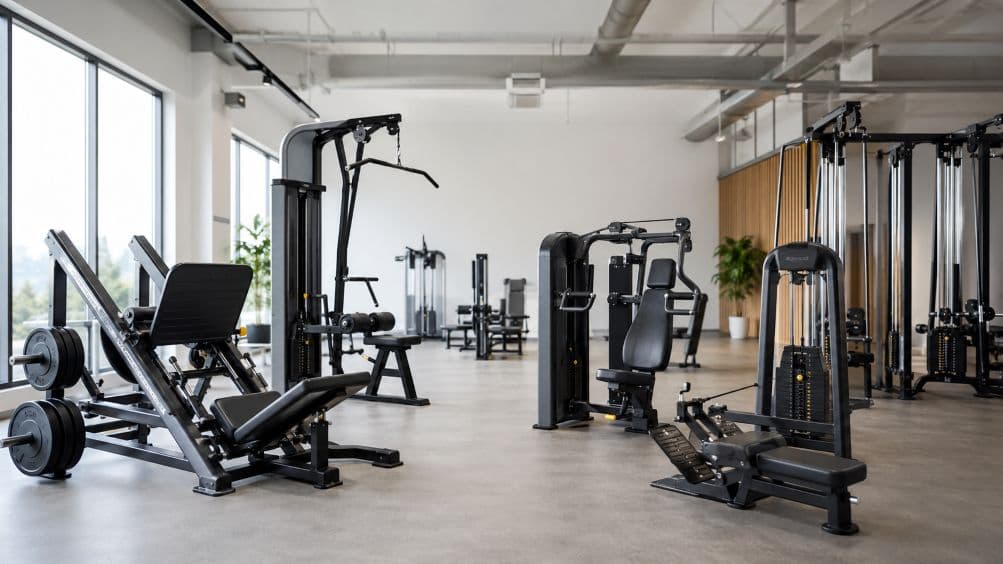
This article will therefore explain what strength training machines are used for, which machines to use depending on the muscle groups, how to include them in a simple strength training program, and which alternatives can be useful for training at home.
What Are Strength Training Machines Used For?
A strength training machine is a piece of equipment designed to guide a movement, because unlike dumbbells or a free barbell, the movement path is often fixed or guided. This makes it easier to focus on the exercise without having to manage as much balance, while helping you follow the right path to isolate the muscle you want to target as much as possible.
This is why many beginners start with machines, because they are generally more reassuring, easier to use, and simpler to include in a workout. A leg press, chest press, or lat pulldown can let you train effectively without immediately needing a high level of technical mastery.
However, machines are not reserved for beginners. A more advanced lifter can also use them to add volume, better target a muscle, or finish a workout with fewer stability demands. They are therefore useful at all levels, as long as they are used within a real program logic.
Machines or Free Weights: Do You Have to Choose?
You should not oppose machines and free weights, because both can have their place in training and be complementary in a strength training program. Machines are interesting because they offer more stability and often make it easier to feel the muscle being worked, especially when you are starting out. They are also practical for learning certain movements or adding targeted work after more complete exercises.
Free weights, such as dumbbells and barbells, require more control. They often involve more coordination, balance, and stabilizing muscles. They can be very effective, but they sometimes require more technique. Free-weight exercises are also often compound movements, so they work several muscle groups at the same time.
The right choice therefore depends on your level, your goal, and the context. A program can absolutely include machines, dumbbells, barbells, cables, and bodyweight work. It is not the tool alone that does everything, but how it is used.
Which Machines Should You Use When You Are Starting Out at the Gym?
Machines for the Chest
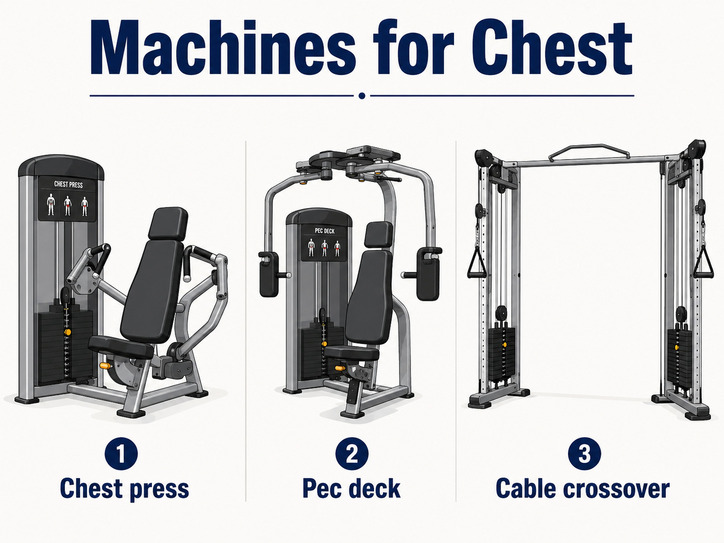
For the chest, the most common machines are the chest press, pec deck, and cables.
The chest press is similar to a guided bench press where you push the handles in front of you, which mainly works the chest, with help from the shoulders and triceps. It is important to know that most chest exercises also involve the shoulders, as we discuss in our article on muscle groups.
The pec deck lets you bring your arms together in front of you. It targets the chest more through an opening and closing movement, and it isolates the chest more than the chest press.
The cable crossover also allows you to work the chest with flyes, because it offers a different tension and lets you vary the angle of the movement.
For a beginner, the chest press is often the simplest. The pec deck or cables can then complete the work.
Machines for the Back
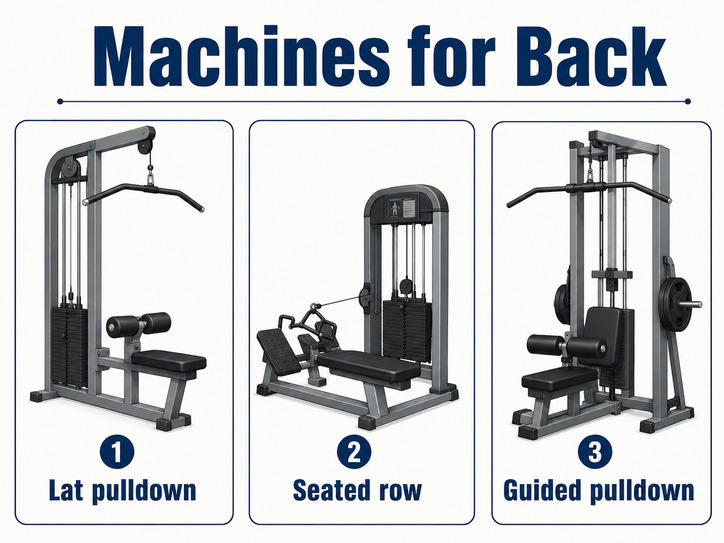
For the back, the most useful machines are the lat pulldown, seated row, and certain guided rowing machines.
The lat pulldown mainly works the width of the back. It is often used as an alternative to pull-ups, especially when you cannot yet do several bodyweight reps.
The seated row works more as a horizontal pulling movement. It helps strengthen the back and work on its thickness, while improving movement control and balancing upper-body training.
Some gyms also offer converging row machines or guided pulling machines. They can be interesting, but the principle remains the same: pull with your back while keeping the movement controlled.
To use these machines well, you should avoid pulling only with your arms. The biceps take part, but the goal is to feel the back working.
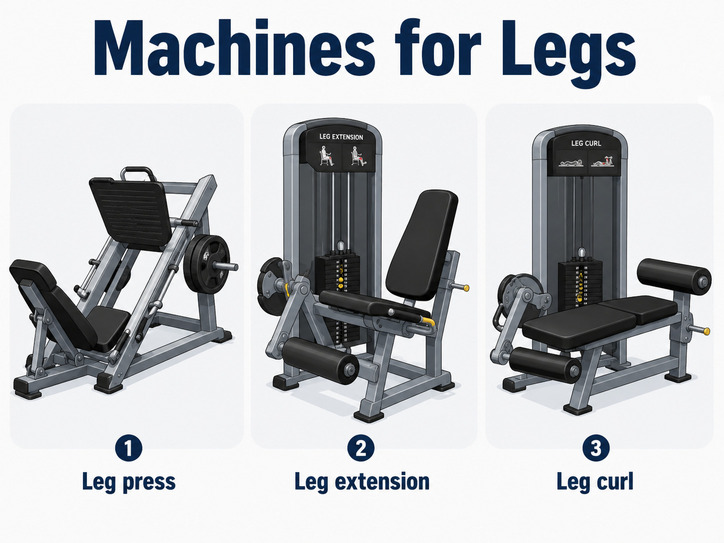
Machines for the Legs
The legs can be trained with several machines that are very common in gyms.
The leg press is one of the best-known machines and lets you work the quads, glutes, and part of the lower body in a stable position.
The leg extension mainly targets the quads, at the front of the thighs. It is an isolation exercise, often placed after a more global movement such as the leg press.
The leg curl targets the hamstrings, at the back of the thighs. It is important so you do not build a leg workout only around the quads.
Some gyms also offer machines for the calves or glutes. They can complete the workout, but it is important to keep a simple and effective logic: one main exercise for pushing, one exercise for the back of the thighs, then possibly one or two accessories.
Machines for the Glutes
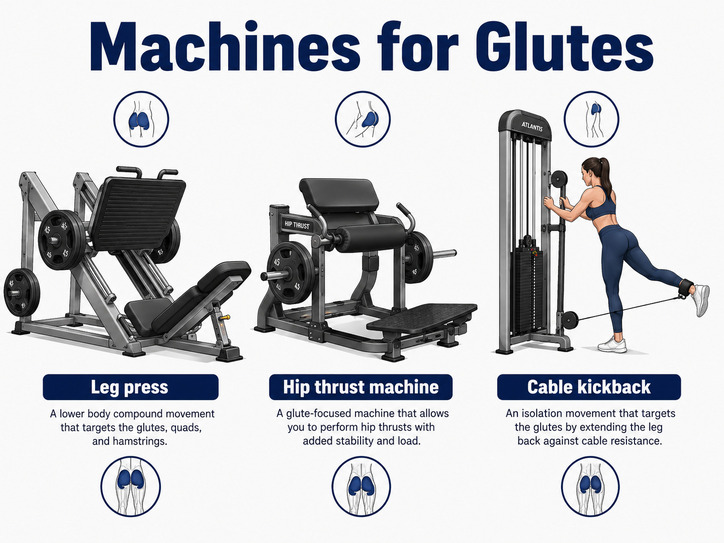
The glutes can work on several machines, even though not all gyms offer the same equipment.
The leg press, which we saw for the legs, can involve the glutes depending on foot placement and range of motion. The hip thrust machine, when available, is very interesting for targeting the glutes more directly. However, it is possible to do this exercise without a machine using a barbell, but the execution requires a bit more experience. Some gyms also offer hip extension machines or cables for kickbacks.
The glutes also work in many leg movements, so it is not always necessary to have a special machine. The most important thing is to choose exercises that allow a good range of motion and a good contraction.
Machines for the Shoulders
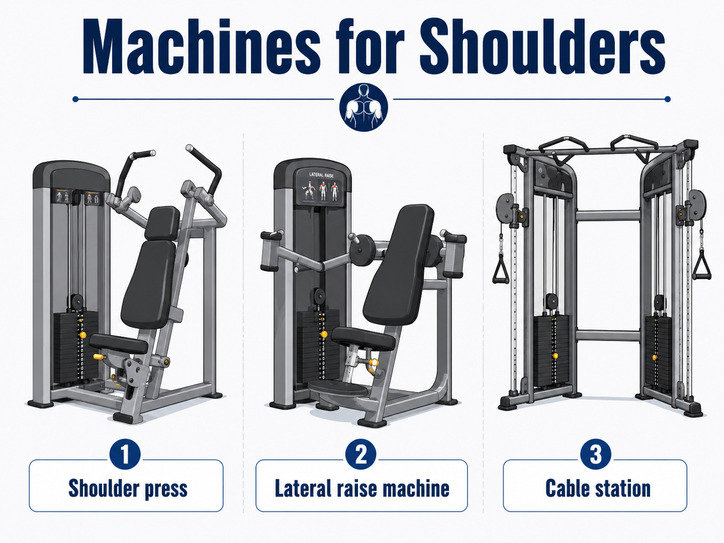
For the shoulders, the most classic machine is the shoulder press which lets you push a load overhead with a guided path. It mainly works the deltoids, with involvement from the triceps.
Some gyms also offer lateral raise machines to target the side of the shoulder, but they are not essential and can easily be replaced by dumbbell lateral raises.
Cables can also be used for lateral raises, reverse flyes, or certain movements for the rear delts. For a beginner, a well-adjusted shoulder press and a few simple cable exercises can already be enough to build a clean base.
Machines for the Arms
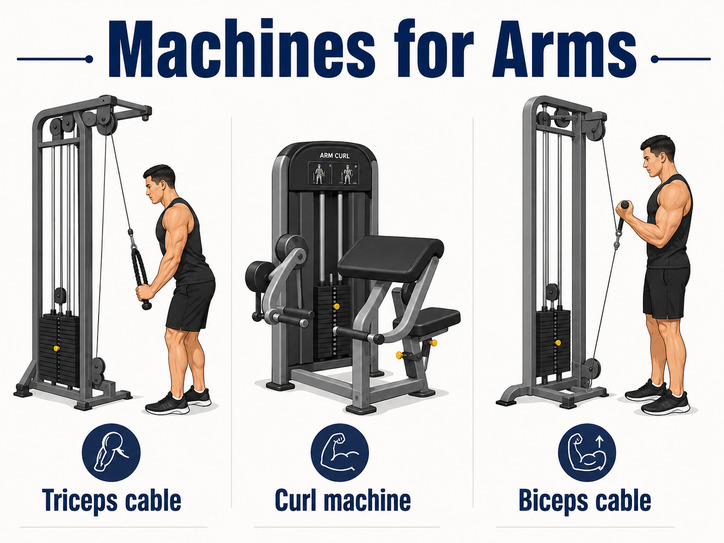
The arms can be trained on some machines, but cables are often the most practical. For the triceps, cable extensions are very common. You can use a rope, straight bar, or handle depending on the movement. It is easy to set up and simple to include at the end of a workout.
For the biceps, cable curls or some curl machines can be used. They allow you to keep steady tension throughout the movement.
However, it is important to remember that the arms already work on many exercises. The biceps take part in pulling exercises for the back, while the triceps take part in pushing exercises for the chest and shoulders. Arm machines are therefore mainly used to complete the work.
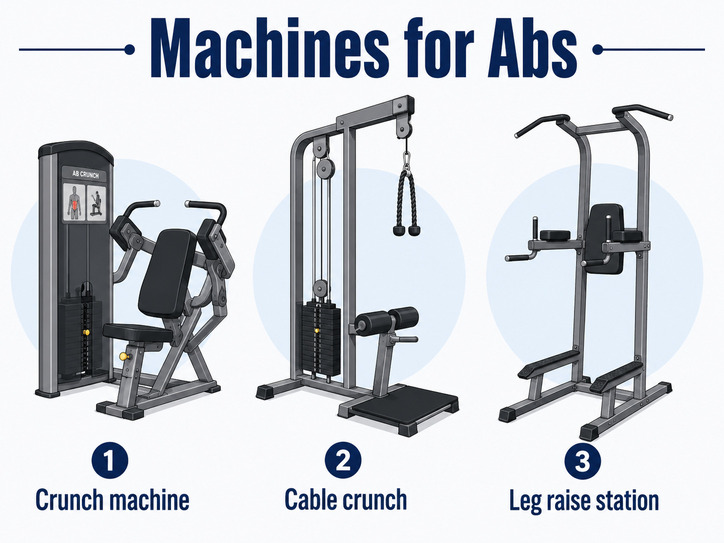
Machines for the Abs
The abs can be trained with crunch machines, cables, or simply bodyweight work.
The crunch machine lets you add resistance to a trunk flexion movement. It can be useful, but it needs to be properly adjusted to avoid pulling only with the arms or hips.
The high pulley can also be used to do rope crunches. It is an interesting exercise for adding progressive load.
That said, it is not mandatory to use a machine for the abs. Planks, leg raises, or other simple exercises can already do the job very well.
Example of a Full-Body Program With Machines
A full-body program with machines can be a good solution for starting out. It allows you to train the whole body in the same workout, with stable movements that are easy to follow.
Here is a simple example:
- leg press for the legs
- leg curl for the back of the thighs
- chest press for the chest
- lat pulldown for the back
- seated row to complete the back
- shoulder press for the shoulders
- triceps extension or cable biceps curl as an accessory
- plank or cable crunch for the abs
This type of workout can be repeated several times per week while keeping the loads appropriate. The goal in the beginning is not to lift as heavy as possible, but to understand the movements, progress cleanly, and keep controlled execution.
Can You Build Muscle With Machines?
Yes, of course you can build muscle with strength training machines. It is not the fact of using a machine or a dumbbell that determines progress on its own. What matters most is training quality, progression over time, training volume, recovery, and nutrition for strength training.
Machines can create enough tension on the muscles, so they can be very effective for hypertrophy, especially if they are well adjusted and used with real progression.
However, using machines randomly is not enough. You need to choose the right exercises, follow a program logic, and track your progress. A well-used machine can be very useful; a machine used without a clear goal just becomes one more piece of equipment in the workout.
Common Mistakes With Machines
The first mistake is setting up the machine incorrectly. A seat that is too high, too low, or too far away can completely change the movement. Before starting, you need to take the time to adjust your position.
The second mistake is going too heavy. Since the machine guides the movement, it can feel like everything is safe. But if the load is too heavy, execution quickly breaks down. Warm-up with ramp-up sets is also very important before loading heavy on machines.
The third mistake is moving too fast. Movements should stay controlled. A machine is not meant for swinging the load from one point to another. The goal is to work the muscle, not just move the weight, while thinking about the stretch and contraction of the muscle.
Another common mistake is using every machine available without a program. Just because a piece of equipment exists in the gym does not mean it has to be used. It is better to do fewer exercises, but choose them better.
Finally, you should not believe that a machine automatically corrects everything. It helps guide the movement, but it does not replace good posture, proper setup, and good focus. It is possible to get injured even on a machine.
Training at Home: What Alternatives Are There to Gym Machines?
Not everyone has access to a gym, and not everyone wants to train only on machines. For home training, there are more realistic alternatives than buying large professional machines.
The adjustable dumbbells are often one of the best choices. They allow you to do exercises for the chest, back, shoulders, arms, and legs. With a pair of dumbbells, you can already build many workouts.
An adjustable bench is also very useful. It lets you do presses, rows, shoulder exercises, arm movements, and several exercise variations.
The resistance bands are simple, compact, and practical for adding resistance. They do not replace everything, but they can complete a home workout.
A pull-up bar can be interesting for the back and arms, especially if you can already do pull-ups or learn them progressively.
A wall-mounted pulley or a small pulley system can also replace certain gym sensations, especially for the triceps, biceps, shoulders, or back.
Finally, some people may choose a compact home gym station, but it requires more space and a higher budget. Before buying this type of equipment, you need to be sure you will really use it.
What to Remember
Strength training machines are very useful for starting out at the gym, learning certain movements, and working muscles with more stability. They can also remain interesting with experience, especially for adding volume or targeting certain muscle groups.
The most important thing is not to use every machine, but to choose the ones that match your goal. Leg press, lat pulldown, chest press, seated row, leg curl, shoulder press, and cables already form a very solid base for training.
Machines are not opposed to free weights. They are part of the possible tools, just like dumbbells, barbells, resistance bands, or bodyweight work. What really matters is program consistency, progression, and regularity.
FAQ
Which machines should beginners use at the gym?
The simplest machines for beginners are often the leg press, lat pulldown, chest press, seated row, leg curl, shoulder press, and cables.
Can you build muscle using only machines?
Yes, it is possible to build muscle with machines if the training is well built, if the loads progress over time, and if nutrition supports the goal.
Machines or free weights: which should you choose?
Both are useful. Machines provide more stability and can be simpler in the beginning. Free weights require more control and coordination. A good program can use both.
Which machine should you use for the chest?
The chest press, pec deck, and cable crossover are the most common machines for working the chest.
Which machine should you use for the back?
The lat pulldown and seated row are two very useful machines for the back. They allow you to work vertical pulling and horizontal pulling.
Which machine should you use to train the legs?
The leg press, leg extension, and leg curl are the most common machines for the legs. They allow you to work the front and back of the thighs.
Which machine should you use to train the glutes?
The leg press, hip thrust machine, hip extension machines, and cables can be used for the glutes depending on the equipment available.
Which machine should you buy for strength training at home?
For home training, it is often more useful to start with versatile equipment such as adjustable dumbbells, an adjustable bench, resistance bands, a pull-up bar, or a wall-mounted pulley rather than a large machine.
Related articles
How to train your chest properly?
The chest muscles are among the muscles that many lifters want to develop as a priority, whether to build size, improve the upper body, or make progress on exercises like the bench press, but training the chest properly is not just about doing the same movement over and over with
Bulking in Strength Training: How to Gain Muscle Without Gaining Too Much Fat
Bulking is a phase where you aim to gain weight to support muscle building. In theory, the idea seems simple: eat more, train hard, and progress. But in practice, this is often where many lifters go wrong. Some eat far too much and mostly gain fat, while others are afraid to eat
How to Cut: Lose Fat Without Losing Muscle
Cutting in strength training is a period where the goal is to lose fat while keeping as much muscle as possible. It often comes after a bulk, but it can also apply to someone who simply wants to improve their body composition, get leaner, or make their muscles more visible. The