
Macros in Strength Training: How to Calculate Protein, Carbs, and Fats Based on Your Goal
Learn how to calculate your strength training macros: calories, protein, carbs and fats based on your goal, muscle gain, cutting or maintenance.

This article has one simple goal: to explain what macros are, what they are used for in strength training, how to split them based on your goal, and how to use a macro calculator intelligently.
What Are Macros?
Macros refer to the three main nutrients that make up most of your diet: protein, carbohydrates, and fats. Each one has a different role in the body, and each one also provides calories.
Protein and carbohydrates provide 4 calories per gram, while fats provide 9. This is why people often talk about both calories and macros. Calories give an overall view of the energy consumed, while macros show how that energy is distributed.
In other words, two diets can have the same total calories without having the same distribution at all, and therefore without having the same usefulness for the body. This is exactly why macros are useful in strength training: they help structure your diet instead of looking only at the number of calories.
Why Macros Are Important in Strength Training
In strength training, nutrition is not only used to cover basic needs. It also influences recovery, workout quality, muscle mass maintenance, and long-term progress. Macros help organize this nutrition in a more logical way.
Protein plays a central role for muscle, while carbohydrates are mainly used to fuel effort and support training volume. Fats, for their part, contribute to the proper overall functioning of the body, especially hormonally and energetically.
When macros are poorly distributed, a lifter can quickly end up with an unbalanced diet, even with the right amount of calories. Too little protein, not enough fats, an unnecessary fear of carbs, or, on the other hand, a poorly controlled calorie surplus. Conversely, a solid macro base helps better guide your diet based on the goal you are aiming for.
Calorie Deficit, Maintenance, and Calorie Surplus
Before getting into macros in more detail, you need to understand one simple thing: body weight mainly changes based on the balance between the calories you eat and the calories you burn.
Maintenance is when you eat roughly as many calories as your body burns. Body weight therefore stays generally stable.
A calorie deficit is when you eat fewer calories than your body burns. The body then has to draw from its reserves, which makes it possible to lose weight, especially fat.
A calorie surplus is when you eat more calories than your body burns. This creates a context that favors weight gain. In strength training, this surplus can help you build muscle, or bulk, if the training is appropriate.
Macros come after this logic. You first need to know whether the goal is to maintain your weight, lose fat, or gain weight. Only then do you distribute the required calories between protein, carbohydrates, and fats.

The Role of Protein
Protein is often the first thing to look at in strength training, and that is not by chance. It provides the amino acids needed to maintain and develop muscle mass. It also plays an important role in recovery after training.
When the goal is to build muscle, protein intake helps support the adaptations linked to training. When the goal is cutting, it becomes even more important because it helps limit muscle mass loss during a phase where calories go down.
This does not mean you should base your entire diet only on protein. It simply means that in strength training, it usually remains the first reference point to set when building your macros.
The Role of Carbohydrates
Carbohydrates are the main source of energy in many training contexts. They take an important place for lifters who train hard, often, or with high volume. They help support performance, workout quality, and the ability to repeat efforts.
Yet they are often misunderstood, because some people see them as essential in huge amounts, while others try to reduce them too much as soon as fat loss is involved. In reality, their place mainly depends on the context. A lifter with several intense sessions per week does not have the same needs as a less active person.
In a macro approach, carbohydrates often serve as the adjustment variable. Once protein and fats are set at a coherent level, which we will see lower in this article, it becomes easier to adjust carbs based on energy needs, the goal, and the body’s response.
The Role of Fats
Fats sometimes have a bad reputation, even though they are essential. They take part in hormonal function, absorption of certain vitamins, general health, and the balance of the diet. In strength training, as everywhere else, they should not be neglected.
The problem does not come from fats themselves, but rather from a poorly managed calorie surplus or a poor-quality diet. Conversely, lowering them too much to “make room” for more carbs or to quickly reduce calories is often a bad idea.
When building macros, fats should therefore remain at a sufficient level. They are not only a secondary variable; they are part of the overall balance.
Where Can You Find Different Macro Sources?
Macros come first from everyday foods. Protein is mainly found in eggs, meat, fish, dairy products, tofu, tempeh, legumes, and some plant-based alternatives. Carbohydrates mainly come from rice, pasta, potatoes, oats, bread, fruit, dried legumes, and other starchy foods. Fats are found in oils, avocado, walnuts, almonds, seeds, eggs, fatty fish, and some dairy products.
Dietary supplements can also help in some cases, but they should remain a practical tool. A Whey protein shake or a plant-based protein can help you reach your protein intake more easily. A mass gainer can increase calorie, protein, and carbohydrate intake for bulking. Conversely, carbohydrates and fats are generally easy to get from regular foods. The most important thing is therefore to first build a solid diet with real meals, then use supplements only if they make organization easier.

Calories and Macros: You Need a Base First
Before calculating your macros, you need to understand one simple point: they do not come out of nowhere; they always fit into a total calorie intake. If the goal is to build muscle, your diet will not be organized the same way as for cutting, and if the goal is maintenance, the logic will change again.
Macros are therefore used to distribute calories, not replace them. This is why a macro calculator generally needs several pieces of information: weight, height, age, sex, activity level, and goal. From this base, it estimates a calorie level and then suggests a coherent macronutrient split based on the total calories needed.
However, you need to keep in mind that a calculation remains a starting point, because the body does not always respond exactly like a theoretical model. The results are used to start the process, then to adjust afterward based on the results observed.
How to Calculate Your Macros
The simplest way to calculate your macros is to follow a logic with the first step being to define the goal. Do you want to build muscle, do a more marked bulk, maintain your weight, or cut? Without that, the numbers do not mean much.
The second step is to set protein. In strength training, it often represents the main reference point because it is directly linked to muscle maintenance and development.
The third step is to set fats at a coherent level before the fourth step, which is to adjust carbohydrates with the remaining calories, based on activity level and the goal.
Using the Macro Calculator
This is where the calculator makes full sense. It allows you to quickly get a practical base from the starting information.
The macro calculator gives you a first base from simple data: weight, height, age, sex, activity level, training frequency, and goal. From this information, it estimates daily calories, then suggests a split between protein, carbohydrates, and fats.
This tool is useful to avoid starting randomly, especially when you do not know how much to eat to build muscle, cut, or maintain your weight. It gives a clearer starting structure, with concrete amounts to use in your diet.
However, you need to keep in mind that the result remains an estimate. The calculator cannot know exactly how the body will react. After a few weeks, you therefore need to observe weight changes, training performance, recovery, and energy levels, then adjust calories or macros if needed.
Muscle-Building Macro Calculator
Estimate your calories, protein, carbs, and fats based on your goal.
Your starting targets
- Estimated basal metabolic rate
- 1,699 kcal / day
- Estimated maintenance calories
- 2,633 kcal / day
- Target calories for your goal
- 2,765 kcal / day
- Protein
- 150 g / day
- Carbs
- 389 g / day
- Fats
- 68 g / day
Calorie split
- Protein : 600 kcal
- Carbs : 1,557 kcal
- Fats : 608 kcal
These results are starting reference points. They should be adjusted based on changes in weight, performance, recovery, and how you feel.
How to read the result
- Protein provides a base to support muscle mass.
- Fats should remain sufficient for general balance.
- Carbs are adjusted based on remaining calories, the goal, and activity.
- Results should be adjusted after 2 to 4 weeks based on progress.
Sources: Mifflin-St Jeor formula for estimating basal metabolic rate; muscle-building protein targets based on International Society of Sports Nutrition positions; calories per macro: protein 4 kcal/g, carbs 4 kcal/g, fats 9 kcal/g.
How to Read Your Macro Calculator Result
When you get a result, you should not look only at the calorie total. You also need to understand what the grams of each macro represent.
Protein shows the dietary base for supporting muscle. Carbohydrates largely indicate the energy level available for strength training. Fats provide a base of dietary and physiological stability.
Many lifters make the mistake of taking the result as something fixed. In reality, it should be seen more as a first structure. If weight does not move in the desired direction, if recovery gets worse, or if hunger becomes unmanageable, macros will need to be adjusted.

Macro Split Based on the Goal
Macros are not split exactly the same way depending on whether you are trying to build muscle, bulk, cut, or maintain your weight. The numbers below are starting benchmarks per kilogram of body weight, to be adjusted afterward based on activity level, training frequency, and the real evolution of weight and performance.
Macro Split for Building Muscle
When the goal is to build muscle, you need to give the body enough energy to progress in training and enough protein to support recovery and muscle building. A slight calorie surplus is therefore generally needed, in order to create a favorable context for muscle gain without encouraging excessive fat gain. In this context, protein keeps an important place, fats should remain at a sufficient level, and carbohydrates are often fairly high to support performance and training volume.
The idea is not to eat a lot without thinking, but to have a diet slightly above maintenance, with a split that allows progress without drifting too quickly toward unnecessary fat gain. In practice, the base often remains the same: protein properly set, fats sufficient, then carbohydrates adjusted according to activity level and the body’s response.
For progressive muscle gain, protein can generally be around 1.6 to 2.2 g per kilogram of body weight per day. Fats generally remain around 0.8 to 1.2 g per kg of body weight per day, in order to keep a sufficient base without taking up too much space in total calorie intake. Carbohydrates then fill the rest, with a common benchmark around 3 to 5 g per kg of body weight per day, or even more for lifters who train often and with good volume.
Macro Split for Bulking
Bulking follows the same logic, but with a more marked calorie surplus. The goal is to bring in more energy to favor clearer progress in body weight, loads, and training volume.
In this case, protein does not need to increase endlessly. It stays at a solid level, fats keep their place, and it is mainly carbohydrates that increase to create the calorie surplus. The main difference from more moderate muscle gain therefore does not come from a complete change in macros, but mainly from a higher energy intake, often largely carried by carbohydrates.
When bulking, protein does not need to go much higher than for classic muscle gain. You often stay around 1.6 to 2.2 g per kg of body weight per day. Fats can stay around 0.8 to 1.2 g per kg of body weight per day. The difference is mainly made through carbohydrates, which increase more easily to create a calorie surplus. In practice, you often end up around 4 to 6 g per kg of body weight per day, sometimes more for very active people or those who tolerate higher intakes well.
Macro Split for Cutting
During a cut, the goal is to lose fat while keeping as much muscle as possible. The priority is therefore to maintain a sufficiently high protein intake, because protein helps limit muscle mass loss when calories go down, while creating a calorie deficit.
Fats should not be lowered too much, because they remain important for overall balance. The calorie deficit is therefore often created mostly by reducing carbohydrates, because they are the easiest to adjust. The goal is not to completely remove one nutrient, but to reduce energy intake, focusing on carbohydrates, in a controlled way while keeping the diet sustainable and workouts decent.
During a cut, protein often becomes the priority, with a simple and useful benchmark often around 1.8 to 2.4 g per kg of body weight per day, sometimes more in very specific cases for already lean and well-trained lifters. Fats generally stay around 0.6 to 1.0 g per kg of body weight per day, so they do not drop too low. The calorie deficit is then created mostly by reducing carbohydrates, which are often around 2 to 4 g per kg of body weight per day depending on activity level, how aggressive the cut is, and individual tolerance.
Macro Split for Maintenance
Maintenance corresponds to a situation where you are trying to keep body weight generally stable. It can be used to stabilize your progress, consolidate habits, or stay on a balanced diet without trying to bulk or cut.
In this case, macros are distributed around a stable calorie intake. Protein remains important to support muscle mass, fats keep a sufficient base, and carbohydrates are adjusted according to activity level and dietary comfort. Maintenance is therefore not an empty phase: it is simply a more stable phase, often useful for building something sustainable.
At maintenance, you generally keep a more stable structure, with protein around 1.6 to 2.0 g per kg of body weight per day, fats around 0.8 to 1.0 g per kg of body weight per day, and carbohydrates adjusted according to activity, often around 3 to 5 g per kg of body weight per day. The goal is not to push hard in one direction or the other, but to keep a coherent, sustainable diet that fits your training.
Simple Benchmarks to Remember
To simplify, you can remember this:
- protein: often 1.6 to 2.2 g/kg/day in strength training, and often higher when cutting
- fats: often 0.6 to 1.2 g/kg/day depending on the goal and total calories
- carbohydrates: the macro that moves the most, generally adjusted according to training and the goal
Simple Example of a Macro Calculation
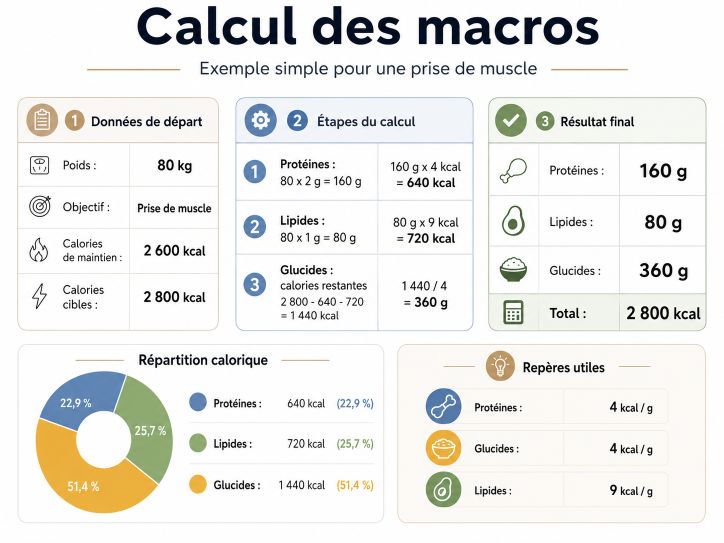
Take a person weighing 80 kg who wants to build muscle. They start by estimating their maintenance calories, for example 2,600 calories per day. To create a slight surplus, they can aim for about 2,800 calories per day.
They then set their protein around 2 grams per kilogram of body weight, or about 160 g of protein per day. That represents 640 calories, because 1 g of protein provides 4 calories.
They then keep a fat base around 1 gram per kilogram of body weight, or about 80 g of fat per day. That represents 720 calories, because 1 g of fat provides 9 calories.
There are therefore about 1,440 calories left to distribute as carbohydrates. Since 1 g of carbohydrate provides 4 calories, that gives about 360 g of carbohydrates per day.
In this example, the person therefore reaches a starting base of around:
- 2,800 calories
- 160 g of protein
- 80 g of fat
- 360 g of carbohydrates
Another example:
A person weighing 70 kg wants to lose fat. If their maintenance is estimated at 2,300 calories, they can start with a moderate deficit around 1,950 calories per day.
During a cut, they can set protein a little higher, for example around 2.2 grams per kilogram of body weight, or about 154 g of protein. That represents 616 calories.
They then keep about 0.8 grams of fat per kilogram of body weight, or about 56 g of fat. That represents 504 calories.
There are therefore about 830 calories left for carbohydrates, or about 208 g of carbohydrates.
In this example, the starting base would therefore be:
- 1,950 calories
- 154 g of protein
- 56 g of fat
- 208 g of carbohydrates
These numbers are not perfect values to copy. They mainly show the method: you start from calories, set protein, set fats, then complete with carbohydrates. Be careful, because carbohydrates provide energy for strength training sessions and for the day. If during a deficit your energy is too low, you will need to increase carbohydrates and therefore reduce the calorie deficit.
Tracking Your Macros Without Aiming for Perfection
Macros help structure your diet, but it is not necessary to hit exactly the same numbers every day. Being a few grams above or below on protein, carbohydrates, or fats does not change everything, as long as the overall picture remains coherent over the week.
The numbers should therefore help organize meals better, not become a permanent constraint. A diet followed consistently, even with a small margin of error, will often be more effective than a plan that is too strict and abandoned after a few days.
How to Distribute Your Macros Throughout the Day
Once macros are calculated, you still need to distribute them. On this point, there is no need to make things complicated. The simplest approach is generally to spread protein across several meals instead of concentrating everything in one serving.
Carbohydrates can be placed more flexibly, often with a practical interest around training depending on preferences, schedule, and digestion, which helps concentrate available energy for the workout. Fats are then distributed naturally throughout the day, while simply avoiding completely unbalancing certain meals.
The goal is not to create a rigid minute-by-minute schedule. It is mainly about keeping a realistic structure that is easy to follow. But the important thing is total calories and macros over the day.
Common Mistakes With Macros
One of the most common mistakes is looking only at protein. It is important, but it is not enough to structure a complete diet.
Another mistake is being afraid of carbohydrates, especially during a cut. Reducing them can be useful, but lowering them too much too quickly often makes training harder, lowers energy at work and throughout the day, and makes the diet less sustainable.
Lowering fats too much is also a classic mistake. Many lifters see them as a simple reserve of calories to remove, even though they have a real role in dietary balance.
Finally, many people forget that a macro calculation has to be adjusted. If nothing changes in the right direction after several weeks, you need to correct the base instead of keeping the same numbers out of habit.
When Should You Adjust Your Macros?
Macros are not meant to stay the same in every situation. They should change if the results do not match the goal.
If weight does not go up at all during a muscle-gain or bulking phase, it can be useful to slightly increase intake. If weight loss is too fast during a cut, or if recovery becomes poor, you may need to raise calories a little or review the split.
You also need to take how you feel into account. Excessive hunger, a clear drop in energy, or performance that drops for a lasting period can signal that something needs to be adjusted. The idea is not to change macros every three days, but not to treat them as untouchable numbers either.
What to Remember
Macros are a simple tool for organizing your diet in strength training. They allow you to distribute protein, carbohydrates, and fats more coherently based on the goal you are aiming for.
Protein often remains the first reference point to set, fats should remain sufficient, and carbohydrates are then adjusted based on energy needs, training volume, and the goal.
A macro calculator can be very useful to get a starting base, but it does not replace observing the results. The right numbers are the ones you can follow consistently, then adjust if needed.
The most important thing is therefore not to aim for theoretical perfection, but to build a clear, useful, realistic, and adjustable base.
FAQ
What Is a Macro in Strength Training?
A macro, or macronutrient, refers to one of the three main categories of nutrients that provide energy: protein, carbohydrates, and fats.
How Do You Calculate Your Macros?
You generally start by defining your goal, then a calorie base. Then you set protein, then fats, and adjust carbohydrates with the remaining calories.
What Is the Difference Between Calories and Macros?
Calories represent the total energy consumed. Macros show how that energy is distributed between protein, carbohydrates, and fats.
Is Protein the Most Important Macro in Strength Training?
In strength training, it is often the first reference point to set, because it plays a central role in muscle maintenance and development, but the balance of all macros is essential for progress.
Should You Reduce Carbs When Cutting?
Not necessarily in an extreme way. They are often adjusted during a cut, but they still have value for supporting training.
Do Fats Make You Gain More Weight Than Other Macros?
They provide more calories per gram, but they should not be seen as a nutrient to remove. They remain important in dietary balance.
Do You Have to Count Macros for Your Whole Life?
No. For many lifters, counting macros is mainly useful for learning, structuring their diet, and understanding their needs better. Over time, you learn to organize your diet without having to weigh and calculate everything.
Does a Macro Calculator Give the Perfect Number?
No. It mainly gives a starting base. The results then need to be adjusted based on changes in weight, performance, and how you feel.
Related articles

Bulking in Strength Training: How to Gain Muscle Without Gaining Too Much Fat
Bulking is a phase where you aim to gain weight to support muscle building. In theory, the idea seems simple: eat more, train hard, and progress. But in practice, this is often where many lifters go wrong. Some eat far too much and mostly gain fat, while others are afraid to eat

How to Cut: Lose Fat Without Losing Muscle
Cutting in strength training is a period where the goal is to lose fat while keeping as much muscle as possible. It often comes after a bulk, but it can also apply to someone who simply wants to improve their body composition, get leaner, or make their muscles more visible. The

Dietary Supplements in Strength Training: Which Ones Exist, What Are They For, and How Should You Use Them?
Dietary supplements occupy an important place in the world of strength training, but they are often presented in an overly simplistic way, even though their real value depends on the product, the goal, and how they fit into training and nutrition. Between useful products, thos