How to Cut: Lose Fat Without Losing Muscle
Learn how to cut in strength training with a calorie deficit, high protein intake, cardio, workouts, macros, and tips to lose fat without losing muscle.

The goal of this article is to explain how to cut in strength training in a clear way: calories, diet, protein, carbs, training, cardio, supplements, and mistakes to avoid.
What Is Cutting in Strength Training?
Cutting in strength training is a phase where you try to lose fat while keeping as much muscle mass as possible, so your muscles look more visible and your muscle definition improves. The goal is therefore not only to lose weight on the scale; the real goal is to lose mainly fat without losing the muscle built through training.
This is why a cut must be different from a simple aggressive diet. If calories drop too low, if protein intake is too low, or if training becomes too light, the body can lose muscle at the same time as fat. The result can be worse, even if body weight goes down.
A well-run cut is therefore based on three foundations: a controlled calorie deficit, sufficient protein intake, and a strength training program that is maintained.
Cutting or Fat Loss: What Is the Difference?
In everyday language, people often use “cutting” and “fat loss” to talk about the same thing. The difference mainly comes from the context.
Fat loss is a broad term; it applies to anyone who wants to reduce body fat.
Cutting, in strength training, is generally more structured. It aims for a specific physical goal: getting more defined, keeping as much muscle as possible, improving the visual result, and maintaining decent performance in training.
In both cases, the foundation is the same: you need to create a calorie deficit, but in strength training, you have to be careful not to lose too much strength or too much muscle during this period.
How to Cut?
To cut, you first need to know your maintenance calories. Maintenance is the calorie level that allows you to keep a stable body weight. If someone eats around 2,600 calories per day and their weight does not change over several weeks, their maintenance is close to 2,600 calories.
To start cutting, you then go slightly below this maintenance level. For example, someone whose maintenance is 2,600 calories can start around 2,200 to 2,350 calories per day. This creates a deficit without immediately falling into a restriction that is too aggressive.
Then, you need to organize your macros. Protein stays high to help preserve muscle mass, fats should not be too low because they are needed for essential body functions, and carbs are often adjusted based on remaining calories, available energy, and workout quality.
A cut is therefore built step by step: maintenance, deficit, macros, training, tracking, adjustment.
How Many Calories Should You Eat When Cutting?
There is no single number for everyone. Calories during a cut depend on body weight, height, age, activity level, number of workouts, and starting maintenance calories.
The simplest approach is to start with a moderate deficit. For many lifters, removing around 10 to 20% of maintenance calories is a more reasonable base than cutting too hard from the start.
Then, you need to observe what happens. If weight drops too fast and energy falls sharply, the deficit may be too aggressive. If weight does not go down after several weeks, you may need to reduce calories slightly or increase expenditure a little.
How Fast Should You Lose Weight When Cutting?
A cut that is too fast often increases the risk of losing muscle, dropping performance in the gym, and making the diet hard to stick to. On the other hand, a cut that is too slow can feel like it never moves forward.
A simple guideline is to aim for around 0.5 to 1% of body weight per week. For someone weighing 80 kg, this represents around 400 to 800 g per week, while for someone weighing 60 kg, this represents around 300 to 600 g per week.
You should not judge progress from a single weigh-in, because weight can vary with water, salt, carbs, stress, or digestion. The most reliable approach is to weigh yourself several times during the week, then look at the average.
If the weight average goes down within the right range and performance and general energy remain decent, the cut is moving well. If weight drops too fast, it is often better to slow down. If nothing moves after two or three weeks, you need to adjust.
Cutting Diet: What Should You Eat?
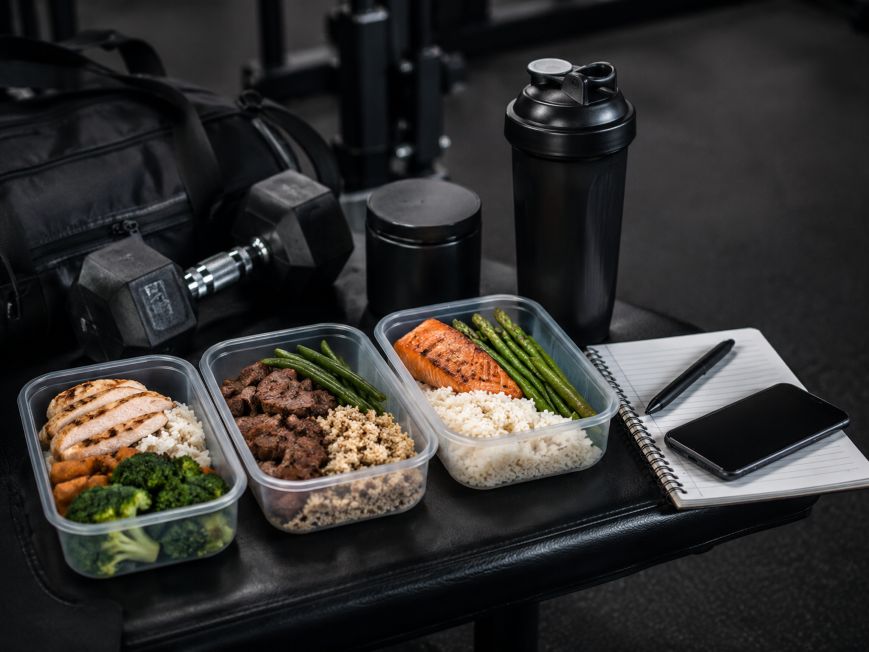
A cutting diet should help you maintain the deficit while keeping enough energy to train. The goal is not to eat only “perfect” foods, but to build simple, filling meals that are easy to follow.
High-protein foods are important: eggs, fish, lean meat, dairy products, tofu, tempeh, seitan, legumes, or protein powder if needed.
Carbs can come from rice, potatoes, oats, pasta, whole-grain bread, fruit, or legumes. You do not have to remove them. Above all, you need to adjust the amounts to reach the desired calorie total, because this is the variable you can adjust.
Fats can come from olive oil, eggs, avocado, nuts, almonds, seeds, or some fatty fish. They should stay in the diet, but their amounts need to be controlled because they provide a lot of calories.
Vegetables are also useful during a cut. They add volume to the plate, fiber, and satiety, which helps make this period easier to sustain.
Macronutrients During a Cut
Protein is often the most important macro during a cut, because it helps preserve muscle mass during the calorie deficit. A practical guideline can be around 1.8 to 2.4 grams of protein per kilo of body weight per day. For example, someone weighing 80 kg can aim for around 144 to 192 g of protein per day.
Fats need to stay sufficient. Dropping them too low can make the diet harder to follow and hurt overall balance. A base around 0.6 to 1 gram per kilo of body weight per day can serve as a practical guideline depending on total calories.
Carbs are often the macro you adjust the most. You reduce them to create the deficit, but you should not remove them without reason because they remain useful for keeping energy in training, maintaining a good training volume, and avoiding fatigue that comes too quickly.
The logic is therefore simple: high protein, sufficient fats, adjusted carbs.
Simple Example of Cutting Macros
Let’s take someone weighing 80 kg with maintenance around 2,600 calories. To start their cut, they decide to aim for around 2,200 calories per day.
They first set protein around 2.2 g per kilo of body weight, or around 176 g of protein. Since 1 g of protein provides 4 calories, this represents around 704 calories.
They then keep 70 g of fat. Since 1 g of fat provides 9 calories, this represents around 630 calories.
That leaves around 866 calories for carbs. Since 1 g of carbs provides 4 calories, that gives around 216 g of carbs.
In this example, the starting base would therefore be:
- 2,200 calories
- 176 g of protein
- 70 g of fat
- 216 g of carbs
These numbers should not be copied by everyone. They mainly show the method: start with calories, set protein, keep enough fats, then fill the rest with carbs.
Cutting Workout Program: How Should You Train?
During a cut, strength training must remain at the center of the program. The role of training is to give the body a reason to keep muscle. If you lower the weights too much, reduce workouts too much, or replace everything with cardio, the signal sent to the muscle becomes weaker.
The goal is therefore to keep training seriously, with basic exercises, controlled loads, and progress that stays as stable as possible. It is not always possible to hit personal records during a cut, especially as the deficit continues, but you should try to maintain your usual performance as much as possible.
A cutting workout program can stay quite close to a classic program. You can use full body, upper-lower, push pull legs, or a split depending on your level. What matters is continuing to train the major muscle groups with enough intensity.

Should You Change Your Program During a Cut?
You do not have to completely change your training program during a cut; in fact, it is often a mistake. If the program was working before, it can remain a good base.
What can change is fatigue management. In a calorie deficit, recovery is sometimes worse, so it can be useful to slightly reduce volume if workouts become too hard to sustain. For example, you can keep the same exercises but do a little fewer sets for certain areas.
It is better to adjust gradually rather than transform the whole workout. Cutting is not a reason to switch from a strength training program to a cardio-only routine.
Should You Do Cardio During a Cut?
Cardio can help during a cut, but it is not mandatory. Its main role is to increase energy expenditure, which can help create or maintain the calorie deficit without reducing food intake too much.
The simplest approach is to add cardio progressively. For example, start with two or three moderate sessions per week, or simply increase your daily step count. Walking more can already make a real difference without adding too much fatigue.
Cardio should not replace strength training, because if cardio becomes too important and gym performance drops, you need to rebalance things. During a cut, the priority remains losing fat while keeping muscle and good overall energy.
Which Supplements Can Help During a Cut?
Supplements are not essential for a successful cut; they can only help in some cases.
Whey or another protein powder can be practical if protein intake is hard to reach with meals. It lets you add protein without making the diet too complicated. But keep in mind that liquid protein can be less filling, and hunger is a variable that needs to be considered during fat loss.
Caffeine can help maintain energy before some workouts, especially when the deficit starts to be felt. It does not replace sleep, but it can improve focus and the quality of some strength training sessions.
Creatine can be kept during a cut; it is not only for bulking. It can help maintain good performance on intense efforts.
Fat burners, on the other hand, should be approached with a lot of caution. Many are mainly sold with aggressive marketing. They do not replace a calorie deficit, training, or consistency in any way.
Can You Build Muscle During a Cut?
It is possible in some cases, but it is not the main goal of a cut. A beginner, someone returning to training, or someone whose diet was poorly organized can sometimes build a little muscle while losing fat.
For someone who is already trained, it is more difficult. A calorie deficit is not the best context for building a lot of muscle. The main goal is rather to keep the muscle mass already gained while fat goes down.
It is therefore better not to judge a cut only by progress on the weights. If performance is maintained well while body weight and waist size go down, that is already a very good sign.
How Long Should a Cut Last?
The length of a cut depends on the starting point and the goal. Someone who has little fat to lose will not need the same length as someone coming out of a long bulk.
A cut can last a few weeks or several months. The most important thing is not to try to go too fast. The more aggressive the cut is, the harder it becomes to maintain and the greater the risk of muscle loss.
It can also be useful to take maintenance breaks if the cut becomes long. This helps manage fatigue, hunger, and progress over time.

Common Mistakes During a Cut
The first mistake is dropping calories too low from the start. This often creates quick weight loss at first, but fatigue comes quickly, performance drops, and the cut becomes hard to maintain.
The second mistake is removing carbs. Reducing them can be useful, but removing them completely is not necessary to cut. Carbs remain important for training energy.
The third mistake is dropping fats too low. They need to stay present in the diet.
The fourth mistake is doing too much cardio and not enough strength training. Cardio helps you expend more energy, but strength training remains essential for keeping muscle.
The fifth mistake is looking for a quick cut. The faster you try to go, the more you increase the risk of losing muscle, recovering poorly, and giving up.
Cheat Meal and Cutting: Should You Avoid It?
A cheat meal can have a place during a cut, but it needs to stay controlled. The problem is not having a more flexible meal from time to time; it is turning that meal into an excess that cancels out a large part of the week’s calorie deficit.
If the cut is based on a moderate daily deficit, one very high-calorie meal can quickly slow progress. In that case, it is possible to smooth out the remaining calories for the day to keep the planned calorie deficit over the day or over the week.
The simplest approach is to see the cheat meal as a planned meal, not as a full day with no limits. You can keep a more enjoyable meal during the week, while staying reasonable with portions and avoiding turning it into an excuse to eat everything that was removed on previous days. A successful cut does not require being perfect all the time, but it does require keeping consistency across the week.
If weight continues to drop in the right range and the cheat meal helps mentally, it can be kept. On the other hand, if weight loss often stalls after this type of meal, it probably needs to be reduced, better planned, or replaced with a more controlled enjoyable meal.
What to Remember
Cutting in strength training is used to lose fat while keeping as much muscle as possible. It is based on a controlled calorie deficit, sufficient protein intake, fats kept in the diet, adjusted carbs, and maintaining strength training.
The goal is not to eat as little as possible, but to create a deficit you can stick to while keeping enough energy to train properly.
A good cut is tracked with average body weight, waist size, photos, performance, and how you feel. If the results are not moving in the right direction, you adjust gradually.
FAQ
How Do You Cut in Strength Training?
To cut, you need to create a calorie deficit, keep enough protein, continue strength training, and adjust calories based on changes in body weight and performance.
Which Supplements Should You Take During a Cut?
The most useful supplements can be protein powder if protein intake is hard to reach, caffeine in some cases, and creatine to help maintain performance. Fat burners are not essential.
How Long Should a Cut Last?
It depends on how much fat you need to lose and how fast you progress. A cut can last a few weeks or several months, but it should stay progressive.
Can You Build Muscle During a Cut?
It is possible for some beginners or lifters returning to training, but for most trained people, the main goal of a cut is mainly to keep muscle while losing fat.
Should You Do Cardio During a Cut?
Cardio can help increase calorie expenditure, but it is not mandatory. Strength training should remain the priority to keep muscle.
Do You Need to Cut Carbs to Lose Fat?
No. Carbs can be reduced, but they are still useful for keeping energy during training. The goal is to adjust them, not remove them.
How Much Protein Should You Eat During a Cut?
A practical guideline is often around 1.8 to 2.4 grams of protein per kilo of body weight per day. Protein is not usually the main adjustment variable during a cut.
How Many Calories Should You Eat During a Cut?
It depends on maintenance calories. A simple starting point is to remove around 10 to 20% of maintenance calories, then adjust based on results.
Related articles

Shoulder Exercises: How to Train Your Shoulders Properly?
Good shoulder exercises are not just about pressing as much weight as possible overhead. To develop complete shoulders, you need to combine several types of movements: presses for overall work, lateral raises to emphasize width, and specific exercises for the rear of the shoulder

Bulking in Strength Training: How to Gain Muscle Without Gaining Too Much Fat
Bulking is a phase where you aim to gain weight to support muscle building. In theory, the idea seems simple: eat more, train hard, and progress. But in practice, this is often where many lifters go wrong. Some eat far too much and mostly gain fat, while others are afraid to eat
Strength Training Machines: Which Ones Should Beginners Use at the Gym?
When you walk into a gym, strength training machines can quickly make it feel like you already need to know everything before getting started. There are machines for the legs, back, chest, shoulders, arms, and abs. Some are easy to understand, while others are much less obvious.