Ab exercises: how can you train your abs effectively?
Discover the best ab exercises: crunch, leg raise, ab roller, obliques, and a sample workout to train your abs effectively.
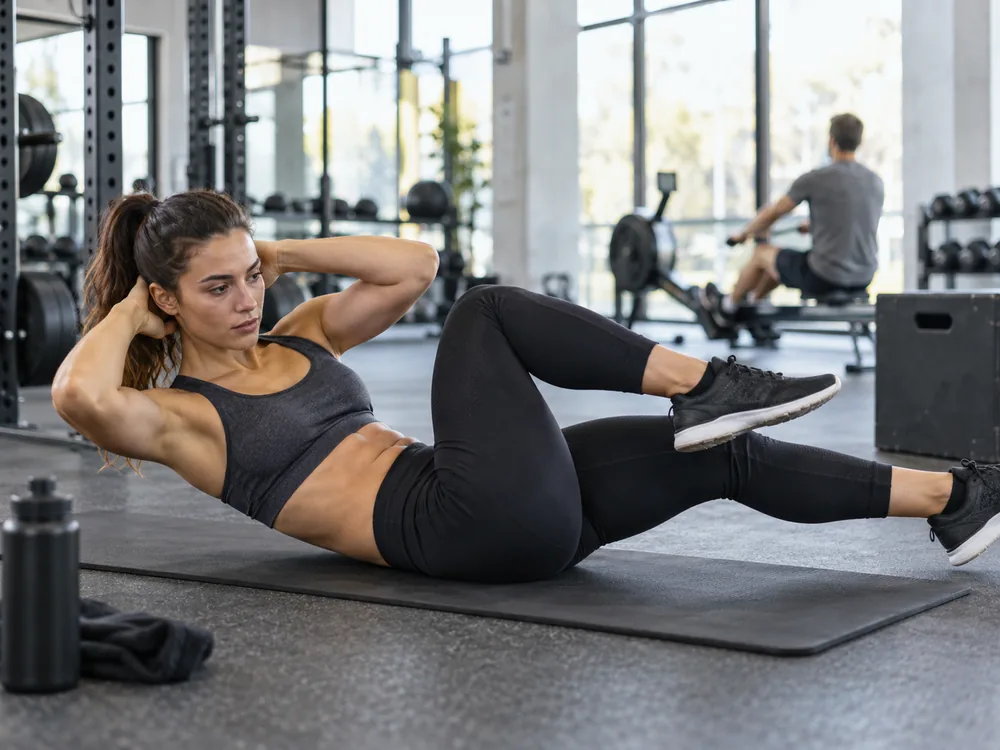
Training your abs is not just about doing crunch after crunch or holding a plank for as long as possible. The abdominal muscles play a role in several movements: they can contribute to trunk flexion, control pelvic position, resist extension, or prevent the torso from rotating under a load.
This is why an effective workout can combine several types of ab exercises without requiring a large number of movements. A few well-chosen exercises, performed correctly and made progressively more difficult, are enough to provide comprehensive training.
Abdominal muscles: understand their role before choosing your ab exercises
To choose your movements, it helps to know what you are actually trying to train: ab exercises engage several muscles whose functions complement one another. The rectus abdominis is the vertical muscle at the front of the abdomen that forms the individual visible sections of the “six-pack” when body fat levels allow them to show. It contributes to trunk flexion, for example when the rib cage moves toward the pelvis during a crunch.
On the sides are the obliques, which contribute to trunk rotation and bending, as well as stabilization. Their role is therefore not limited to exercises in which you deliberately rotate your torso. Deeper, the transverse abdominis contributes to stability in the abdominal region. This does not mean that there is a movement that can isolate it completely: many exercises engage several core muscles simultaneously. Comprehensive ab training can therefore combine dynamic movements with exercises in which the abdominal muscles primarily prevent the trunk or pelvis from moving into an undesirable position.
What are the best ab exercises in strength training?
Looking for a single best ab exercise is not necessarily the right approach, because one movement may be particularly suited to trunk flexion, while another primarily requires resisting extension, rotation, or bending.
Several broad categories of movements can therefore be distinguished:
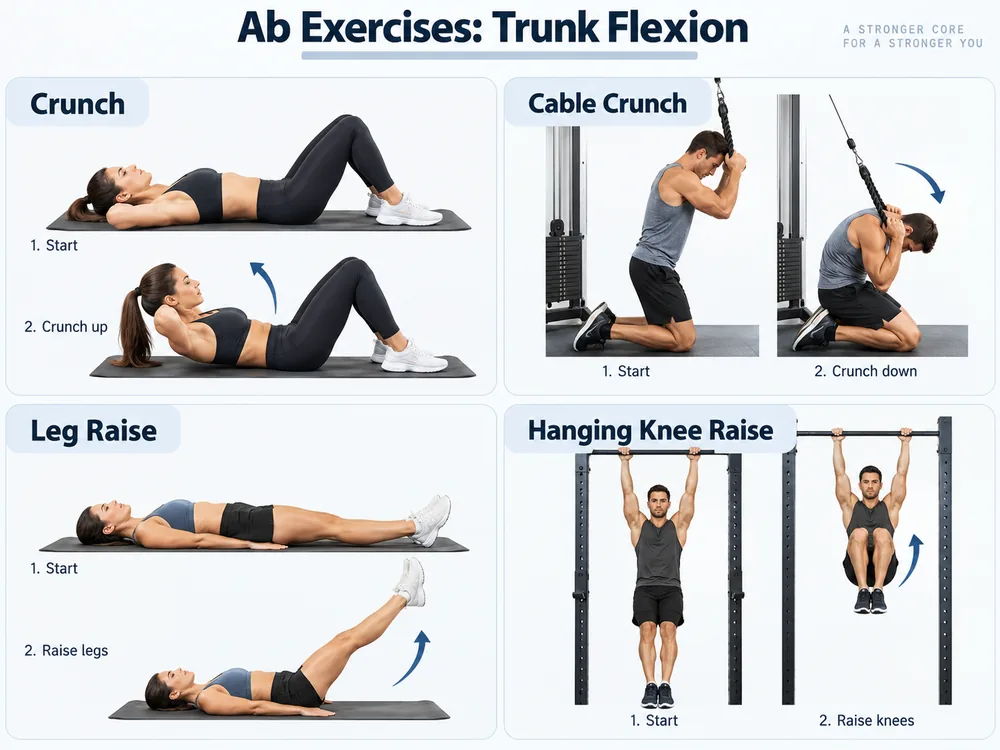
- Trunk flexion: a crunch or cable crunch, with the goal of bringing the rib cage toward the pelvis.
- Leg movement and pelvic control: a leg raise or knee raise, with a strong emphasis on controlling the pelvis during the movement.
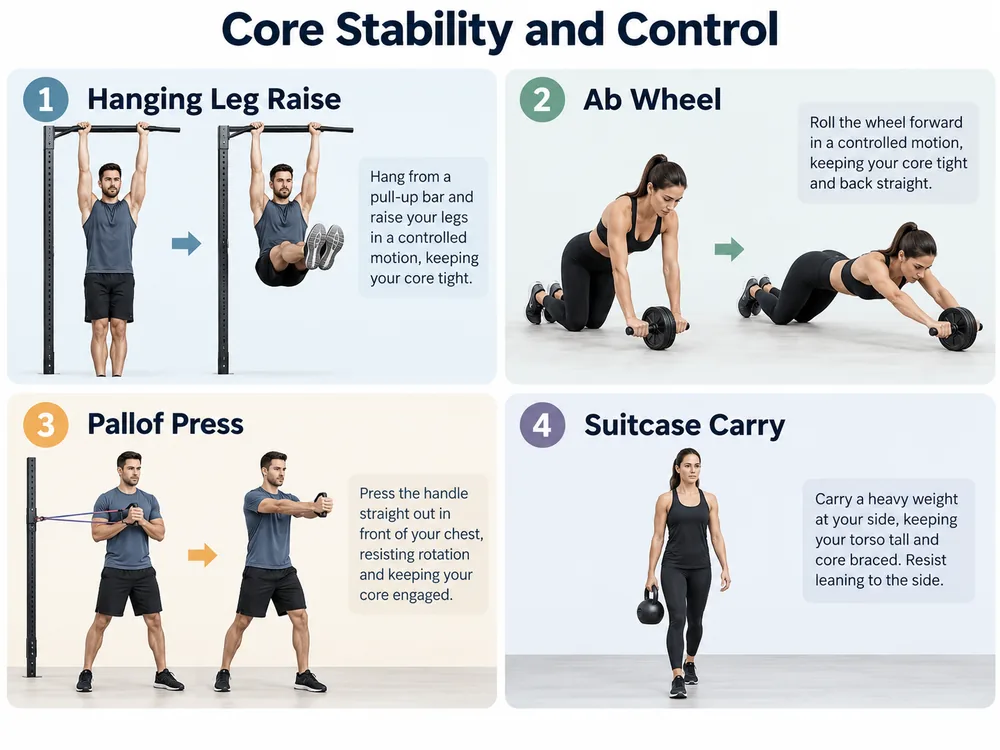
- Anti-extension: the ab roller, where the goal includes preventing excessive arching of the lower back.
- Anti-rotation: the Pallof press, which requires resisting a force that tries to rotate the torso.
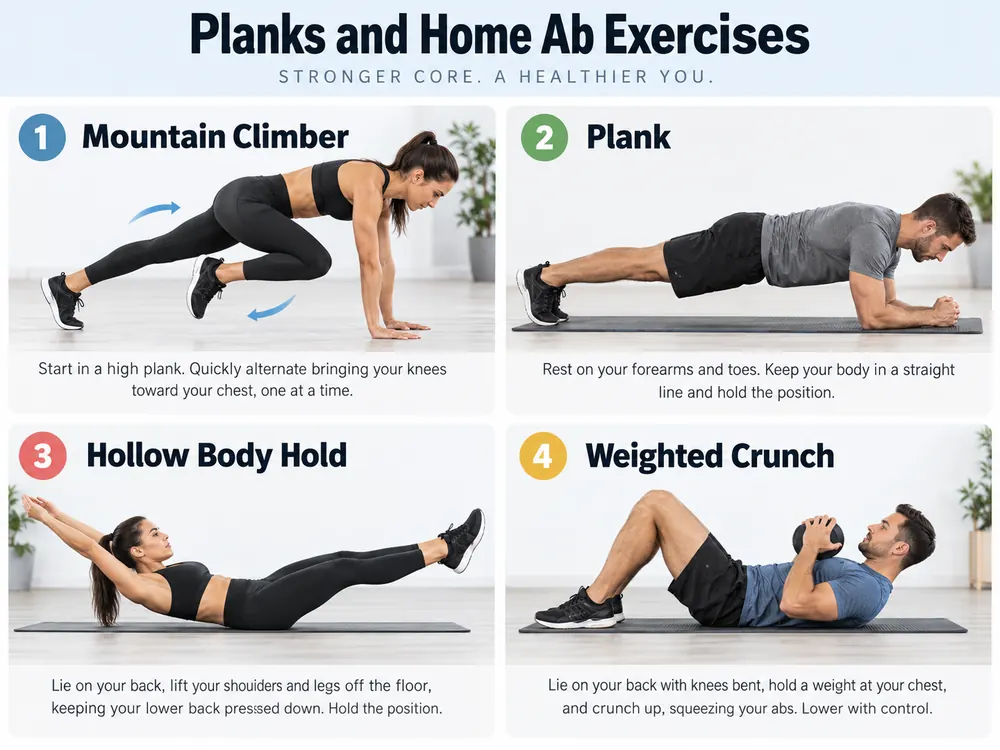
- Dynamic stabilization: the mountain climber, where the trunk must remain stable as the legs move.
This classification is more useful than cramming eight or ten ab exercises into the same workout. A flexion movement, an exercise involving pelvic control, and stability work can already cover several different functions.
The choice also depends on your experience level and your ability to progress with the movement. Among all the available ab exercises, a relatively simple exercise whose difficulty can be increased gradually may be more useful than an impressive-looking variation that is difficult to measure.
Ab crunch: how do you perform this abdominal exercise correctly?
When the goal is to train trunk flexion, bringing the rib cage toward the pelvis is enough: there is no need to rise all the way into a sitting position. This is precisely the principle behind the crunch, which has a relatively short range of motion. During the movement, the head naturally follows the torso. Pulling on it with your hands does not improve abdominal engagement, and using a rocking motion to come up reduces control of the repetition. The lowering phase also deserves to be controlled rather than simply letting the trunk drop back down.
The value of the ab crunch also comes from how easily it can progress with your level, since a bodyweight version may be suitable at first, before adding a weight plate, cable resistance, or a more difficult variation. You can also slow down certain phases of the movement. However, the goal is not to make every repetition artificially extremely slow, but to maintain enough control for the exercise to remain measurable and allow progress over the weeks.
Leg raise: how does it work the abs and pelvis?
The sensation felt in the lower abdomen explains why this movement is often described as an exercise for the “lower abs,” although this expression does not mean that an independent part of the rectus abdominis is being isolated.
When the legs or thighs lift, the hip flexors contribute significantly to the movement. During a leg raise, one of the challenges is therefore to control pelvic position and avoid producing the movement solely through the hips. A posterior pelvic tilt at the end of the repetition helps create actual movement of the pelvis.
The difficulty can be adjusted with different variations:
- a leg raise on the floor;
- a raise on a bench;
- a hanging knee raise;
- a hanging leg raise.
Bending the knees shortens the lever arm and generally makes the exercise more accessible. Conversely, gradually straightening the legs increases the difficulty without necessarily changing the movement entirely.
With hanging variations, momentum can quickly take over. If the body swings significantly before each repetition, lifting the feet higher does not necessarily mean that the abs are working harder; controlling the trunk and pelvis remains the priority.
Ab roller and ab wheel: an anti-extension ab exercise
The greater the distance between the knees and hands, the longer the lever arm becomes and the harder the abdominal muscles must work to prevent the trunk from extending. This mechanism makes the ab roller particularly demanding.
During the exercise, one goal is to avoid letting the pelvis gradually drop and the lower back arch as the arms move forward. Using an ab wheel is therefore not just about rolling the wheel as far as possible: the useful range of motion ends when the position can no longer be properly controlled. The kneeling version is a logical starting point for progression, and once a distance is mastered, you can simply roll the wheel slightly farther in subsequent workouts. Progressing through range of motion allows you to increase the difficulty very gradually without changing exercises every workout.
Oblique exercises: rotation, anti-rotation, and core stability
Rotating the torso against resistance is one way to engage the muscles on the sides of the abdomen, but it is not the only way. The obliques also work when the body must prevent rotation or resist lateral bending.
A cable rotation, for example, involves deliberate movement of the trunk. The Pallof press works differently: the resistance tries to rotate you while you must remain stable. During a suitcase carry, the weight is held on only one side, and the trunk must resist the tendency to lean.
These three situations help explain why an oblique exercise does not always have to involve rotating the torso. When choosing your oblique exercises, you can train both the production of movement and resistance to movement.
Mountain climber: ab exercise, dynamic core stability exercise, or cardio?
When performed very quickly, switching legs repeatedly, this movement becomes primarily dynamic and readily raises the heart rate. In this context, it naturally fits into a circuit or certain warm-ups. Conversely, slowing down the movement while trying to keep the pelvis and trunk stable significantly changes the demands. The mountain climber then places greater demands on the ability to maintain a position despite the alternating movement of the legs.
This does not necessarily make it the top-priority exercise specifically for ab hypertrophy. For that goal, movements with resistance or difficulty that is easy to quantify, such as a weighted crunch or an ab roller, are generally easier to progress with.
Core stability exercises for the abs: is the plank enough to train the abdominals?
During a plank, the work mainly involves holding a position while various forces try to change it. A crunch, by contrast, requires active trunk flexion. Resisting movement and deliberately producing movement are two different demands.
Therefore, core stability exercises and dynamic exercises are not competing methods. A plank can develop the trunk’s ability to remain stable, while a crunch or leg raise provides a different type of work. Including core stability exercises for the abs can therefore complement a workout without needing to replace all dynamic exercises with static positions. However, the many core stability variations and their progressions are a broad enough topic to cover in a dedicated article.
Abs workout: an example of how to organize your exercises
A simple approach is to select a few exercises that place different demands on the abdominal muscles, without it being necessary to pile on movements to create a coherent workout.
Here is an example of an abs workout:
- Cable crunch or weighted crunch: 3 sets of 8 to 15 repetitions
- Leg raise or knee raise: 3 sets of 8 to 15 repetitions
- Ab roller: 3 sets of 6 to 12 repetitions
- Pallof press or suitcase carry: 2 to 3 sets per side
These repetition ranges provide guidelines, not mandatory thresholds. Above all, the resistance and variation should allow you to maintain controlled execution.
You do not need to perform all four exercises every time, either. Depending on the rest of your training and the amount of abdominal work done during the week, two or three movements may be enough. For example, you can pair a dynamic movement for the rectus abdominis with an exercise for pelvic control or anti-extension.
How many times per week should you do ab exercises?
Squats, heavy pulling movements, standing exercises, and loaded carries already engage the trunk to varying degrees. This indirect work should be taken into account, even though it does not necessarily replace dedicated abdominal sets when developing the abs is a goal.
For many people who train, two to three direct training sessions per week may be sufficient. However, this is not a universal frequency: the number of sets, their difficulty, and the recovery available must also be considered. A few easy sets of core stability exercises do not have the same impact as a full workout made up of challenging sets. Similarly, the stabilization required during other strength training movements is not exactly the same as direct abdominal training.
Exercise frequency should therefore be integrated into the strength training program as a whole. You do not need to train your abs every day to make progress.
How can you progress with ab exercises?
Repeating exactly the same sets at the same difficulty for months eventually tells you little about actual progress, because, as with other muscle groups, you need to be able to increase the demands.
With ab exercises, several variables can help: increasing the number of repetitions, adding weight, using a greater range of motion, moving to a more difficult variation, or simply improving technical control.
With a cable crunch, for example, you can gradually reach the upper end of the repetition range before slightly increasing the resistance. With an ab roller, a few extra centimeters already lengthen the lever arm, while for a leg raise, gradually moving from bent knees to a straighter position also represents progress.
Control itself can become an indicator: twelve repetitions without swinging or losing position represent progress over the same number of repetitions previously achieved using momentum.
Keeping certain ab exercises for several weeks therefore makes tracking easier, while constantly changing movements makes it much harder to compare performance and measure actual progress.
Ab exercises at home: how can you progress without much equipment?
A lack of equipment does not prevent you from training the abdominal muscles effectively. The crunch, floor leg raise, hollow body, mountain climber, and plank can all be performed with bodyweight. A small wheel also makes it easy to add anti-extension work.
The challenge with training abs at home tends to arise when the initial variations become too easy. At that point, endlessly adding repetitions is not the only option: additional weight, a greater range of motion, a different lever arm, or a change in tempo can increase the difficulty. These ab exercises at home therefore follow the same progression principles as those performed at the gym. A program devoted entirely to abdominal training at home can cover the variations and their organization in greater detail.
Ab exercises: common mistakes to avoid
The way you perform repetitions, organize progression, or even interpret sensations can limit the benefits of training.
- Performing every repetition very quickly makes it harder to truly control the movement and pelvic position.
- Using a lot of momentum often allows you to artificially increase the number of repetitions without increasing the intended work.
- Pulling on your head during crunches does not train the abs more effectively and can make the movement uncomfortable for the neck.
- Swinging during hanging raises gradually turns the exercise into a swinging motion.
- Chasing only the burning sensation does not, by itself, indicate that a set will produce more muscle growth.
- Accumulating hundreds of repetitions is not required. When an exercise becomes very easy, increasing its difficulty generally makes more sense than extending the set indefinitely.
- Never increasing the difficulty means continually asking the body to repeat an effort it has already mastered.
- Constantly changing exercises prevents you from clearly tracking progress on the same movement.
- Confusing ab development with abdominal fat loss leads you to expect localized exercises to produce an effect they cannot target. Strengthening the abs and making those muscles visible are two different issues; reducing body fat depends in particular on overall energy balance, which is more closely related to a bodybuilding cut.
- Continuing despite back or hip pain is not a progression strategy. Persistent or unusual pain is a reason to stop or modify the movement and, if necessary, seek advice from a healthcare professional.
Ab exercises: key takeaways
A good selection of ab exercises does not require a large number of movements. The rectus abdominis, obliques, and deep core muscles contribute to different functions, which explains the value of combining a few complementary exercises.
A crunch, leg raise, ab roller, and anti-rotation movement can provide a simple foundation. What matters most after that is progressing over time, maintaining controlled execution, and adjusting frequency to the rest of your training. Core stability work also has its place, but is a broad enough topic to be covered separately.
FAQ
What are the best exercises for the abs?
There is no single list that works for everyone. A crunch trains trunk flexion, the leg raise combines hip movement with pelvic control, the ab roller requires resisting extension, and the Pallof press requires resisting rotation. Combining a few different functions provides more comprehensive training.
What is the best ab exercise?
There is no absolute best ab exercise. To develop the rectus abdominis with resistance that is easy to increase gradually, a weighted crunch or cable crunch can be practical. An ab roller serves a different purpose, since it primarily requires resisting trunk extension.
How many times per week should you train your abs?
Two to three direct training sessions per week may suit many people who train, but this is not a mandatory frequency. You need to consider the number of sets performed, their difficulty, recovery, and the abdominal work already involved in other exercises.
Should you train your abs every day?
No. The abs do not need to be trained daily to make progress. As with other muscles, spacing workouts farther apart can allow you to accumulate enough work while recovering between sessions.
Is the crunch effective?
Yes, the crunch can be an effective exercise for training the rectus abdominis when performed with controlled trunk flexion. It can also be made more difficult with a weight or cable resistance, which makes progression easier.
Does the leg raise work the lower abs?
The leg raise does not isolate a separate muscle corresponding to the “lower abs.” The hip flexors contribute to the movement, while the abs help control the pelvis and trunk, among other functions.
Is the ab roller effective?
The ab roller is a demanding anti-extension exercise. The core muscles must prevent the pelvis and lower back from moving into excessive extension as the wheel moves away from the body. Starting on your knees and gradually increasing the range of motion allows you to control the difficulty.
Are core stability exercises enough to build abs?
Core stability exercises train the trunk’s ability to resist movement, but they do not replicate the dynamic work of a crunch or other exercises. They can therefore be used as a complement rather than viewed as the only way to train the abs.
How can you progress with ab exercises?
Progress can come from increasing repetitions, weight, range of motion, or the difficulty of the variation. Better control of the movement can also represent progress. Keeping a few exercises long enough allows you to compare performance from one week to the next.
Can you build your abs at home?
Yes. Many exercises, such as the crunch, leg raise, hollow body, mountain climber, or plank, require little or no equipment. When these movements become easy, the priority is to find a way to gradually increase their difficulty rather than endlessly adding repetitions.
Related articles
RPE, RIR, and muscle failure: how do you manage effort in strength training?
Learn how to use RPE and reps in reserve to adjust your sets, make progress, and manage muscle failure based on your goal.
Glute exercises: which movements should you choose to build them effectively?
Hip thrusts, squats, lunges, Romanian deadlifts, and hip abduction: learn how to choose your glute exercises, perform them, and progress.
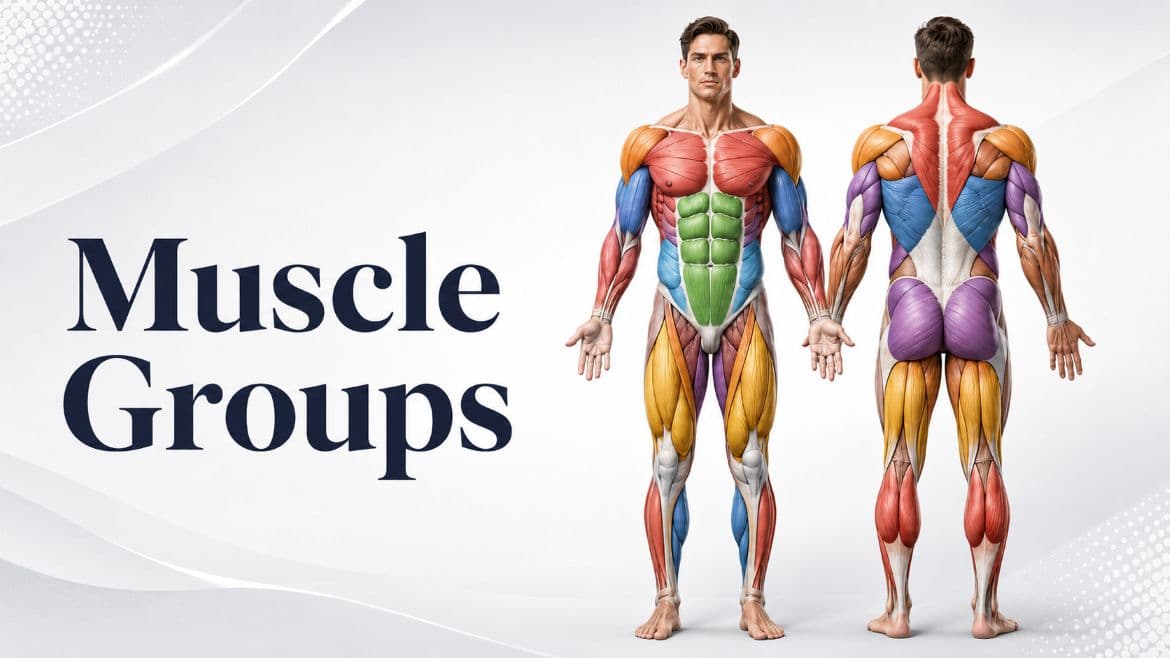
Muscle Groups: Understanding the Main Muscles of the Body to Train Better
A guide to understand the basics of the topic and organize your training more effectively.