Glute exercises: which movements should you choose to build them effectively?
Discover the best exercises for glutes: hip thrusts, squats, lunges, Romanian deadlifts, hip abduction, and a sample workout to build them effectively.
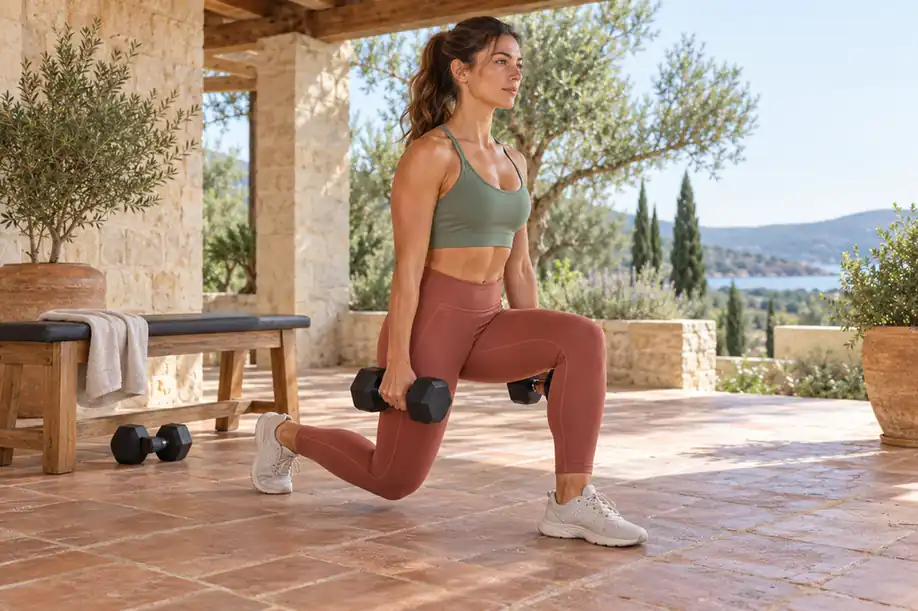
Hip thrusts, squats, lunges, and Romanian deadlifts offer several ways to work the lower body, with differences in positioning, range of motion, and balance that matter when putting together a workout. Rather than piling them on, it is better to understand what each one offers, choose those that suit your level and equipment, then learn how to progress on them.
This guide explains how to perform the main movements, complement gluteus maximus training with gluteus medius exercises, and organize a workout at the gym or at home, with accessible guidelines for beginners.
Which muscles make up the glutes?
The glutes consist of three main muscles. The largest, the gluteus maximus, contributes substantially to the size of the buttocks and helps extend the hip. This action involves straightening the hip, for example when you stand up from a squat or raise your hips during a hip thrust.
On the side of the pelvis, the gluteus medius and the deeper gluteus minimus help move the leg out to the side, a movement called abduction, and stabilize the pelvis when you stand on one leg. Their role explains why glute exercises are not limited to movements that push the hips forward: unilateral exercises and hip abduction also complement the workout.
What are the best exercises for glutes?
Your choice of glute exercise depends on what you want to add to your training, because a movement that is easy to load, such as the hip thrust, places different demands on the body than a Bulgarian split squat, where each leg works separately, or cable hip abduction, which focuses more on the sides of the hips. The Romanian deadlift provides another situation, with substantial hip flexion during the lowering phase and considerable involvement of the backs of the thighs.
A selection can therefore combine a hip thrust or glute bridge, a Romanian deadlift or squat, followed by a unilateral exercise and possibly hip abduction. Kickbacks, lunges, and step-ups provide other options depending on the equipment available, without requiring you to include them all or look for one movement that would be best for everyone.
Hip thrust: a staple glute exercise
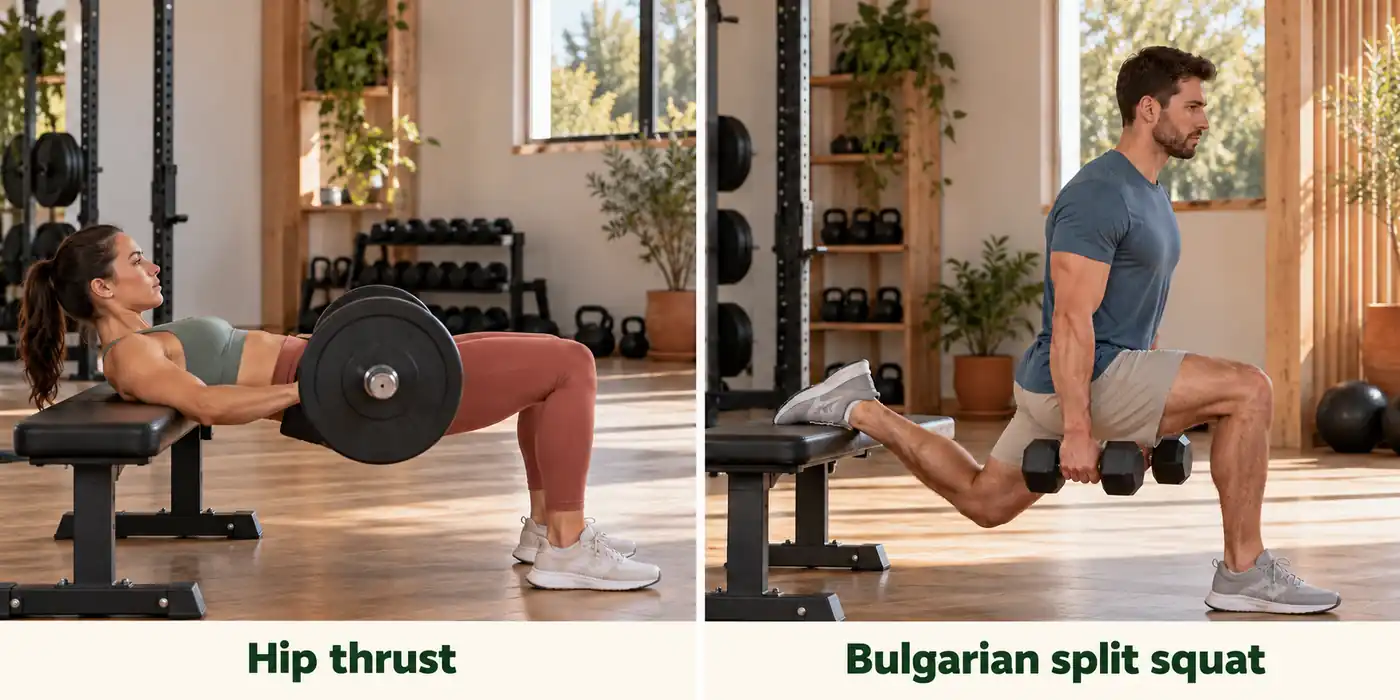
The hip thrust is a staple exercise for building the glutes because it lets you load hip extension in a position where your upper back rests on a bench and your feet stay on the floor. You raise your hips against resistance, with a strong glute contraction at the top, then control the lowering phase before repeating.
Position your upper back against a stable bench, approximately at the level of the bottom of your shoulder blades, and place your feet flat in front of you, adjusting their distance so your shins are nearly vertical when your hips are raised. This position serves as a starting point and can be adjusted for comfort; when using a barbell, add padding at the crease of your hips and hold it with your hands to keep it in place.
- Brace your core, keep your chin slightly tucked, and push through your feet without lifting your heels.
- Rise until your hips are extended, with your torso roughly in line with your thighs, then pause briefly if needed to check your position.
- Lower back down while keeping your pelvis under control, without letting the weight pull you down.
At the top of the movement, trying to gain a few centimeters by excessively arching your lower back shifts the movement to your spine rather than usefully extending your hips farther. This is why your ribs should stay controlled instead of flaring toward the ceiling. A barbell and a hip thrust machine then make it easier to progress in weight, while a dumbbell on your hips or your body weight lets you learn the movement with a simpler setup.
Bulgarian split squat: a well-rounded unilateral exercise
With one foot on the floor in front of you and the other resting behind you on a bench, the Bulgarian split squat primarily works the front leg as you lower and rise, while also requiring pelvic stability. The glutes and quadriceps contribute to the effort, and their relative involvement can vary with stride length, hip flexion, and torso position.
To find a stable position, leave a small amount of lateral space between your feet, as if they were on two rails rather than a tightrope, and choose a rear support that does not force you to arch your back. Place your front foot far enough forward to lower comfortably, then bend your leg while letting your rear knee move toward the floor, keeping your entire front foot planted and allowing a slight forward lean if it naturally accompanies hip flexion. Then push the floor away to rise, without trying to pull your body up with the rear leg.
You do not need to keep your front knee behind your toes; it can move forward as long as the movement remains comfortable and controlled.
If you lose your balance before your leg is truly fatigued, lightly hold a stable upright support so you can focus on lowering and pushing back up, then gradually add one or two dumbbells once you can achieve the same range of motion on both sides. A moderate forward lean and greater hip flexion can emphasize the glutes without turning the exercise into an isolation movement.
Romanian deadlift: working the glutes in a stretched position
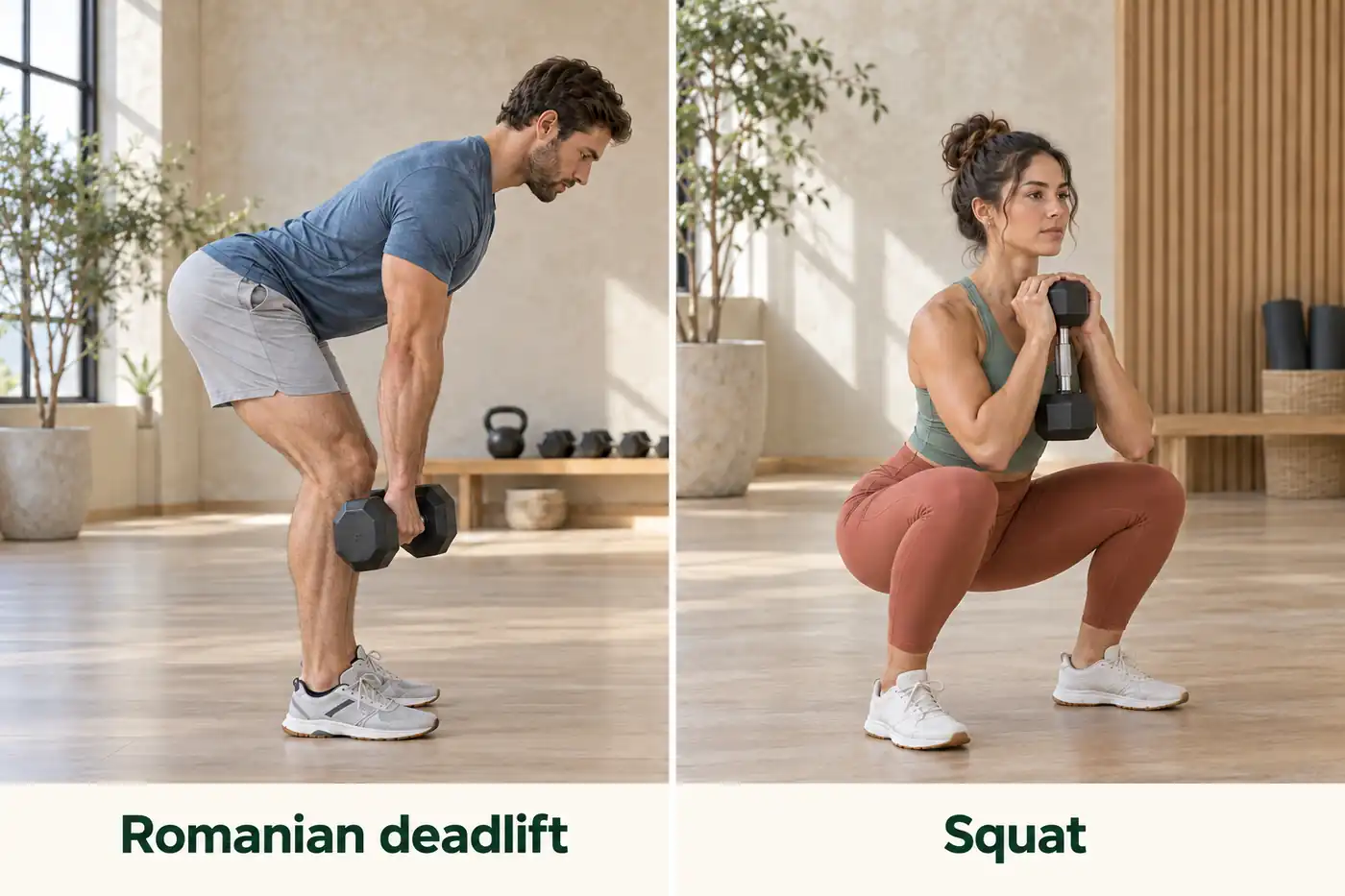
Also called the Romanian deadlift or RDL, this exercise works the glutes and heavily engages the hamstrings through a hip hinge, meaning a movement where the hips shift backward as the torso leans forward. To learn this movement, first practice without weight by pushing your buttocks behind you, as if closing a door, while keeping your knees slightly bent.
With a barbell or two dumbbells in front of your thighs, place your feet approximately hip-width apart, brace your core, and repeat this backward movement of the hips, letting the weight travel close to your legs. Your knees remain unlocked, but they should not bend so much that the lowering phase turns into a squat, and both your back and pelvis stay controlled as tension builds in the backs of your thighs.
Stop lowering when you can no longer push your hips back without changing your back position. This may place the weight below the knees for some people and farther down for others, without requiring you to touch the floor. Return to standing by bringing your hips forward, then stop in an upright position without leaning backward to finish the rep.
Squats for glutes: are they effective?
Squats can certainly build the glutes along with the quadriceps and adductors, as illustrated by a nine-week study in untrained people in which squats and hip thrusts produced similar increases in the size of the glute muscles measured, with greater thigh development from squats. This finding does not make the two movements equivalent in every situation, but it confirms that squats have a place when your goal is to build your glutes.
To get started, you can hold a dumbbell in front of your chest, place your feet in a comfortable position, and lower by bending your hips and knees, keeping your feet firmly planted and your knees generally pointing in the same direction as your toes. Find a depth you can control, then rise without an uncontrolled bounce or a sudden change in torso position, gradually increasing your range of motion if it remains comfortable.
Body proportions, depth, and torso position influence how the work is distributed, and a very wide stance does not guarantee better glute targeting. If an actual limitation in your hips or ankles prevents you from lowering, targeted work on joint mobility can help you use a greater range of motion; our selection of leg exercises also shows how to complement this movement in a lower-body workout.
Glute bridge: a simpler alternative to the hip thrust
With your back on the floor rather than on a bench, the glute bridge uses the same principle of hip extension with a simpler setup and a generally shorter range of motion, making it practical for beginners or home workouts. Lie on your back, bend your knees, and place your feet flat, approximately hip-width apart, then contract your glutes to raise your hips until your shoulders, hips, and knees align, without pressing through your neck or increasing the arch in your lower back.
Lower slowly and, when the sets become easy, add a weight held on your hips or progress to a single-leg variation while avoiding rotation of the pelvis. You can continue progressing with the glute bridge if it suits you, without necessarily having to replace it with a hip thrust.
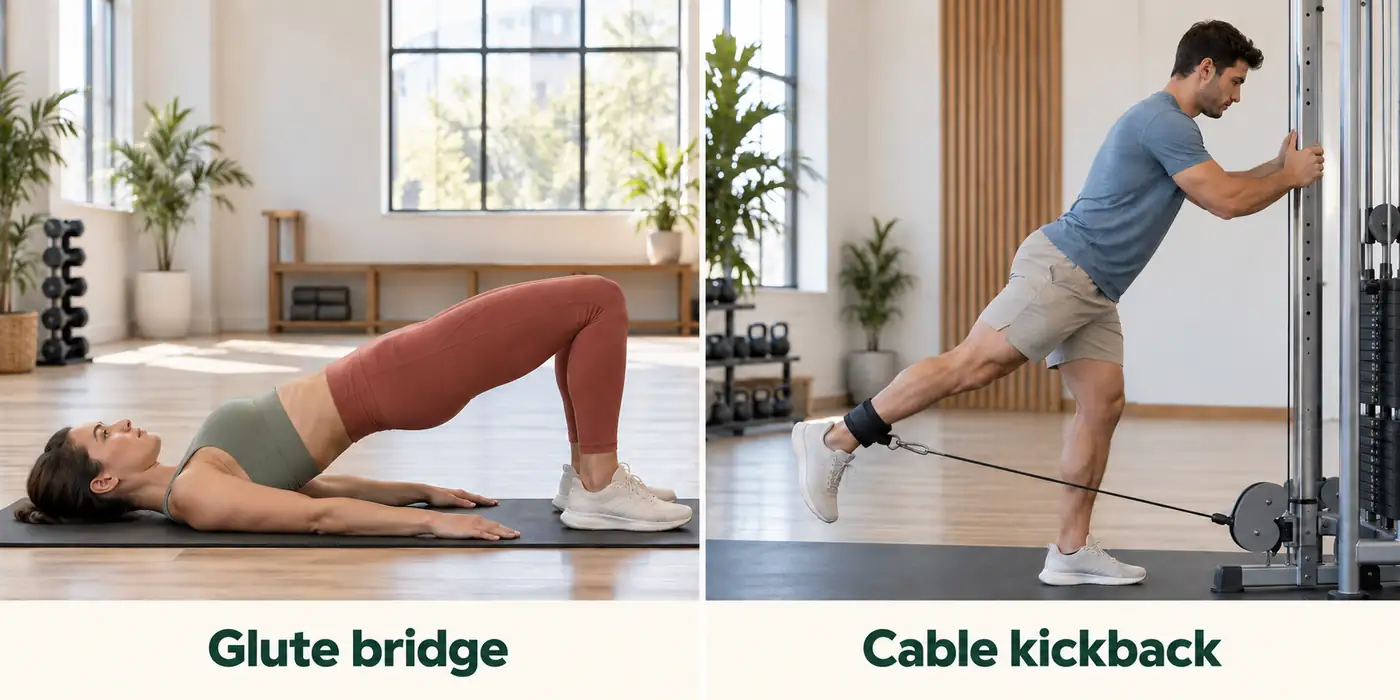
Cable kickback: isolating hip extension more
The glute kickback provides more targeted work by moving your leg backward against resistance from a low cable pulley, with an ankle strap and your hands supported to stabilize your body. Keep your supporting leg slightly bent, lean your torso forward a little if it helps your positioning, and move your thigh backward, then bring it back without letting the weight pull you.
Instead of trying to lift your foot as high as possible, stop the movement as soon as you need to arch your back or rotate your pelvis to continue, and reduce the resistance if you need to swing your whole body. The weight used will generally be much lower than in a squat or hip thrust, but the kilograms shown for these exercises are not comparable and cannot, on their own, tell you how well you are working.
Hip abduction: working the gluteus medius
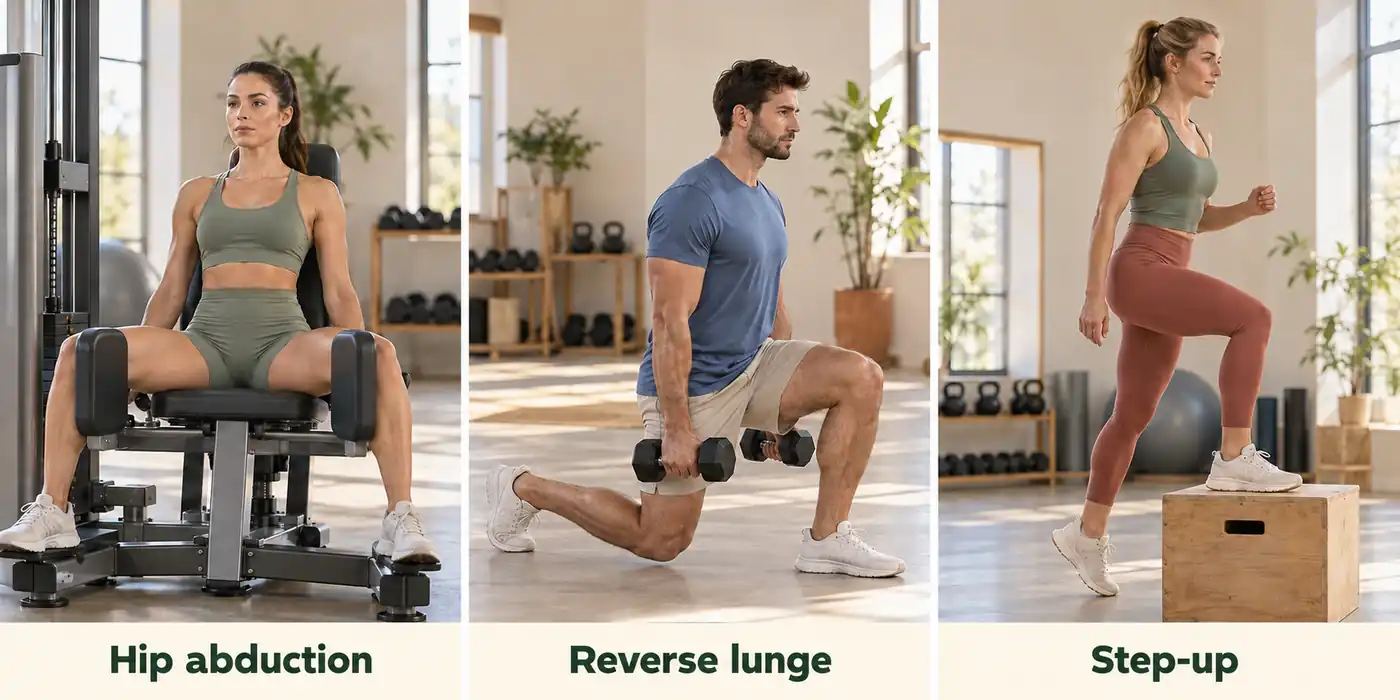
Moving the leg out to the side involves the gluteus medius and gluteus minimus in particular, with their involvement depending on your position and the movement chosen. These hip abduction exercises complement the extension work performed in hip thrusts or Romanian deadlifts by adding another hip function to your training.
On a hip abduction machine, sit in a stable position with the pads against the outsides of your thighs, then spread your legs without jerking and resist as they come back together. Keep your pelvis on the seat, because bouncing or lifting your body to move more weight makes the movement less controlled.
A low cable pulley offers another option: use an ankle strap and keep one hand on a support to move your leg out to the side while keeping your torso relatively still, without hiking your hip to extend the movement. At home, you can use a resistance band, making sure the movement comes from the hips rather than simply rotating your feet.
Developing these muscles does not change the width of your bony pelvis and does not guarantee that the natural indentations on the sides of your hips will disappear.
Lunges and step-ups: two other useful exercises
Lunges work the glutes and thighs one leg at a time, with several variations depending on your comfort level and the space available. In a reverse lunge, step one foot backward, bend both legs, and push primarily through the leg that stayed in front to return to standing, choosing a stride length that allows your hip to flex comfortably; a slight forward lean can accompany the movement and place more emphasis on the glutes. You can then use walking lunges if you can maintain your balance and have enough space.
The step-up involves stepping onto a stable step or box by pushing primarily through the leg placed on it, with that foot resting entirely on the support. Minimize the push from the foot that remains on the floor, control the lowering phase, and choose a height that lets you keep your pelvis under control, rather than a box so high that you need to launch yourself or distort your posture to get up.
Which exercises build glute size and shape?
If you are looking for an exercise to get rounder glutes, keep in mind that training can increase muscle size, but appearance also depends on pelvic anatomy, muscle attachment points, and body fat distribution. Building the gluteus maximus and adding gluteus medius work can therefore change the size of the area without guaranteeing a specific shape.
A combination of hip thrusts, Bulgarian split squats or squats, Romanian deadlifts, and hip abduction lets you vary the training demands, provided you distribute the work according to your ability to recover and keep movements you can progress on. Recovery and nutrition support this work: increasing the number of workouts while sharply reducing food intake can slow progress, and no supplement is essential to start building your glutes.
Glute exercises at home
To do your glute exercises at home, you can start with glute bridges, lunges, and split squats, then add a hip thrust against a firm couch or a bench that will not slide, along with a step-up if you have a stable step designed to support your weight. A resistance band also lets you do hip abduction or kickbacks, with a reliable anchor point when the variation you choose requires one.
The main obstacle arises when body weight is no longer enough to make the sets challenging. You can address this with dumbbells, a securely loaded bag, or a unilateral variation, such as progressing from a two-leg glute bridge to a single-leg glute bridge.
You can also improve control during the lowering phase or increase your range of motion, but these adjustments cannot replace progressive increases in resistance indefinitely. When you finish all your sets with many reps still possible, choose a measurable way to make the exercise harder and keep using it long enough to track your progress.
How should you choose your glute exercises?
Before adding movements, look at those already included in your leg workouts, because squats and Romanian deadlifts also work the glutes and may already account for a substantial part of their training. In that case, a few sets of hip thrusts and hip abduction may add more variety than three additional exercises very similar to what you already do.
To organize a workout that focuses more on the glutes, the following categories provide a selection framework:
- A hip extension movement that is easy to load, such as a hip thrust or glute bridge.
- A movement involving substantial hip flexion, such as a Romanian deadlift or squat.
- A unilateral exercise, such as a Bulgarian split squat, lunge, or step-up.
- Optionally, hip abduction or kickbacks to round out the work.
These categories overlap, since the Bulgarian split squat already combines unilateral work and hip flexion, so they are not four boxes you must check. You can choose hip thrust + Romanian deadlift + Bulgarian split squat + hip abduction, or squat + hip thrust + lunges + kickbacks, then reduce the number of movements if you are a beginner or if the rest of your program already places considerable demands on the lower body.
Sample glute workout
The following workout is intended for someone who already knows how to perform the movements and wants to dedicate a training session to the glutes, with working sets performed after warming up and rep ranges that serve as guidelines for progression.
| Exercise | Sets | Reps | Suggested rest |
|---|---|---|---|
| Hip thrust | 3 | 6 to 12 | 2 to 3 minutes |
| Bulgarian split squat | 3 | 8 to 12 per leg | About 2 minutes before working the same leg again |
| Romanian deadlift | 3 | 8 to 12 | 2 to 3 minutes |
| Machine or cable hip abduction | 2 | 12 to 20 | 1 to 2 minutes |
Combining loaded hip extension, a unilateral exercise, a hip hinge, and hip abduction lets you work the glutes in several situations, but you can adjust the order if fatigue prevents you from maintaining good form. In particular, you can place the Romanian deadlift before the Bulgarian split squat or split them across two days, and take a short break between sides during unilateral exercises when your breathing or balance requires it.
If you are a beginner, choose three exercises with two sets each instead, for example a hip thrust or glute bridge, a split squat with both feet on the floor, and hip abduction. Learn the Romanian deadlift separately with a light weight, then include it once you have mastered the movement, without treating the complete workout as a minimum you must perform from the start.
To prepare for the workout, do a few minutes of light activity and sets with gradually increasing resistance on the loaded movements. On your working sets, start by keeping about two to three reps in reserve, meaning you finish while estimating that you could still perform two or three clean reps, without having to reach failure on every set.
How many times a week should you train your glutes?
Training the glutes twice a week is a practical starting point for many people, whether through lower-body workouts or exercises distributed throughout a more general strength training program. The ACSM recommendations published in 2026 emphasize regular training of the major muscle groups and individualizing the program, rather than using the same structure for everyone.
This does not mean you need to repeat the complete workout above twice, because you can, for example, include hip thrusts and Bulgarian split squats in a first workout, then Romanian deadlifts and hip abduction in a second, accounting for squats and lunges already performed elsewhere in the week.
Start by keeping at least one day without demanding glute work between these workouts, then adjust the spacing and number of sets according to your recovery. Fatigue that still interferes with subsequent movements or performance that declines over several consecutive workouts can justify reducing the work, while even one weekly workout can allow you to progress if it fits your program better.
How can you progress on glute exercises?
By keeping your main exercises for several weeks and recording the weights, reps, and sets you perform, you have benchmarks to see whether your training is actually progressing, provided your range of motion and control remain comparable. An extra rep achieved by substantially shortening the lowering phase or adding momentum does not represent the same progress as a rep performed under your usual conditions.
For a hip thrust programmed for three sets of 8 to 12 reps, you can start with the same weight for 10, 9, and 8 reps, then aim to gradually improve those results until you reach 12 reps on each set with the planned number of reps in reserve. At that point, increase the weight slightly and start again lower in the range, rather than trying to add weight every workout at all costs.
The Bulgarian split squat sometimes first requires better pelvic stability and the same depth on both sides before adding heavier dumbbells is justified. Start with the side that feels less comfortable and use a weight you can control on both sides; during hip abduction, also maintain the same range of motion and resist the urge to speed up your reps to increase the displayed weight.
If you plateau, check your consistency, rest between sets, and recovery before adding volume, because increasing the weight, number of sets, and frequency all at once makes it difficult to know what is improving your training and what is simply increasing fatigue.
Common mistakes in glute exercises
Chasing sensations can take up too much attention when you start training your glutes, especially if you judge the workout solely by the burning sensation you feel. This sensation can accompany effort, but it is not enough to measure muscle development, which is also tracked through progress in weights, reps, and form.
- Limiting yourself to hip abduction or hip thrusts leaves out other ways to work the glutes, whereas a selection of complementary movements lets you vary the positions and functions involved.
- Adding weight at the expense of control often ends up shortening your range of motion or adding momentum, particularly during kickbacks, making performance difficult to compare.
- Looking for one universal position overlooks differences in limb proportions and joint comfort; guidelines should help you adjust your technique rather than impose the same stance width on everyone.
- Changing your entire workout every week reduces the time spent mastering movements and makes it harder to track their progress.
- Expecting a specific shape from a single exercise creates an expectation that training cannot guarantee, since it can build muscle without reshaping the bony pelvis.
Clear or unusual joint pain also requires stopping the movement in question and having the problem assessed if it persists, rather than pushing through to finish the set.
Key takeaways
Hip thrusts, Bulgarian split squats, Romanian deadlifts, squats, and hip abduction place different demands on the body, allowing you to build a workout around your level, equipment, and the rest of your program. Choose a few movements you can master and progress on, giving consistency and recovery as much attention as the difficulty of your sets.
Sources and references
- Plotkin D. L. et al., Hip thrust and back squat training elicit similar gluteus muscle hypertrophy and transfer similarly to the deadlift, Frontiers in Physiology, October 9, 2023. Read the study on PubMed.
- American College of Sports Medicine, ACSM Unveils Landmark 2026 Resistance Training Guidelines, March 17, 2026. Read the official summary.
- Pete McCall, American Council on Exercise, What is the difference between Romanian Deadlift vs Deadlift?, October 5, 2021. Read the technique guide.
FAQ
What is the best exercise for glutes?
Hip thrusts, squats, Bulgarian split squats, and Romanian deadlifts can all contribute to glute development, with different demands that make combining them useful depending on your level, equipment, and the rest of your program.
Is the hip thrust more effective than the squat?
The study by Plotkin and his colleagues observed similar glute development with squats and hip thrusts under the conditions tested, which does not allow a universal winner to be identified. The hip thrust focuses the movement more on hip extension, while the squat also works the thighs considerably.
Which exercises should you choose for the gluteus medius?
Machine, cable, or banded hip abduction lets you train this hip function, while unilateral exercises such as step-ups and Bulgarian split squats also require pelvic stability.
Can you build your glutes at home?
Glute bridges, lunges, and split squats let you get started at home, with resistance bands, dumbbells, or unilateral variations to increase the difficulty when body weight is no longer enough.
How can you build your glutes quickly?
To build your glutes, the most useful approach is to progress consistently on a few movements you have mastered while allowing time to recover, rather than adding exercises every day. Visible changes depend in particular on your starting point and consistency, with no guaranteed timeline in advance.
Hip thrust or glute bridge: what is the difference?
Your upper back rests on a bench during the hip thrust and stays on the floor during the glute bridge, which generally reduces the range of motion of the latter while making the setup easier, especially at home.
How many glute exercises should you do in a workout?
Two to four exercises can be enough depending on the number of sets and the rest of your week, without needing to add four specific movements when your workout already includes squats or lunges.
Related articles
RPE, RIR, and muscle failure: how do you manage effort in strength training?
Learn how to use RPE and reps in reserve to adjust your sets, make progress, and manage muscle failure based on your goal.
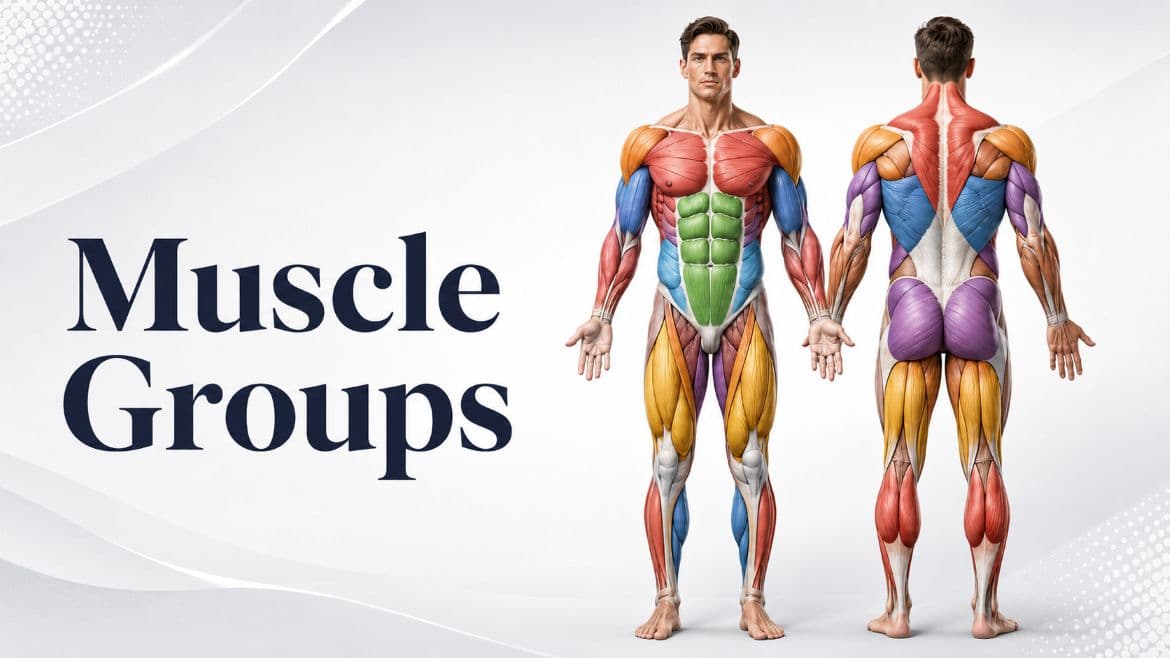
Muscle Groups: Understanding the Main Muscles of the Body to Train Better
A guide to understand the basics of the topic and organize your training more effectively.
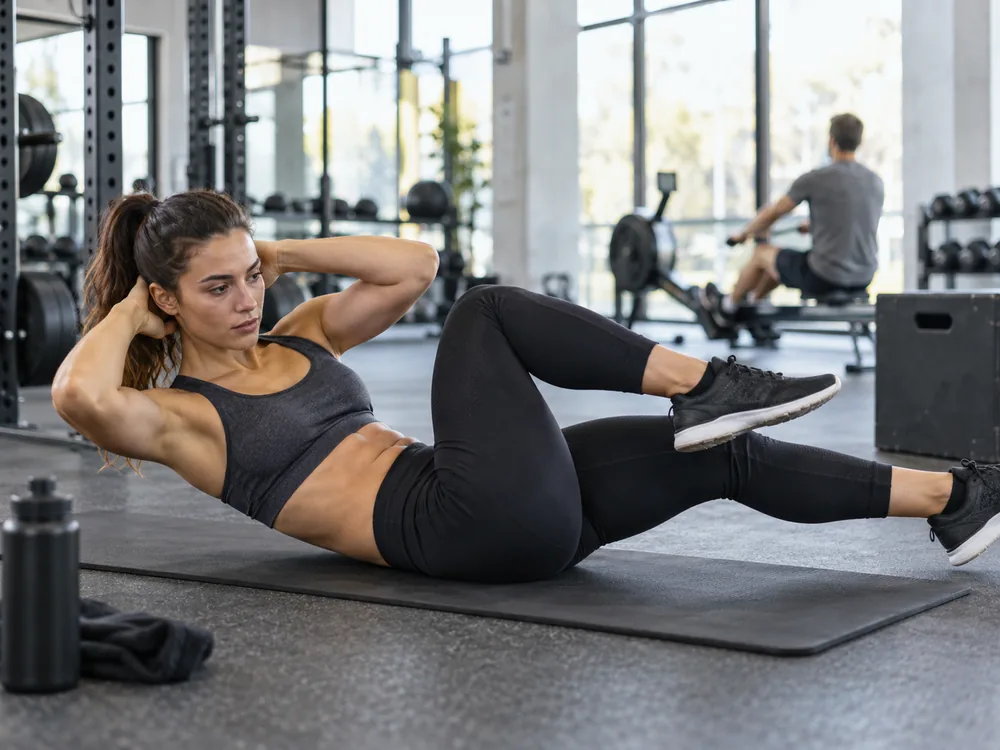
Ab exercises: how can you train your abs effectively?
Discover how to choose and progress with ab exercises: crunch, leg raise, ab roller, obliques, core stability exercises, and a sample workout.