Core Training: Which Exercises Should You Do and How Can You Progress?
Learn how to do core training correctly, which muscles it works, which exercises to choose, and how to progress.
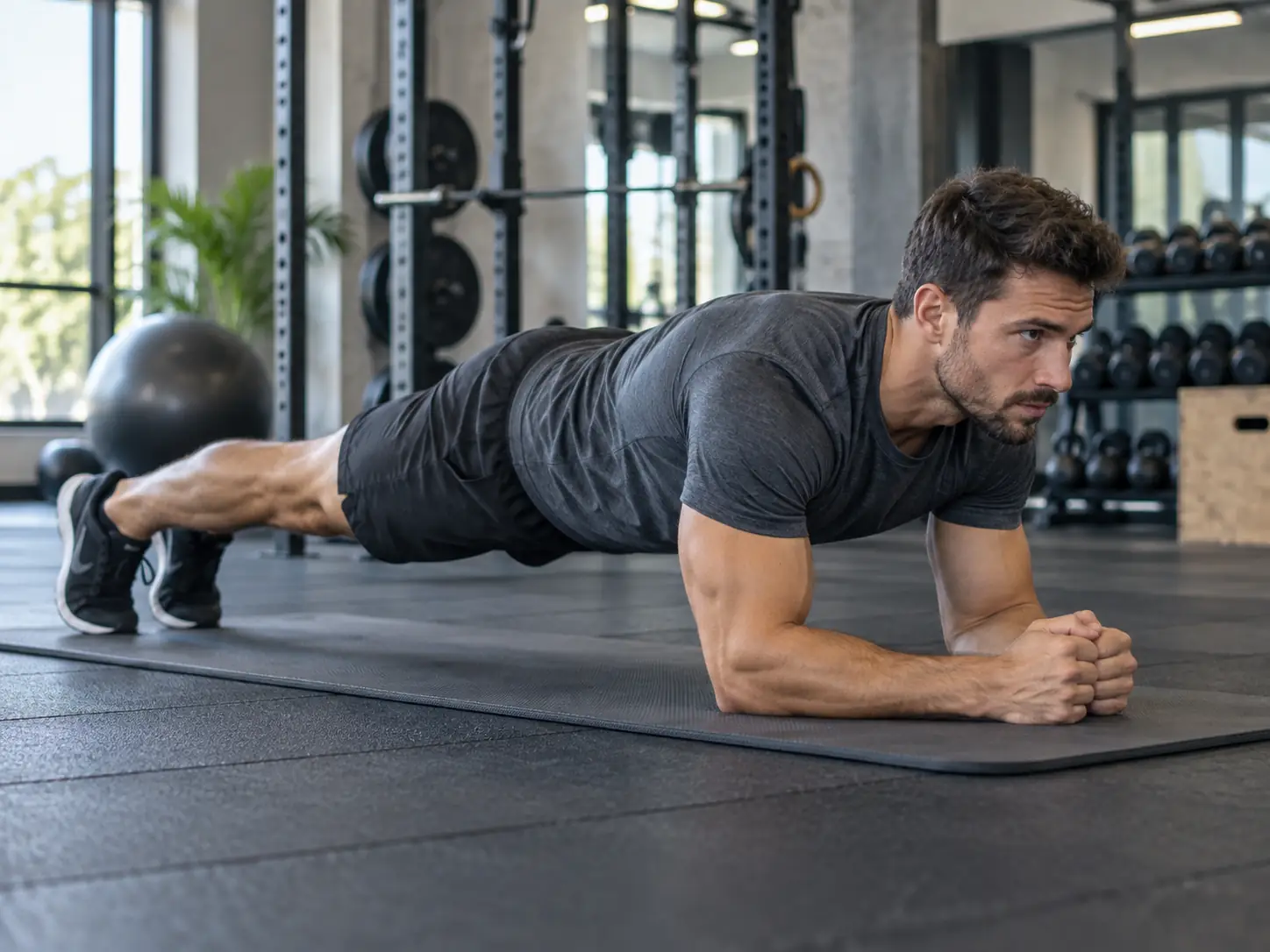
Core training is not simply about holding a plank for as long as possible. It trains the core muscles to maintain a position, resist movement, or stabilize the body during an exercise. Depending on the variation you choose, the demands can be very different.
Standard plank, side plank, dead bug, or Pallof press: these exercises do not engage the core in exactly the same way. To progress, you need to understand what each one trains, choose an appropriate difficulty, and know when to move on to a more demanding variation.
What Is Core Training?
Core training includes exercises in which the core muscles work primarily to control or prevent movement. Unlike a crunch, in which the abs help flex the trunk, a plank primarily requires you to maintain a position despite the forces trying to change it.
Three main functions can be distinguished:
- Anti-extension: preventing the lower back from arching under the effect of a force, as during a plank.
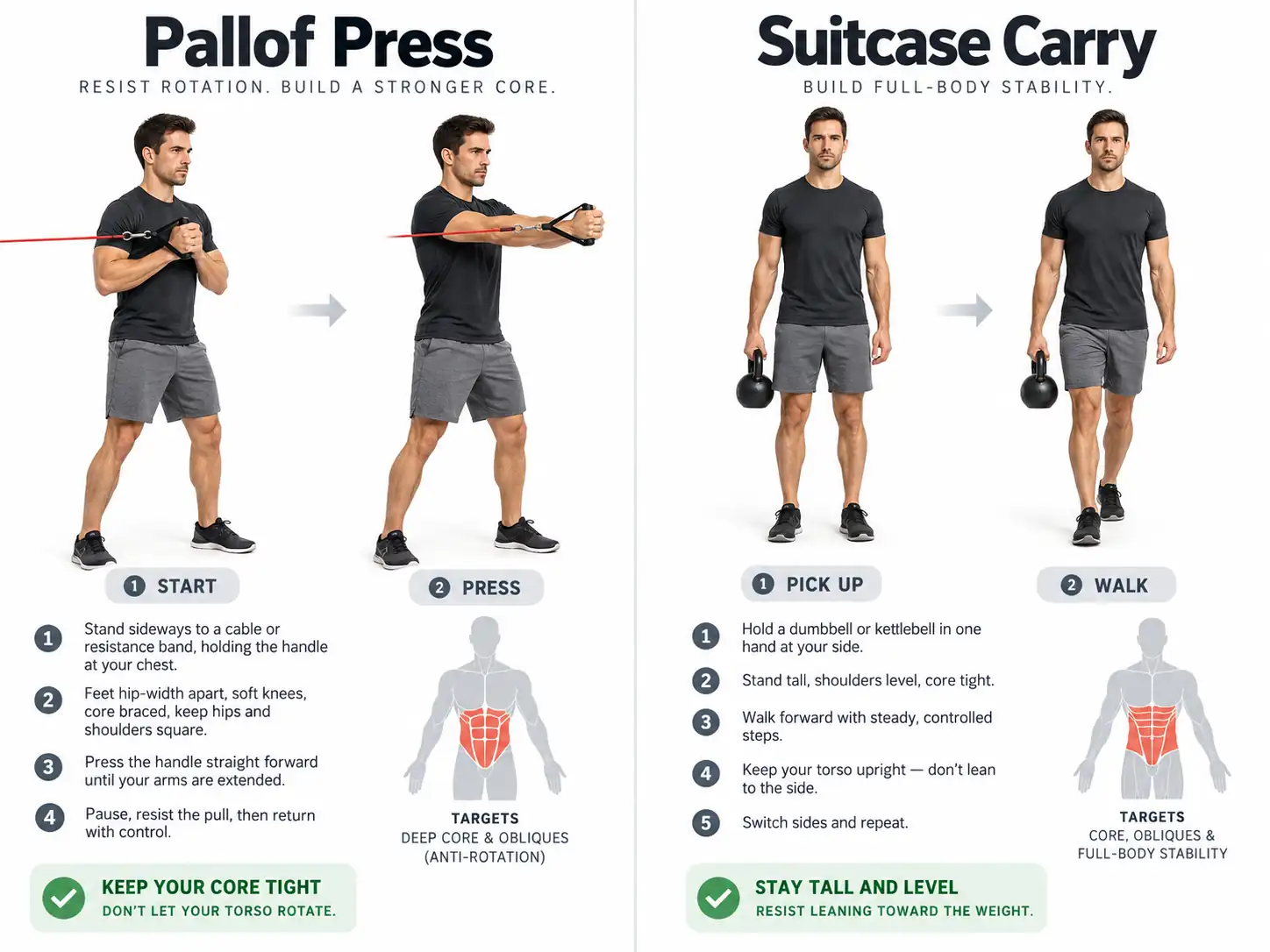
- Anti-rotation: resisting a force that tries to rotate the trunk, as with the Pallof press.
- Anti-lateral flexion: preventing the trunk from leaning to the side, as during a side plank or suitcase carry.
Core training also comes into play in exercises involving movement. During a squat, a row, or a standing military press, the core muscles help control body position while the arms or legs produce the effort. It is therefore not a single exercise, but a way of engaging the muscles that provide core stability.
Which Muscles Does Core Training Work?
Core stability exercises engage several muscles at the same time. Their involvement varies depending on body position, points of support, and the direction of resistance.
The main muscles involved are:
- The rectus abdominis: it helps resist trunk extension in particular.
- The internal and external obliques: they help control rotation and lateral flexion.
- The transverse abdominis: a deep muscle involved in stabilizing the abdominal region.
- The erector spinae and multifidus: they help support and control the spine.
- The glutes: they help stabilize the pelvis in several variations.
- The shoulders and shoulder girdle muscles: they are particularly involved in exercises in which the arms support the body.
The standard plank places substantial demands on the anterior abdominal muscles, while the side plank particularly increases the demand on the muscles that resist lateral trunk flexion. None of these exercises completely isolates a muscle, because even when the goal is to work the transverse abdominis or obliques, several muscle groups work together to maintain the position.
How Do You Perform a Plank Correctly?
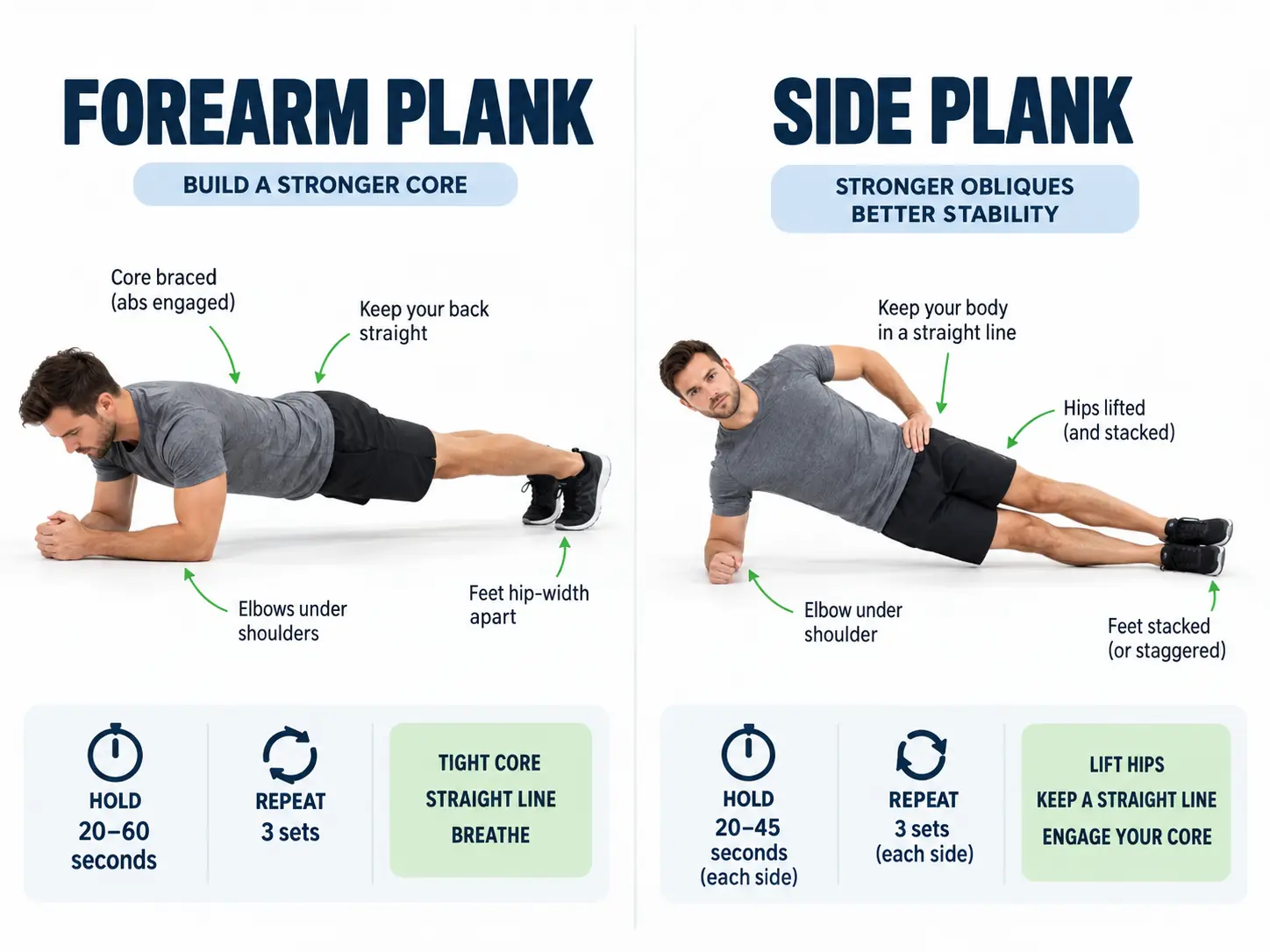
The forearm plank is the best-known core stability exercise and requires no equipment, but its difficulty depends heavily on the position you adopt.
To perform a standard plank:
- Place your forearms on the floor, with your elbows approximately under your shoulders.
- Extend your legs and support yourself on your toes.
- Keep your head, trunk, and pelvis naturally aligned.
- Contract your abs and glutes to control the position of your pelvis.
- Breathe steadily without completely releasing the tension.
- Hold the position for as long as you can control it, then rest.
The most important point is to avoid letting your pelvis sag. As your abs fatigue, your lower back may gradually arch and your initial position may deteriorate. Conversely, raising your hips too high brings your body closer to a V-shaped position and generally makes the exercise easier. There is also no need to excessively round your back or tuck your pelvis under.
A proper plank should remain challenging enough to engage the muscles without forcing you into a posture you can no longer control. Once your alignment consistently deteriorates, it is better to end the set.
Side Plank: What Is It For and How Do You Do It?
The side plank involves holding your body on its side, supported by one forearm and your feet or knees. Its main benefit is training the trunk's ability to resist lateral flexion.
The obliques play an important role, but the back muscles, glutes, and muscles of the supporting shoulder also contribute to stabilization.
To perform a standard side plank:
- Lie on your side with your elbow under your shoulder.
- Extend your legs and support yourself on the edges of your feet.
- Lift your pelvis to align your shoulders, hips, and ankles.
- Keep your torso facing sideways without rotating toward the floor.
- Breathe normally and hold the position, then switch sides.
If this version is too difficult, bend your knees and keep them on the floor. This shortens the lever arm and reduces the demand. Once you have mastered the straight-leg version, you can gradually increase the duration, change your foot position, or use a more demanding variation.
The most common mistakes are letting the pelvis drop, rotating the body forward, or placing the elbow too far from the shoulder. If your shoulder becomes the limiting factor before your core muscles do, check your position and adjust the difficulty.
Dynamic Core Training: How Does It Differ From Static Core Training?
Static core training involves holding a relatively fixed position for a set amount of time. The standard plank, hollow body hold, and side plank are examples. In dynamic core training, the arms, legs, or body move while the trunk must remain controlled. The goal is therefore no longer just to resist forces in a stationary position, but to maintain this stability despite movement.
Several exercises can train this ability:
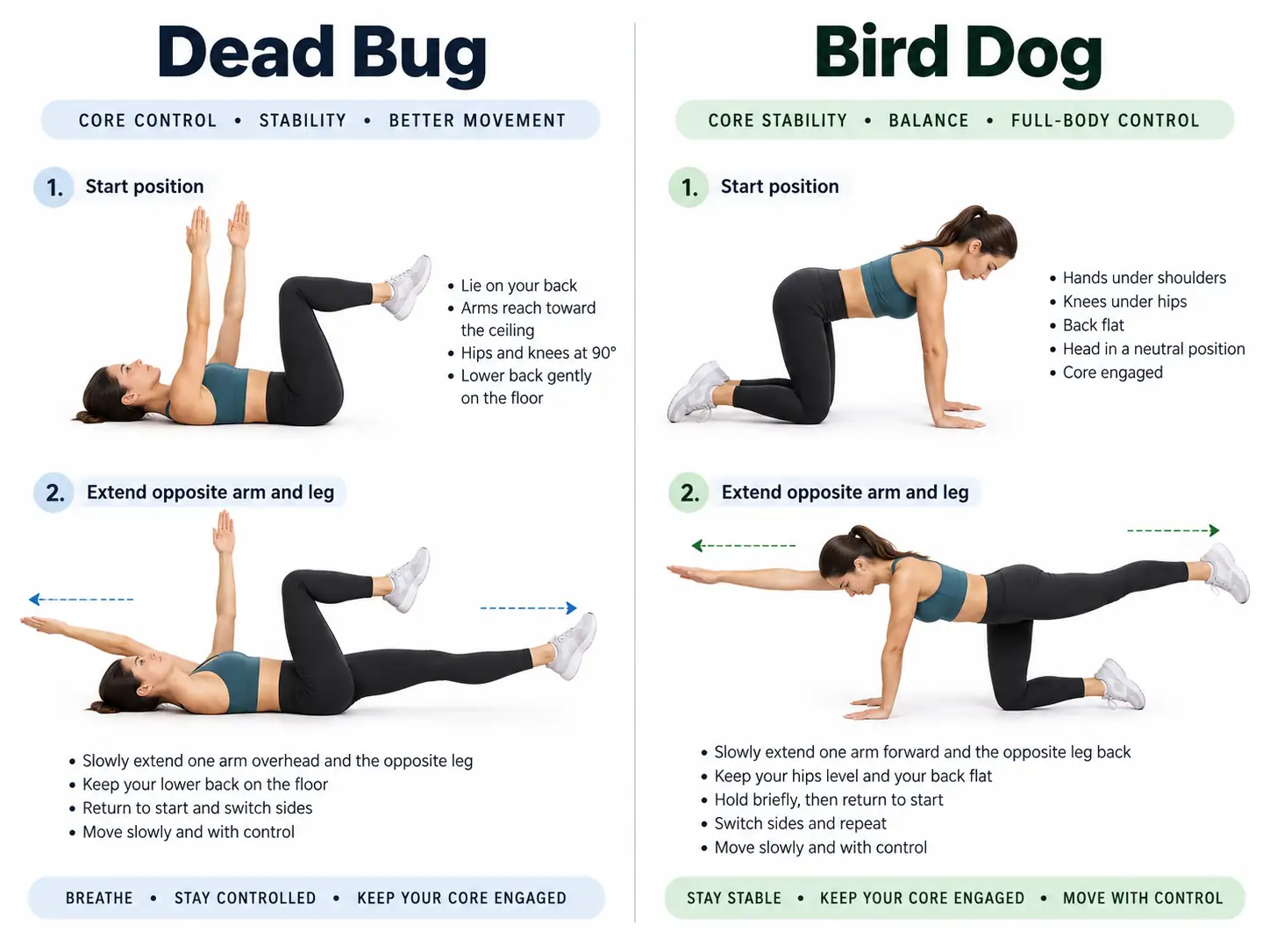
- Dead bug: lying on your back, you alternate moving your limbs while controlling the position of your pelvis and lower back.
- Bird dog: on all fours, you extend one arm and the opposite leg without letting your pelvis rotate.
- Plank shoulder taps: in a straight-arm plank position, you alternate touching the opposite shoulder while limiting trunk rotation.
- Controlled mountain climber: you alternate bringing your knees toward your chest without losing your pelvic position.
These movements are not interchangeable. The dead bug exercise trains core control while lying down, whereas plank shoulder taps add substantial demands on the shoulders and resistance to rotation.
Dynamic core training does not necessarily mean moving quickly. A slow execution often makes it easier to control the movement and identify compensations.
Which Core Stability Exercises Should You Choose?
The choice depends primarily on the function you want to train. Doing many plank variations is not necessarily as beneficial as selecting a few exercises with complementary demands.
| Target function | Suitable exercises |
|---|---|
| Resisting extension | Plank, hollow body hold, dead bug |
| Resisting rotation | Pallof press, controlled plank shoulder taps |
| Resisting lateral flexion | Side plank, suitcase carry |
| Controlling the trunk during movement | Bird dog, dead bug, controlled mountain climber |
The Plank and Hollow Body Hold for Anti-Extension
In a plank, the trunk must resist the pelvis's tendency to drop. The hollow body hold presents a different demand: lying on your back, you keep your shoulders and legs off the floor while controlling your lower back position. The straighter your legs and the closer they are to the floor, the more demanding the hollow body hold generally becomes. Bending your knees makes it easier.
The Pallof Press for Anti-Rotation
The Pallof press is performed with a resistance band or cable positioned to the side of the body. By holding the handle in front of your chest and then extending your arms, you increase the lever arm of the resistance. The core muscles must prevent your torso from rotating toward the anchor point. You can progress by increasing the resistance, moving your hands farther away from your torso, or changing your support position.
The Suitcase Carry for Anti-Lateral Flexion
The suitcase carry involves walking while holding a weight in just one hand, like a suitcase. The weight tries to tilt the body toward the loaded side. The core muscles must resist this force to maintain a relatively upright position.
Unlike the side plank, this exercise combines core stabilization, walking, and holding a weight. The difficulty depends on the weight used, the distance covered, and your ability to walk without leaning.
The Dead Bug and Bird Dog for Dynamic Control
These exercises are particularly useful for learning to separate limb movements from trunk movements.
In the dead bug exercise, the goal is to move your arms and legs without losing control of your pelvis. In the bird dog exercise, you need to avoid rotation and excessive spinal movement while extending one arm and the opposite leg.
Both exercises are easy to adapt, whether you are getting started or supplementing a strength training session.
Core Stability Training for Abs: Is It Different From Ab Exercises?
Core stability training works the abs, but it does not engage these muscles in the same way as a crunch or certain leg raises. In a crunch, the rectus abdominis helps flex the spine, whereas in a plank, the abs contract primarily to prevent the trunk from extending.
The two types of training can complement each other. Dynamic exercises develop the ability to produce movement against resistance, while stabilization exercises train the ability to resist a force. To build a more complete ab workout, you can combine core stability training with other ab exercises, choosing movements based on your goals and the equipment available.
You also need to distinguish between strengthening your abs and losing fat. Core stability training for your stomach can strengthen the muscles in that area, but it does not let you choose where your body loses fat. The only way to lose fat is through a calorie deficit and nothing else..
Core Stability Training for the Back and Lower Back: Is It Useful?
The abdominal muscles and the muscles around the spine work together to stabilize the trunk, so core stability training is not limited to the front of the abdomen.
In an exercise such as the bird dog, the back muscles help support the spine while one arm and the opposite leg move. The side plank also engages the muscles along the sides of the trunk, while the suitcase carry requires you to resist an asymmetrical load.
These exercises can develop core muscular endurance and control, two abilities that are useful in many strength training movements. However, core stability training for the lower back is not a universal treatment for back pain. Pain can have different causes, and suitable exercises are not necessarily the same for everyone.
If you have pain that is persistent, unusual, or aggravated by certain movements, an assessment by a healthcare professional is preferable before continuing or intensifying your training.
Core Exercises for Beginners: Which Exercises Should You Start With?
When getting started, it is better to choose a relatively simple exercise and learn to control your position before increasing the difficulty.
One possible progression is to start with:
- Incline plank: hands or forearms on a stable elevated surface to reduce the demand.
- Knee plank: the same principle as a standard plank, but with a shorter lever arm.
- Simplified dead bug: move one leg at a time while keeping the other bent.
- Bird dog: extend an arm or a leg separately before coordinating both.
- Kneeling side plank: learn to hold your pelvis in position without immediately supporting your body weight on your feet.
You do not need to master all of these exercises before moving on to a standard plank. Some beginners can start directly with short sets on their forearms.
The right level is one that allows you to perform several clean repetitions or sets with a noticeable challenge, without consistently losing the intended position.
How Long Should You Hold Core Stability Exercises?
There is no ideal duration that applies to every exercise and every person. For a standard plank, 20 to 45 seconds can already make a useful set if the variation is challenging enough. A beginner can start with sets of 10 to 20 seconds, while a more advanced trainee can use a more difficult position.
The duration should match the quality of your form. Holding for 30 seconds with good control can be more appropriate than holding for a minute in a gradually deteriorating position.
If you can easily hold a plank for several minutes, continuing to increase the time is not necessarily the best way to progress. A more demanding variation can increase the muscular demand while keeping sets relatively short. The choice also depends on your goal: building endurance in a specific position may justify longer holds, while strength work may favor greater difficulty.
How Do You Progress in Core Training?
You can progress in different ways. Increasing the hold time is the simplest option, but it is not the only one.
Gradually Increase the Duration
If you can hold the position correctly for 20 seconds, you can aim for 25 or 30 seconds in subsequent sessions.
The increase should remain reasonable so that you maintain the same quality of form. Once the duration feels easy, it may be better to change the difficulty rather than systematically add time.
Move On to a More Difficult Variation
Here are two examples of progression:
Plank:
- Incline plank
- Knee plank
- Standard plank
- Long lever plank
Side plank:
- Supported on the knees
- Legs extended
- Variation with an increased lever arm or additional weight
Each step changes the mechanical demands, so you need to check that the new variation remains controllable before increasing the volume.
Change Your Points of Support
Plank shoulder taps illustrate this method: temporarily lifting one hand off the floor forces the trunk to resist more rotation. The movement should remain slow enough to prevent your pelvis from swaying excessively from side to side.
Gradually Add Resistance
For a Pallof press, you can use a stronger resistance band or increase the cable weight. For the suitcase carry, you can progress by using a heavier weight or covering a greater distance, provided you maintain controlled walking.
You do not need to change every variable at the same time. Increasing just one element makes it easier to track progress and identify what becomes too difficult.
How Many Times a Week Should You Do Core Training?
For many people, two to three core training sessions per week are a reasonable starting point.
However, this frequency is not a requirement. It depends on the difficulty of the exercises, the number of sets, and the rest of your training.
Someone who does several strength training sessions with squats, deadlifts, standing exercises, or loaded carries already engages their core muscles regularly.
In that case, a few specific sets can complement the existing work without necessarily adding a long session dedicated solely to the abs.
Conversely, if your strength training program does little to engage the core, or if you want to improve at a specific exercise, you can devote more work to it.
Should You Do Core Training Every Day?
No, you do not need to do core training every day to progress.
Daily practice may be an option with easy exercises, low volume, and sufficient recovery. For example, a few controlled dead bug repetitions do not cause the same fatigue as several challenging sets of planks or heavy carries.
You therefore need to distinguish between short technique sessions and demanding workouts. If you perform challenging sets, it is generally more beneficial to allow adequate recovery and assess your progress over several weeks than to accumulate daily work without a clear goal.
Sample Core Workout
Here is a simple program that combines several core functions. It can be used alongside a strength training session or as a short standalone session.
| Exercise | Sets | Duration or repetitions |
|---|---|---|
| Standard plank | 3 | 20 to 40 seconds |
| Side plank | 2 per side | 20 to 30 seconds |
| Dead bug | 3 | 8 to 12 repetitions per side |
| Pallof press | 2 per side | 8 to 12 repetitions |
Allow about 30 to 60 seconds of rest between sets, or more if needed to regain good form. These numbers are practical guidelines to adjust, not universal durations.
The plank primarily trains resistance to extension, the side plank adds a lateral flexion demand, the dead bug trains control during movement, and the Pallof press rounds out the session with resistance to rotation.
You do not need to perform all four exercises in every session. Two or three well-chosen movements can be enough, particularly if you already follow a complete strength training routine. To progress, keep the same exercises for several sessions and gradually increase the difficulty when the sets become easy.
Common Core Training Mistakes
Several habits can limit the benefits of training:
- Focusing only on holding for a long time: duration alone does not tell you how challenging an exercise is for the muscles or how well it is performed.
- Letting your pelvis sag: the intended position is no longer maintained.
- Raising your hips too high: this can reduce the demand on the abs during a standard plank.
- Holding your breath: it is better to maintain controlled breathing during prolonged holds.
- Choosing a variation that is too easy: when an exercise is no longer challenging, you may need to progress it.
- Moving on to a difficult variation too quickly: greater resistance is not useful if it prevents you from controlling the movement.
- Using shaking as an indicator of effectiveness: it may occur during exertion, but it does not prove that an exercise is being performed better.
- Always repeating the same exercise: a plank does not cover every core function.
- Continuing despite unusual pain: you need to stop the exercise and investigate the cause of the pain.
The best practical indicator remains your ability to perform an exercise with good control, then gradually increase the demand without compromising your form.
Key Takeaways
Core training is not limited to the plank. It includes different exercises that allow the trunk to resist extension, rotation, or lateral flexion, sometimes while the arms and legs are moving.
To progress, choose a few complementary exercises, master their execution, and gradually increase the difficulty. You do not need to hold for several minutes or train every day: consistency and progression suited to your program matter more than accumulating hold time.
Sources and References
These references document the principles of muscle strengthening, core functions, and precautions regarding back pain. The durations and sets suggested in this article are practical examples to adapt, not universal prescriptions.
- Currier B. S. et al. (2026) — American College of Sports Medicine Position Stand: Resistance Training Prescription for Muscle Function, Hypertrophy, and Physical Performance in Healthy Adults. Medicine & Science in Sports & Exercise.
- National Strength and Conditioning Association (2015) — Foundations of Fitness Programming, Core Training section.
- O’Toole K. (2020) — Implementing Core Training Concepts into Strength Training for Sport. NSCA Coach.
- Verville L. et al. (2023) — Systematic Review to Inform a WHO Clinical Practice Guideline: Benefits and Harms of Structured Exercise Programs for Chronic Primary Low Back Pain in Adults. Journal of Occupational Rehabilitation.
FAQ
What Is Core Training?
Core training includes exercises that engage the core muscles to maintain a position or resist movement.
Which Muscles Does Core Training Work?
It primarily engages the abs, obliques, and back muscles. The glutes and shoulders are also involved, depending on the exercise.
How Long Should You Hold Core Stability Exercises?
A set of 20 to 45 seconds may be enough with an appropriate variation. The duration should allow you to maintain good positioning.
Is It Useful to Do Core Training Every Day?
It is not essential. Two to three sessions per week can be a good starting point, depending on the rest of your training.
What Is the Best Core Stability Exercise?
There is no universally best exercise. The plank, side plank, and Pallof press train complementary functions.
How Do You Perform a Plank Correctly?
Place your elbows under your shoulders, keep your body aligned, control your pelvis, and breathe steadily without letting your lower back arch.
Does Core Training Work the Abs?
Yes. The abdominal muscles help support the trunk and resist the forces that try to change its position.
What Is the Difference Between Static and Dynamic Core Training?
Static core training involves holding a position. Dynamic core training adds movement of the limbs or body while maintaining control of the trunk.
Is Core Training Good for Your Back?
It trains the muscles that help stabilize the spine, but it is not a universal treatment for back pain.
How Do You Progress in Core Training?
You can increase the duration, choose a more demanding variation, change your points of support, or gradually add resistance.
Related articles
RPE, RIR, and muscle failure: how do you manage effort in strength training?
Learn how to use RPE and reps in reserve to adjust your sets, make progress, and manage muscle failure based on your goal.
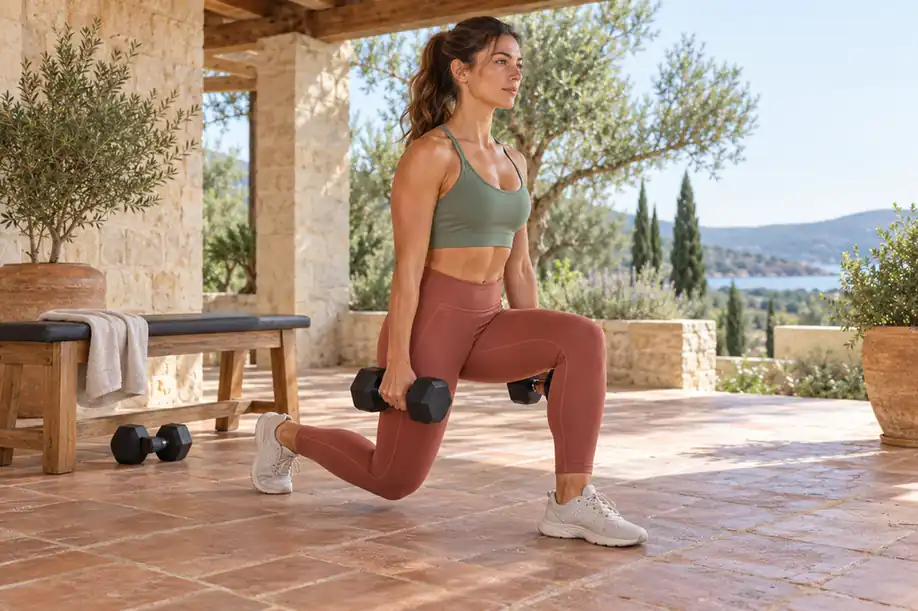
Glute exercises: which movements should you choose to build them effectively?
Hip thrusts, squats, lunges, Romanian deadlifts, and hip abduction: learn how to choose your glute exercises, perform them, and progress.
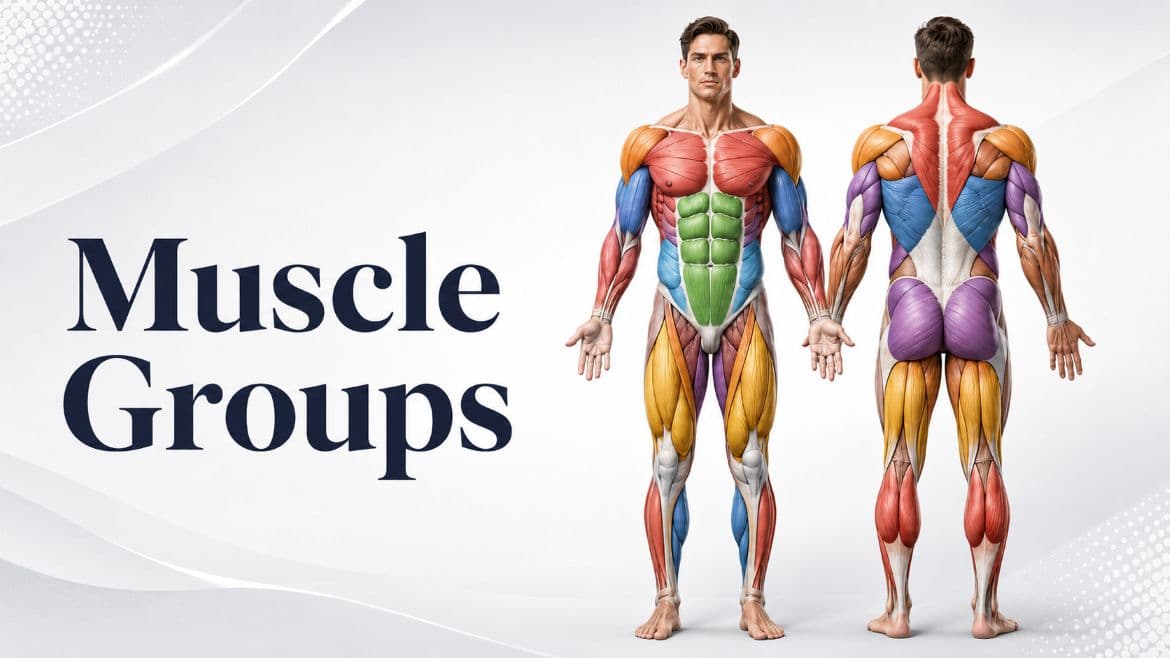
Muscle Groups: Understanding the Main Muscles of the Body to Train Better
A guide to understand the basics of the topic and organize your training more effectively.