Creatine: how to use it effectively for bodybuilding
Discover the effects of creatine for bodybuilding, the right dosage, when to take it, which form to choose, and the precautions to know.
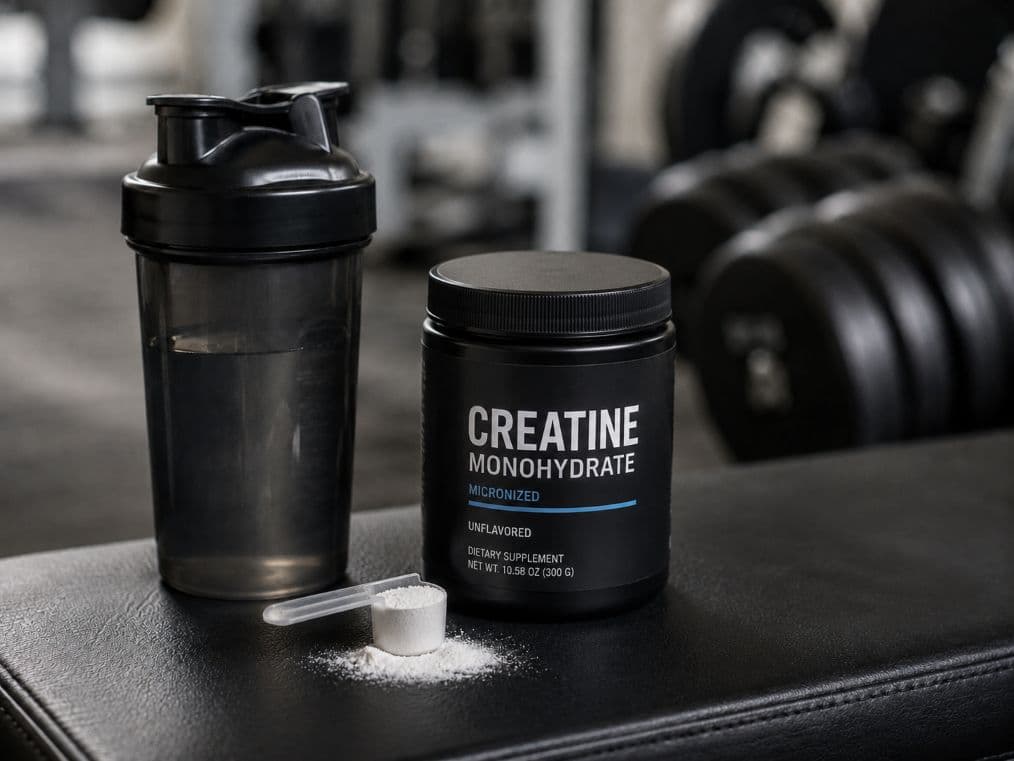
What exactly is creatine?
Creatine is a substance naturally found in the body, mainly in the muscles. It is also supplied through food, especially meat and fish, and the body can make some of it itself from certain amino acids. In muscle, some of this creatine is stored as phosphocreatine, a reserve used to help rapidly regenerate ATP, which serves as immediate fuel during short, explosive, or very intense efforts, such as a heavy set, a sprint, or repeated effort with little recovery.
This is why creatine is so popular among people who lift weights. It does not act like a stimulant that you feel directly during a workout, but rather as ongoing support by gradually increasing the reserves available in the muscles when it is taken regularly.
The benefits of creatine for bodybuilding
In bodybuilding, creatine is useful because many exercises rely on short, intense efforts, whether it is a heavy bench press, squat, deadlift, leg press, row, or even a longer set taken close to failure. When immediate energy reserves drop during a difficult set, performance can fall quickly. Creatine does not eliminate this fatigue, but it can help support this type of effort better, which can mean one more repetition, maintaining a load better, or a better ability to repeat quality sets.
This is where its purpose needs to be clearly understood: creatine does not build muscle on its own. It can simply help you train better, and if that training is well organized, progressive, and supported by proper nutrition, this better quality of work can contribute to more consistent progress. It is therefore especially useful for people who train seriously, who want to improve their performance, and who already have a solid foundation, because if the bodybuilding program is poorly designed, if the loads never increase, or if nutrition is inadequate, creatine will not make up for those mistakes.
The International Society of Sports Nutrition considers creatine monohydrate one of the most effective supplements for improving high-intensity exercise capacity and supporting gains in lean mass during training, which explains why it often appears in bodybuilding recommendations.
Expected effects of creatine
The most realistic effects mainly concern strength, power, the ability to repeat intense efforts, and training volume, because creatine is involved in the energy system used for short and explosive efforts. During a heavy set or very intense effort, the muscle quickly uses its ATP, which provides immediate energy for muscle contraction, and phosphocreatine helps regenerate that ATP quickly. The problem is that phosphocreatine reserves drop quickly during this type of effort, which contributes to the loss of strength as repetitions go on. The benefit of creatine is therefore to increase the reserves available in the muscle to better support these short, intense, or repeated efforts.
In practice, this can mean a better ability to maintain a load across several sets, gradually add repetitions on certain exercises, or maintain better quality work when the workout becomes difficult. This does not mean that every workout will become easy or that your weights will suddenly skyrocket overnight. Rather, it means that over several weeks, some people are able to sustain their progress better, handle demanding workouts better, and maintain better quality on important exercises.
Creatine can also cause the number on the scale to rise slightly, especially at first, because it can increase the amount of water stored in the muscles. This can be surprising when you are monitoring your weight, but this increase does not automatically mean fat gain. Two opposite mistakes should therefore be avoided. The first would be believing that creatine is a magic product that builds muscle without effort. The second would be thinking that it is useless because you do not feel an immediate effect like you do with caffeine or certain pre-workouts. Its value should instead be judged over time by looking at whether performance improves more, whether heavy sets are maintained better, whether training volume remains more stable, and whether everything fits well into a consistent routine.

How much creatine should you take per day?
The simplest dosage is to take about 3 to 5 g of creatine per day, which remains the most practical method for most people who train, although some people prefer to base it on body weight using a commonly used reference of around 0,03 g per kilogram of body weight per day, or for example about 2,4 g for a person weighing 80 kg. In real life, a fixed dose of 3 to 5 g per day is often easier to follow because it avoids unnecessary calculations and makes it possible to maintain a consistent routine, especially for someone who simply wants to use creatine correctly without complicating their program.
Taking more than this dose is not necessarily more beneficial, because once muscle stores are well saturated, greatly increasing the amount does not mean the effects will be proportionally better. However, it can increase the risk of digestive discomfort in some people. The most important point is consistency, because creatine works through gradual accumulation in the muscles. It is therefore better to take a small dose every day for several weeks than to take it only occasionally before a big workout.
Someone who forgets a dose from time to time does not need to panic. Simply resume as usual the next day. The goal is not to be perfect down to the gram, but to maintain a sufficiently regular habit so that stores remain elevated.
The loading phase
The loading phase consists of taking a higher dose for a few days, often around 20 g per day divided into several doses, then switching to a lower maintenance dose. This method is mainly used to saturate muscle stores more quickly.
It is not mandatory, because you can also start directly with 3 to 5 g per day. Stores then rise more gradually, using a method that is simpler, more comfortable, and often easier to maintain. For most people who train, the standard daily dose is more than sufficient. The loading phase can be useful if you want to go faster, but it is not essential and may cause digestive discomfort more easily in some people.
Taking creatine every day
Creatine can be taken very simply, mixed into water, in a shaker, with a beverage, or directly with a meal. It does not need to be paired with a specific product or taken at a special time. The main thing is to choose a method that is easy to repeat every day. With powder, you simply need to follow the intended dose and mix it properly, while with capsules, the main thing is to check how many capsules are needed to reach the desired dose, because some formulas require several capsules to provide 3 or 5 g of creatine.
You can drink coffee when taking creatine, contrary to common misconceptions, but it is not necessarily useful to take them together because the data on combining creatine and caffeine are mixed. This caution mainly comes from certain studies in which caffeine, taken in high doses and repeatedly during a creatine loading phase, appeared to reduce some of the expected benefits, without allowing us to say that a cup of coffee during the day cancels out the effects of creatine. To keep things simple, you can take your creatine with a meal, in a shaker, or with water, and have your coffee at another time of day if you already drink it.
Powder is often more economical and more practical if you already use a shaker, while capsules can be useful for travel, for avoiding the taste, or for people who prefer to swallow a supplement without mixing it into a beverage. It is not necessary to take it with fast-digesting sugar, juice, or a special beverage for it to work, although taking it with a meal can simply help fit it into your day more easily and reduce the chance of forgetting it.
When should you take creatine?
The exact timing matters less than consistency, so creatine can be taken after a workout, with a meal, at breakfast, in a shaker, or at another convenient time, as long as that time is easy to maintain over the long term. Many people who train like to take creatine after a workout, not because this is necessarily the only right time, but because it is easy to include in a post-workout routine, especially when they already have a meal or a shake after lifting weights. Others prefer to take it in the morning or with a regular meal, and this approach works too, because creatine does not depend on a window immediately after training. It mainly works over time, as muscle stores gradually increase.
On rest days, it also makes sense to take it because its benefit is based on accumulation in the muscles and not only on that day's workout, which means consistency matters more than taking it only on training days. The question of “before or after a workout” should therefore remain simple: both are possible, but because creatine is not an immediate stimulant, it is better to choose the most convenient time rather than look for perfect timing that you will not maintain.
Which creatine should you choose?
Creatine monohydrate is generally the most logical choice because it is the most studied form, the most widely used, the easiest to find, and often the least expensive, making it sufficient for the vast majority of people who train. Creapure is a registered trademark used as a quality label for creatine monohydrate produced by Alzchem in Germany. It can be useful if you are looking for a product with clear traceability, but it is not a different form of creatine, since it is still creatine monohydrate.
More complex formulas are not automatically better, especially when they combine several ingredients to justify a higher price, while a simple, properly dosed, clearly labeled creatine monohydrate is often more than sufficient. For a first purchase, the simplest choice is therefore a powdered creatine monohydrate with a short ingredient list, a dose that is easy to measure, and no unnecessary blend.

Creatine when bulking and cutting
When bulking, creatine has a fairly logical place because the goal is often to progress with weights, repetitions, and training volume. It can therefore help support intense efforts better, provided that the calorie surplus, protein intake, and recovery are already well managed. It does not replace nutrition, because even with creatine, you still need to eat enough, train with real progression, and recover sufficiently to build muscle. Otherwise, the supplement is simply being added to a foundation that does not work.
When cutting, creatine can also be kept in, even though some people think they need to stop taking it to look leaner, because during a calorie deficit, maintaining good training performance can help preserve as much muscle as possible. The slight water retention associated with creatine can change body weight or appearance a little in some people, but it does not prevent fat loss if the calorie deficit is properly in place. A variation in water within the muscle must therefore be distinguished from actual fat gain.
Is creatine dangerous?
In healthy people, creatine used at standard doses is generally considered safe and well tolerated, with a large amount of data available on creatine monohydrate, which explains why it is often presented as one of the most studied supplements in sports nutrition. The confusion often comes from the connection between creatine, creatinine, and the kidneys, because creatinine is a marker found in blood tests to estimate kidney function, and some people conclude from this that taking creatine necessarily damages the kidneys, even though that interpretation is too quick.
Creatinine is a breakdown product of creatine, so someone who takes creatine may sometimes have slightly higher blood creatinine, especially if they are muscular, train a lot, or also consume a lot of protein. This can make a blood test more difficult to interpret and sometimes artificially lower the estimated GFR, also called eGFR, without automatically meaning that the kidneys are functioning less well. In someone without a known health problem, the available data do not show that creatine taken at standard doses damages the kidneys. However, for someone who already has kidney disease, an already low GFR, a known abnormality, a particular treatment, or medical monitoring, caution is necessary and advice from a healthcare professional remains essential.
It is also a good idea to mention creatine use before a blood test, especially when kidney function is being monitored, because the doctor will then be able to interpret the results with more context instead of looking only at creatinine or estimated GFR without knowing that a creatine supplement is being used. The overall context must also be taken into account, because someone who takes many supplements, is poorly hydrated, follows an extreme diet, or already has abnormal medical markers should not reason in the same way as a healthy person who simply takes 3 to 5 g of creatine monohydrate per day.
The appropriate message is therefore nuanced: creatine should not be presented as dangerous for everyone, but it should not be presented as suitable for absolutely every situation without consideration either, especially when there is a medical concern. Product quality also matters because, as with all supplements, it is better to choose a simple, clearly labeled formula from a reputable brand without exaggerated promises rather than an opaque blend that adds many ingredients without a clear benefit
Creatine, weight gain, water retention, and hair
Creatine can cause the number on the scale to rise slightly, especially at first, because it can increase the amount of water stored in the muscles, but this does not mean that it causes weight gain in the sense of fat gain. This distinction is important because someone who is cutting may panic when they see their weight rise even though their calorie deficit is still in place, just as someone who is bulking may think they are gaining muscle quickly when part of the change simply comes from intramuscular water. It is therefore better not to judge creatine based only on a few days of scale readings, but to look at changes over several weeks, along with performance, measurements, photos, overall appearance, and nutritional context.
As for hair loss, the topic comes up often because of a hypothesis involving DHT, a hormone involved in hair loss in people who are predisposed to it, but to date, a direct link between creatine and hair loss has not been clearly demonstrated. Someone who is very concerned about this issue, or who already has significant alopecia, can of course seek medical advice. The most accurate approach is not to present hair loss as an established effect of creatine.
Common mistakes with creatine
The first mistake is believing that creatine works like an immediate booster when it is not a stimulant. The second is taking far too much in the belief that it will speed up results, even though a simple dose of 3 to 5 g per day is often enough. The third is stopping after a few days because you do not feel anything, even though its benefits should mainly be assessed over several weeks.
You should also avoid confusing weight gain with fat gain, choosing a complicated formula when simple creatine monohydrate is enough, or relying on the supplement to compensate for a poorly designed program, inadequate nutrition, or insufficient recovery.
Key takeaways
Creatine is a useful supplement for bodybuilding, especially for short, intense, and repeated efforts. It can help support strength, training volume, and progress, provided that training, nutrition, and recovery are already consistent.
The simplest approach is to take 3 to 5 g of creatine monohydrate per day at a time that is easy to maintain, including on rest days, without unnecessarily complicating the timing or form of the product.
FAQ
What is creatine used for?
Creatine helps the muscles produce energy quickly during short, intense efforts, which can support strength, repetitions, and training volume in bodybuilding.
When should you take creatine?
The exact timing is secondary. Creatine can be taken after a workout, with a meal, or at another convenient time. The most important thing is to take it regularly.
How much creatine should you take per day?
For most people who train, 3 to 5 g of creatine per day is a simple and effective dose. There is no need to take much more.
How should you take creatine?
Creatine can be mixed into water, in a shaker, with a beverage, or taken with a meal. The most important thing is to take it every day on a regular basis.
Which creatine should you choose?
Creatine monohydrate is the simplest and most studied choice. A powdered version with a clear ingredient list and no unnecessary blend is sufficient for most people who train.
Is creatine dangerous?
For a healthy person, creatine taken at standard doses is generally considered safe, but in the case of kidney disease, a known medical condition, or medical monitoring, professional advice should be sought.
Does creatine make you gain weight?
Creatine can cause a slight increase in weight, mainly because of water stored in the muscles, but that does not mean it causes fat gain.
Should you take creatine on rest days?
Yes, you can take creatine on rest days because it mainly works through accumulation in the muscles, so consistency matters more than taking it only on training days.
Creatine before or after a workout?
Both are possible. Since creatine is not an immediate stimulant, it is better to choose the most convenient time so you can take it regularly.
Related articles

Bulking in Strength Training: How to Gain Muscle Without Gaining Too Much Fat
Bulking is a phase where you aim to gain weight to support muscle building. In theory, the idea seems simple: eat more, train hard, and progress. But in practice, this is often where many lifters go wrong. Some eat far too much and mostly gain fat, while others are afraid to eat

How to Cut: Lose Fat Without Losing Muscle
Cutting in strength training is a period where the goal is to lose fat while keeping as much muscle as possible. It often comes after a bulk, but it can also apply to someone who simply wants to improve their body composition, get leaner, or make their muscles more visible. The

Dietary Supplements in Strength Training: Which Ones Exist, What Are They For, and How Should You Use Them?
Dietary supplements occupy an important place in the world of strength training, but they are often presented in an overly simplistic way, even though their real value depends on the product, the goal, and how they fit into training and nutrition. Between useful products, thos