
BCAA vs EAA for Strength Training: Which Are Actually Useful?
Discover the difference between BCAAs and EAAs, their value for strength training, when to take them, their limitations, and what to choose based on your diet.
BCAA vs EAA: what you need to understand before choosing
BCAAs and EAAs are all amino acids; they are among the building blocks the body uses to make and renew proteins. This does not mean you necessarily need to consume them as dietary supplements, because a diet containing enough high-quality protein already naturally provides BCAAs and EAAs.
A serving of meat, fish, eggs, dairy products, or suitable plant proteins provides different amino acids, just like whey does because it is a complete protein. That is why the first question is not really “which amino acid supplement should I choose?” but rather “does my diet already meet my protein needs?”
For most people who regularly do strength training, around 1.4 to 2 grams of protein per kilogram of body weight per day is a good guideline, which for an 80 kg person represents about 112 to 160 g of protein per day depending on their training level, diet, and goal. This daily total generally matters more than adding a few grams of BCAAs around a workout.
Amino acids and muscle growth
Dietary proteins are made up of amino acids and, after digestion, these amino acids become available for many functions in the body, including making and renewing muscle proteins. Strength training creates a stimulus that the muscles must adapt to and, to repair tissue and make new muscle proteins, the body must have the necessary amino acids available.
Some amino acids can be made by the body, while others, called essential amino acids, must come from the diet. There are nine essential amino acids in adults, and this category is particularly important when discussing BCAAs and EAAs. Stimulating the mechanisms associated with protein synthesis is therefore not enough on its own, because the body must also have access to the different amino acids needed to make new muscle proteins.
The difference between BCAAs and EAAs
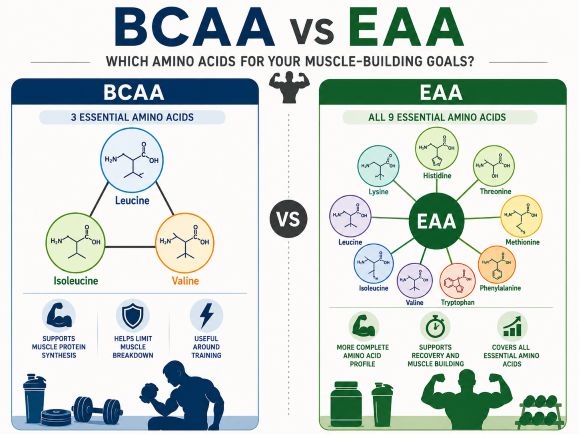
BCAA stands for Branched-Chain Amino Acids, and there are three of them: leucine, isoleucine, and valine. EAA stands for Essential Amino Acids and includes the nine essential amino acids: leucine, isoleucine, valine, lysine, methionine, phenylalanine, threonine, tryptophan, and histidine.
The three BCAAs are therefore part of the EAAs. In other words, taking EAAs provides leucine, isoleucine, and valine, but also the other six essential amino acids the body needs. Leucine is especially well known in strength training because it is involved in mechanisms that stimulate muscle protein synthesis, but sending this signal is not enough if the other necessary amino acids are not available.
BCAAs consumed around a workout can help stimulate muscle protein synthesis, but a source that provides all the essential amino acids is generally better suited to fully support this process.

What are BCAAs used for in strength training?
In strength training, BCAAs matter mainly because they are among the amino acids used by muscle, with a particular role for leucine, which helps trigger mechanisms related to muscle protein synthesis. This does not mean that drinking BCAAs will directly speed up muscle gain, but rather that they are involved in a process that also depends on the presence of other amino acids, total protein intake, training, and recovery.
Their usefulness can therefore mainly be understood around exercise: they can quickly provide certain amino acids when a workout is far from a meal, or serve as a light drink during training when you do not want to eat or drink a heavier shake. As for desired effects such as better recovery or less muscle soreness, some studies suggest a possible benefit in certain contexts, but results remain variable and do not justify presenting BCAAs as an essential supplement.
In practice, BCAAs therefore do have a function, but their real value depends mainly on what is already missing from the diet and around training, rather than simply on the fact that you do strength training.
The benefits of EAAs compared with BCAAs for strength training
If someone genuinely wants to use an amino acid supplement, EAAs are generally a more consistent option than BCAAs, especially when eating a real protein source is difficult. Someone who trains very early in the morning and cannot tolerate breakfast before a workout may, for example, prefer a drink containing EAAs, just as they can be practical when the last meal was a long time ago and a whey shake or solid meal does not sit well right before training.
In this context, EAAs provide the essential amino acids in a light drink, but this remains a practical solution rather than a requirement. If you can easily consume a protein source before or after your workout, the additional benefit of EAAs becomes much less important.
BCAAs, EAAs, or whey: what should you choose for strength training?
Whey is a complete protein. It naturally provides BCAAs, the other essential amino acids, as well as nonessential amino acids, and its main benefit is simple: it makes it easy to supplement your daily protein intake.
EAAs provide essential amino acids in free form and can be practical when you want a light option around training, while BCAAs are limited to three amino acids.
If your diet is low in protein, prioritize a protein-rich meal first or, if needed, whey.
If you train fasted, have trouble digesting protein before exercise, or want a very light option, EAAs can be considered.
If your diet already provides enough complete protein, BCAAs are rarely a priority.
A whey shake already naturally provides several grams of BCAAs, so taking whey, EAAs, and BCAAs at the same time generally provides little additional benefit.
The best time to take BCAAs or EAAs
The question “when should you take BCAAs?” comes up often, but the exact timing is less important than the dietary context around the workout. Before training, BCAAs or EAAs may make more sense when your last protein-rich meal was several hours ago, whereas if you ate a meal containing a reasonable amount of protein one or two hours before your workout, their value becomes much more limited.
During training, they can easily be consumed in a water bottle, which can be practical during a fasted workout or simply for people who enjoy this type of drink. After training, the same logic applies: if you plan to have a meal with a protein source or a whey shake soon afterward, adding BCAAs generally provides little extra benefit.
There is therefore no universal answer to “BCAAs before or after a workout?” It is better to look at when you consumed your last protein source and when you will have the next one. On rest days, it is generally not useful to schedule BCAAs or EAAs at a specific time, because total daily protein intake remains the priority.

Bulking, cutting, fasted training: the real practical cases
Amino acids while bulking
While bulking, BCAAs are rarely the first thing to optimize, because muscle growth depends mainly on progressive training, an appropriate slight calorie surplus, enough protein, and proper recovery.
An 80 kg person who already consumes around 140 to 160 g of protein per day through meals and possibly whey already gets plenty of essential amino acids, so adding BCAAs will not compensate for a lack of calories or training without progression.
Amino acids while cutting
While cutting, BCAAs do not cause fat loss, because fat loss mainly comes from maintaining a calorie deficit over time. The goal is then to preserve as much muscle as possible through strength training, sufficient protein intake, and a reasonable deficit. BCAAs can be part of a routine, but they do not protect muscle on their own.
For fasted training, EAAs are generally more consistent than BCAAs if the goal is to provide essential amino acids without consuming a full meal.
For someone who is vegetarian or vegan, the priority is first to improve the quantity, quality, and variety of dietary protein, with options such as soy, tofu, tempeh, legumes, grains, seitan, or plant protein powders depending on dietary habits.
BCAAs or creatine: which should you choose?
BCAAs and creatine do not have the same role, since BCAAs provide three amino acids that are already naturally present in dietary protein, whereas creatine works through a different mechanism.
Its value in strength training is well established for supporting performance during repeated high-intensity efforts and supporting adaptations to resistance training.
For someone who already adequately meets their protein needs and is simply deciding between creatine and BCAAs, creatine is generally the more relevant choice for strength training.
BCAAs: risks, side effects, and precautions
In a healthy person using typical amounts, BCAAs are generally well tolerated, but greatly increasing the dose does not mean getting better results. Some people may experience digestive discomfort such as nausea, bloating, or intestinal discomfort, and depending on the product, flavorings, acidifiers, or sweeteners may also contribute to these issues.
A very concentrated drink consumed during an intense workout may also be less well tolerated by some people. Extra caution is recommended in cases of kidney or liver disease, a metabolic disorder, medical treatment, or monitoring for a health problem, and in this situation it is better to ask the healthcare professional who knows your medical history before regularly using this type of supplement.
Common mistakes with BCAAs and EAAs
The most common mistake is treating BCAAs as a replacement for protein, even though a few grams of leucine, isoleucine, and valine do not replace a diet that provides all the necessary amino acids.
Another mistake is adding BCAAs when daily protein intake is already more than sufficient, without trying to determine what problem the supplement is supposed to solve.
Ratios such as 2:1:1, 4:1:1, or 8:1:1 should not become the main selection criterion either, because a higher amount of leucine does not automatically mean better muscle gain.
Finally, stacking whey, creatine, BCAAs, EAAs, glutamine, and pre-workout without a specific goal mainly increases the number of supplements used, whereas each product should address an identifiable need.
BCAAs do not build more muscle without appropriate training any more than they cause fat loss without a calorie deficit.
What to remember
Amino acids are important for making muscle proteins, but that does not mean they need to be consumed as supplements.
If your daily protein intake is already appropriate, BCAAs are generally not a priority, while if you still want to use an amino acid supplement, especially around a fasted workout or when a complete protein is difficult to consume, EAAs are generally more consistent.
In most other situations, a protein-rich meal or whey addresses the need more directly because it provides enough complete protein.
FAQ
BCAA vs EAA: which should you choose?
If you specifically want to take amino acids around your workout, EAAs generally make more sense because they provide all the essential amino acids. If your diet already provides enough protein, neither is necessary in most cases.
What is the difference between BCAAs and EAAs?
BCAAs include three essential amino acids: leucine, isoleucine, and valine. EAAs include all nine essential amino acids and therefore also include these three BCAAs.
What are BCAAs used for?
BCAAs are involved in protein metabolism, and leucine in particular plays a role in mechanisms that stimulate muscle protein synthesis. However, their value as a supplement remains limited when you already consume enough complete protein.
When should you take BCAAs?
BCAAs can be consumed before, during, or after a workout. Their value depends mainly on your diet around training. If you recently consumed protein or plan to have a meal or whey after your workout, they generally provide little additional benefit.
Should you take BCAAs before or after a workout?
There is generally no need to focus on very precise timing. Total protein intake over the day is more important. Taking them around a workout may make more sense when training takes place far from meals.
Are BCAAs useful for strength training?
BCAAs contain essential amino acids involved in muscle metabolism, but their value as a supplement is often limited for someone who already consumes enough protein.
Are EAAs better than BCAAs?
If the goal is specifically to consume amino acids around a workout, EAAs generally make more sense because they provide all nine essential amino acids. That does not mean they are essential.
BCAA vs whey: which should you choose?
If your goal is to supplement your daily protein intake, whey is generally more suitable. It is a complete protein that naturally provides BCAAs as well as the other essential amino acids.
Are BCAAs dangerous?
In a healthy adult using typical doses, BCAAs are generally well tolerated. Digestive issues can still occur. In case of illness, medical treatment, or specific medical monitoring, it is preferable to ask a healthcare professional for advice.
Can you take BCAAs while cutting?
Yes, but BCAAs do not directly cause fat loss. Cutting primarily relies on a calorie deficit, sufficient protein intake, and training that helps preserve as much muscle mass as possible.
Related articles

Dietary Supplements in Strength Training: Which Ones Exist, What Are They For, and How Should You Use Them?
Dietary supplements occupy an important place in the world of strength training, but they are often presented in an overly simplistic way, even though their real value depends on the product, the goal, and how they fit into training and nutrition. Between useful products, thos

Creatine: how to use it effectively for bodybuilding
Creatine is one of the most widely used supplements in bodybuilding because it is simple, inexpensive, well studied, and directly related to short, intense efforts. But it is also surrounded by many questions about its actual effects, dosage, the right time to take it, weight gai

Macros in Strength Training: How to Calculate Protein, Carbs, and Fats Based on Your Goal
When you start getting interested in nutrition for strength training, you quickly hear about macros. Yet many lifters use this word without always knowing what it really covers. Macros, or macronutrients, are simply the main categories of nutrients that provide energy: protein, c