
Preworkout: What Does It Do and How Should You Take It?
Learn what preworkout does, its main ingredients, its effects, when to take it, and the precautions to know before training.
Preworkout is a supplement taken before training to seek greater alertness, better tolerate certain types of exercise, or enhance the muscle pump. But the product name does not tell you what it contains: a formula with caffeine does not work like a stimulant-free blend, and some ingredients require several weeks of regular intake.
Before buying one, you therefore need to look at its composition, the amounts per serving, and the time you train. A product that makes you feel more awake is not necessarily the one that will help you progress the most.
What Is Preworkout?
Preworkout, or a pre-workout supplement, is usually a blend of several ingredients sold as a powder to mix with water. The spellings “pré-workout” and “preworkout” are also used to refer to this same category.
There is no universal formula. Some products combine caffeine, citrulline, and beta-alanine, others add creatine, while caffeine-free versions focus on non-stimulant ingredients. Two tubs with the same label can therefore offer very different benefits.
This supplement remains optional. It differs from protein powder in particular: its main purpose concerns the conditions under which you exercise, rather than your daily protein intake. To understand its role alongside other products, see our guide to strength training supplements.
What Does Preworkout Do?
The intended effects depend on the ingredients. Caffeine can increase alertness and reduce perceived fatigue during certain types of exercise. In strength training, it can also improve some measures of strength or muscular endurance, meaning the ability to repeat an effort before having to stop. These benefits are neither guaranteed nor identical across all exercises.
A muscle pump, often called a “pump,” refers to the feeling of fuller muscles during a workout. Some formulas aim to enhance it with ingredients associated with nitric oxide production, such as citrulline. However, a more pronounced pump does not prove that you are building more muscle.
It is therefore necessary to distinguish three things: how you feel, what you manage to do during the workout, and the progress you make over the weeks. A stimulant can change the first without guaranteeing the other two.
What Is in Preworkout?
The most common ingredients do not have the same role, and especially not the same onset of action.
| Ingredient | Main Intended Role | What You Need to Understand |
|---|---|---|
| Caffeine | Alertness and support for certain aspects of performance | Can have an effect during that day's workout |
| Citrulline or citrulline malate | Nitric oxide production and performance during certain types of exercise | Results vary across studies |
| Beta-alanine | Increased muscle carnosine | Requires regular intake over several weeks |
| Creatine | Support for short, intense, repeated efforts | Consistency matters more than taking it right before a workout |
Caffeine
Caffeine is one of the ingredients with the best-established immediate effects on alertness and certain aspects of athletic performance. One of its actions is to block receptors for adenosine, a substance involved in the sensation of fatigue. It does not provide calories: feeling more energetic does not mean you have received additional fuel.
Check the total amount per serving and add up the other sources throughout the day: coffee, tea, energy drinks, or other supplements. Guarana extracts can also provide caffeine.
The European Food Safety Authority (EFSA) considers that, in healthy adults, single doses of up to 200 mg and a total of up to 400 mg throughout the day, from all sources combined, generally do not raise safety concerns under the conditions assessed. These are safety guidelines, not targets to reach or a guarantee of good tolerance. Some people experience side effects at lower amounts.
Citrulline and Citrulline Malate
Citrulline helps increase the availability of arginine, which is used to produce nitric oxide. Nitric oxide plays a role in widening blood vessels. This is the mechanism highlighted in formulas designed to enhance the muscle pump.
The effects on performance are less consistent than those of caffeine. A meta-analysis found a small average benefit in the number of repetitions performed with citrulline malate, but other trials found no improvement in the types of exercise tested. Its benefits should therefore be described as possible, not guaranteed.
Citrulline malate combines citrulline and malate: its total weight does not consist solely of citrulline. A serving labeled as containing 6 g of citrulline malate therefore does not provide 6 g of pure citrulline. A dedicated article will explain these differences and the dosages studied.
Beta-Alanine
Beta-alanine is used to gradually increase muscle carnosine, which helps limit changes in acidity in the muscle during certain intense efforts. Its benefits are mainly documented for sustained efforts lasting about one to four minutes; this does not mean it automatically improves every strength training set.
Its effects do not primarily depend on taking it right before a workout. Increasing muscle stores requires regular intake over several weeks, so taking it occasionally in a preworkout does not necessarily reproduce the protocols studied.
It can cause tingling, known as paresthesia. This beta-alanine-related tingling is generally temporary and considered harmless at usual doses in healthy adults, even though it can be unpleasant. It does not prove that the product improves your performance. Splitting the daily amount into several small doses can reduce it. An article dedicated to beta-alanine will explain its use.
Creatine
Creatine helps muscles rapidly replenish the energy used during short, intense efforts. Having it in a preworkout can be convenient, but it does not need to be taken right before training.
Its benefits mainly rely on increasing muscle stores through regular intake. Common protocols use, in particular, 3 to 5 g of creatine monohydrate per day. Check what your blend already provides before adding a separate dose, and do not use training days alone as your reference.
Our article on creatine for strength training explains its dosage, effects, and daily use.
Other Ingredients
Electrolytes, especially sodium, can help replace losses from heavy sweating, particularly during prolonged exercise or in hot weather. Their presence does not automatically make a formula a better supplement for a regular gym workout.
Some formulas also add vitamins or amino acids, but a longer list does not demonstrate greater effectiveness: you should be able to explain why each addition is useful in your situation. BCAAs and EAAs, for example, address a different question from that of a stimulant effect before exercise.
What Dosages Should You Look for in Each Ingredient?
The amounts below help you compare formulas and understand the dosages studied in healthy adults. They are not a recipe for combining everything: some ingredients are taken regularly, while others are used before exercise.
| Ingredient | Dosage Guidelines | How Should You Take It? |
|---|---|---|
| Pure L-citrulline | About 5 to 8 g in some trials, with no clearly established optimal dose | Protocols vary, and performance benefits remain inconsistent. |
| Citrulline malate | 6 to 8 g, about 40 to 60 minutes before exercise in several studies | Check the citrulline/malate ratio: the blend's weight does not consist solely of citrulline. |
| Beta-alanine | 4 to 6 g per day in reference protocols | Split into small doses, for example 0.8 to 1.6 g, over several weeks, including rest days. |
| Creatine monohydrate | 3 to 5 g per day in common protocols | Take regularly, including rest days. Taking it right before a workout is not essential. |
| Caffeine, optional | The safety guidelines are a maximum of 200 mg per dose and 400 mg throughout the day, from all sources combined | These are not doses to aim for. Tolerance varies, and even 100 mg can disrupt sleep in some people. Avoid pure caffeine powder that you have to measure yourself. |
For citrulline malate labeled with a ratio of 2:1 by weight, 6 g of the blend theoretically corresponds to 4 g of citrulline and 2 g of malate. With 8 g, you get about 5.3 g of citrulline. This calculation assumes that the stated composition is accurate: the two forms therefore cannot be compared gram for gram.
Some commercial formulas can provide a lot of caffeine while containing little citrulline or beta-alanine per serving. A strong stimulant effect does not prove that the other ingredients are properly dosed. For beta-alanine, the main thing to look at is daily intake: a small amount consumed only on training days does not match regular-intake protocols.
Do not double the serving to compensate for an underdosed ingredient, because you would also double the caffeine and all the other substances. Using separate ingredients lets you adjust each amount independently, but does not guarantee greater effectiveness.
Track your calories and macros from a photo or description of your meal with Welling AI Diet Coach, an app featuring an AI nutrition assistant.
When Should You Take Preworkout?
For a formula containing caffeine, about 30 to 60 minutes before training is a good guideline, with many protocols using a dose around an hour before exercise. However, the timing depends on the form consumed and the individual's response: it is not a rule that must be followed to the minute.
Drinking your shake two minutes before your first set does not allow the same absorption time. This does not mean there will be no effects, but they may appear later in the workout.
Do not look for a single time that applies to every ingredient. Consistent creatine and beta-alanine intake matters more than having them in your shaker right before warming up.
Finally, consider bedtime. A dose that is well timed for your workout may be too late for your sleep. The effects depend on the dose and your sensitivity; a controlled study notably observed sleep disruptions with a high dose of caffeine taken several hours earlier.
Preworkout With or Without Caffeine: Which Should You Choose?
A formula with caffeine may suit an adult who wants an effect on alertness, tolerates stimulants well, and trains early enough, but is less appropriate if the day already includes several caffeinated drinks.
A preworkout without caffeine may be better suited to a late workout, someone sensitive to this substance, or someone who drinks a lot of caffeinated beverages throughout the day. It may contain non-stimulant ingredients, but their amounts and actual benefits still need to be examined.
The absence of caffeine is not enough to validate the entire formula. Also check the other substances present, especially if the product promises a stimulant effect despite this claim.
Can You Replace Preworkout With Coffee?
Yes, in part. If the desired effect comes mainly from caffeine, coffee can provide this stimulant without buying a blend of several powders.
However, it is not strictly equivalent to every preworkout. It does not provide any citrulline, beta-alanine, or creatine they may contain, and its caffeine content varies depending on the coffee and how it is prepared. A cup therefore does not tell you precisely how much you are consuming.
The choice therefore depends on what you are actually looking for and your digestive tolerance, without assuming that a powder is necessarily more effective.
Can You Make Homemade Preworkout?
Yes, you can make your own preworkout by buying the ingredients separately instead of a ready-made blend. This lets you choose what you use, know the amounts of each ingredient, and prepare a version with or without a stimulant.
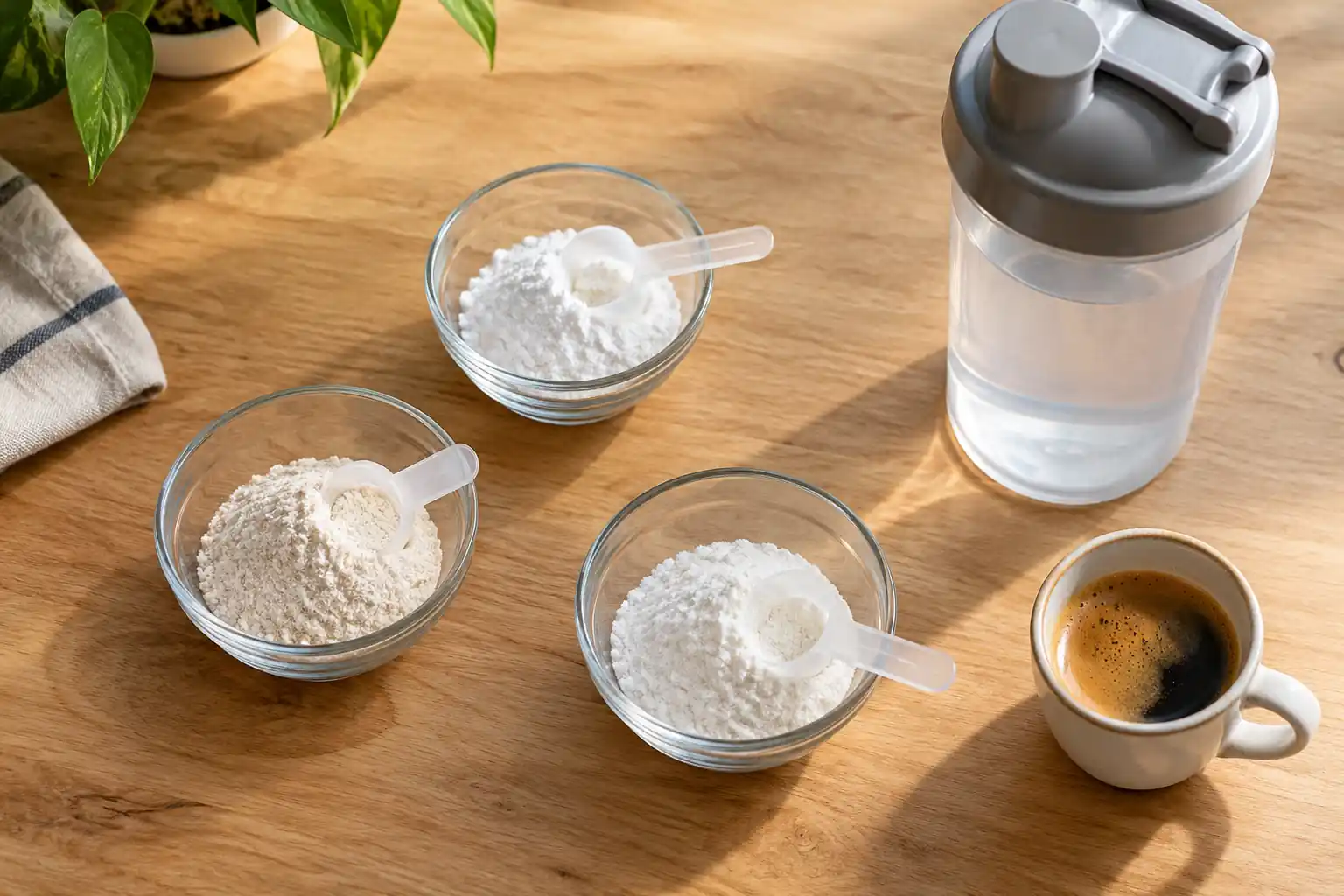
In practice, you can mix citrulline or citrulline malate into water, then optionally add beta-alanine or creatine if these ingredients are already part of your supplementation. Prepare one serving at a time, measure each powder separately, and check its concentration: a scoop of citrulline malate does not necessarily provide the same amount of citrulline as pure citrulline powder.
However, all these ingredients do not need to be combined before a workout. Beta-alanine and creatine mainly depend on regular intake; adding them to your shaker occasionally is not enough to reproduce the effects of consistent supplementation. You can therefore take them at another time and reserve your pre-workout blend for the ingredients you want to use before exercise.
For caffeine, avoid pure powder that you have to measure yourself: a measuring error can cause serious poisoning. If you want a stimulant effect, choose coffee or a premeasured product that clearly states its caffeine content, accounting for other sources consumed throughout the day. Do not automatically add a stimulant if you train late.
Making homemade preworkout lets you control its composition, but does not automatically make a combination of several ingredients more effective or better tolerated. Start simply and avoid introducing several new ingredients at once.
What Are the Side Effects and Precautions for Preworkout?
Side effects depend on the formula and the amounts consumed. Stimulants can cause nervousness, restlessness, nausea, increased heart rate, and difficulty sleeping, among other effects. Some ingredients can also cause digestive issues, while beta-alanine can cause tingling.
Before use, check:
- the amount of caffeine in the serving actually consumed;
- the number of scoops corresponding to that serving;
- the other stimulants and plant extracts;
- the combined intake from your usual drinks and supplements.
Do not double the serving to get more citrulline or creatine: you would also double the caffeine and all the other ingredients. A product that does not suit your needs cannot necessarily be fixed by increasing its dose.
If you have cardiovascular disease, high blood pressure, take medication, or have a history of reacting badly to stimulants, ask a healthcare professional for advice before use. Pregnancy and breastfeeding also require appropriate advice; the general guidelines for healthy adults are not enough to assess these blends. Supplements may have contraindications and drug interactions.
Palpitations or feeling unwell are not signs to seek out when assessing a product's effectiveness. In that case, stop taking it and seek medical advice if unusual symptoms appear.
Should You Take Preworkout Before Every Workout?
No. Occasional use may serve a specific purpose, but there is no need to pair every workout with a stimulant. With habitual caffeine consumption, some sensations may become less noticeable. This does not justify gradually increasing doses, and habituation does not mean that all effects on performance disappear.
If you regularly need a product to manage to start your workout, first look at your sleep, meals, and accumulated training load. Compensating for persistent fatigue with more stimulant can perpetuate a problem, especially if taking it then delays sleep.
This optional use of preworkout should not be confused with the consistency sought when choosing creatine or beta-alanine supplementation.
Is Preworkout Really Useful?
It can be if its composition addresses an identifiable need, with appropriate amounts and good tolerance. Caffeine's effect on certain aspects of performance is a stronger argument than the simple promise of an “explosive” shake.
But a benefit during one workout does not guarantee additional muscle gains over the long term. To assess the product's usefulness, look at your training results and recovery, not just the intensity of the sensations.
If your weights or repetitions are already increasing and you arrive at the gym rested, you do not necessarily need to add it. Conversely, a stimulant provides neither the calories from a missed meal nor the hours of sleep needed for recovery.
How Should You Choose a Preworkout?
Start with the amount of caffeine and the corresponding serving. A value stated for two scoops should not be compared with another product's value for one scoop without accounting for the amounts actually consumed.
Then examine the individual doses. A blend labeled as totaling 8 g does not tell you how much citrulline or beta-alanine it contains if the amounts are not detailed. A transparent formula is easier to assess than a blend that only shows its overall weight.
To compare two labels, check these points:
| What to Check | Useful Question |
|---|---|
| Serving | How many grams and scoops will I consume? |
| Caffeine | How much will I add to my daily total? |
| Ingredients | Are the amounts of each listed? |
| How it works | Does the ingredient work on an as-needed basis or require regular intake? |
| Timing | Does this formula suit my workout time and bedtime? |
Do not be guided solely by the number of ingredients or how strong the sensations are. Choose a formula you can understand, rather than a product whose serving you would need to increase to reach the desired amounts.
Key Takeaways
Preworkout refers to a pre-workout blend, not a standard formula. Caffeine can affect alertness and certain aspects of performance, while creatine and beta-alanine mainly rely on regular intake.
Check the doses, stimulants, and timing of use. If the product worsens your sleep or pushes you to increase amounts, its usefulness becomes questionable. It is still possible to progress in strength training without preworkout.
Preworkout FAQ
How Long Before a Workout Should You Take Preworkout?
For a standard formula containing caffeine, about 30 to 60 minutes before a workout is a guideline. The timing varies depending on the product's form and the individual.
Can You Take Creatine With Preworkout?
A preworkout may already contain it. Check the amount before adding a separate dose: the goal is to manage total intake and consistency, not to take multiple doses around your workout.
Why Do Some Preworkouts Cause Tingling?
Beta-alanine can cause paresthesia, particularly after taking a large dose at once. This tingling does not measure either the product's effectiveness or the quality of your workout.
Is Preworkout Without Caffeine Risk-Free?
No. The absence of caffeine removes one possible source of side effects, but the other ingredients, doses, and potential interactions still need to be examined.
Sources
- Jagim AR, Harty PS, Camic CL. Common Ingredient Profiles of Multi-Ingredient Pre-Workout Supplements. Nutrients, January 24, 2019.
- Guest NS et al., ISSN. International society of sports nutrition position stand: caffeine and exercise performance. January 2, 2021.
- Scapec B et al. Caffeine, but not paracetamol (acetaminophen), enhances muscular endurance, strength, and power. Published online September 8, 2024.
- European Food Safety Authority (EFSA). Caffeine, guidelines from the 2015 assessment.
- Acute Effect of Citrulline Malate on Repetition Performance During Strength Training: A Systematic Review and Meta-Analysis. 2021.
- Devrim-Lanpir A et al. Effects of Acute Citrulline Malate Supplementation on CrossFit Exercise Performance. September 24, 2024.
- Trexler ET et al., ISSN. International society of sports nutrition position stand: Beta-Alanine. 2015.
- Antonio J et al. Common questions and misconceptions about creatine supplementation: what does the scientific evidence really show? February 8, 2021. ; Timing of Creatine Supplementation around Exercise: A Real Concern? August 19, 2021.
- NIH Office of Dietary Supplements. Dietary Supplements for Exercise and Athletic Performance, updated April 1, 2024.
- Dose and timing effects of caffeine on subsequent sleep: a randomized clinical crossover trial. SLEEP, published online in 2024, 2025 volume.
- French Anti-Doping Agency (AFLD). Dietary Supplements, accessed October 19, 2026.
- FDA — Warning About Pure and Highly Concentrated Caffeine.
Related articles

Macros in Strength Training: How to Calculate Protein, Carbs, and Fats Based on Your Goal
When you start getting interested in nutrition for strength training, you quickly hear about macros. Yet many lifters use this word without always knowing what it really covers. Macros, or macronutrients, are simply the main categories of nutrients that provide energy: protein, c
Dietary Supplements in Strength Training: Which Ones Exist, What Are They For, and How Should You Use Them?
Dietary supplements occupy an important place in the world of strength training, but they are often presented in an overly simplistic way, even though their real value depends on the product, the goal, and how they fit into training and nutrition. Between useful products, thos
BCAA vs EAA for Strength Training: Which Are Actually Useful?
If you are looking for an amino acid supplement for strength training, the two options may seem similar, yet their composition is not the same and their value depends mainly on what your diet already provides. BCAAs contain three essential amino acids, while EAAs include all the