Leg exercises: how to effectively build your lower body?
Discover the best leg exercises for strength training: squats, leg press, lunges, leg extension, leg curl, hip thrust, calf raises and a complete workout.
Leg muscles you should know
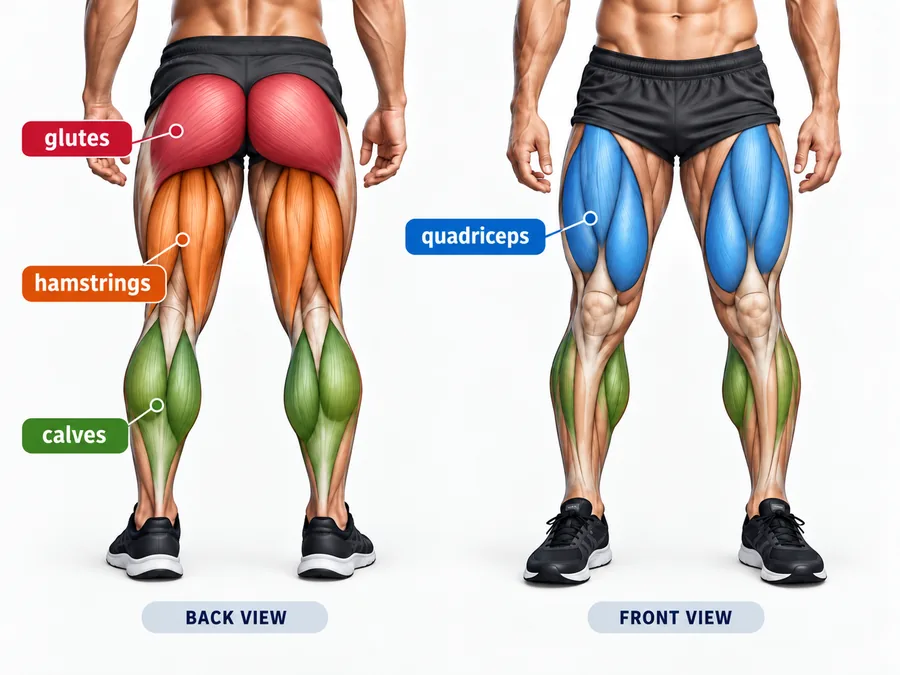
Before choosing a leg exercise, it is useful to know which muscles need to be worked. The quadriceps are located at the front of the thigh, they are mainly involved in knee extension and work hard during squats, the leg press, lunges and the leg extension. The hamstrings are located at the back of the thigh and are involved in particular in knee flexion and hip extension. The leg curl directly works the hamstrings, while the stiff leg deadlift works them more as they lengthen under tension.
The glutes play an important role in hip extension and pelvic stability, because they are involved in squats, lunges and the stiff leg deadlift, and are worked particularly hard during the hip thrust. The calves are mainly involved in ankle movement and can be trained with standing, seated or leg press calf raises.
Finally, the adductors are located on the inner thighs, and are involved in bringing the legs together and in pelvic stability. This distribution explains why a good leg strength training workout generally contains several types of exercises rather than a single movement repeated in different forms.
The best leg exercises for strength training
There is no single exercise that is better than all the others, the most useful exercises complement one another. The squat, leg press and lunges provide a good foundation for working several muscles at the same time, especially developing the quadriceps while also working the glutes and, depending on the movement, the adductors.
The leg extension can then add more specific work for the quadriceps. For the back of the thighs, the leg curl and stiff leg deadlift do not play exactly the same role, the first relies mainly on knee flexion, while the second uses a hip hinge. The hip thrust provides work that is more focused on the glutes. Finally, the calves can be trained directly with standing or seated calf raises.
A well-structured leg workout can therefore include a compound movement for the thighs, a unilateral exercise, a hamstring exercise, possibly a quadriceps isolation exercise and calf work, but it is not necessary to systematically include every exercise in the same workout.
Squat, leg press and lunges: the foundation for the thighs
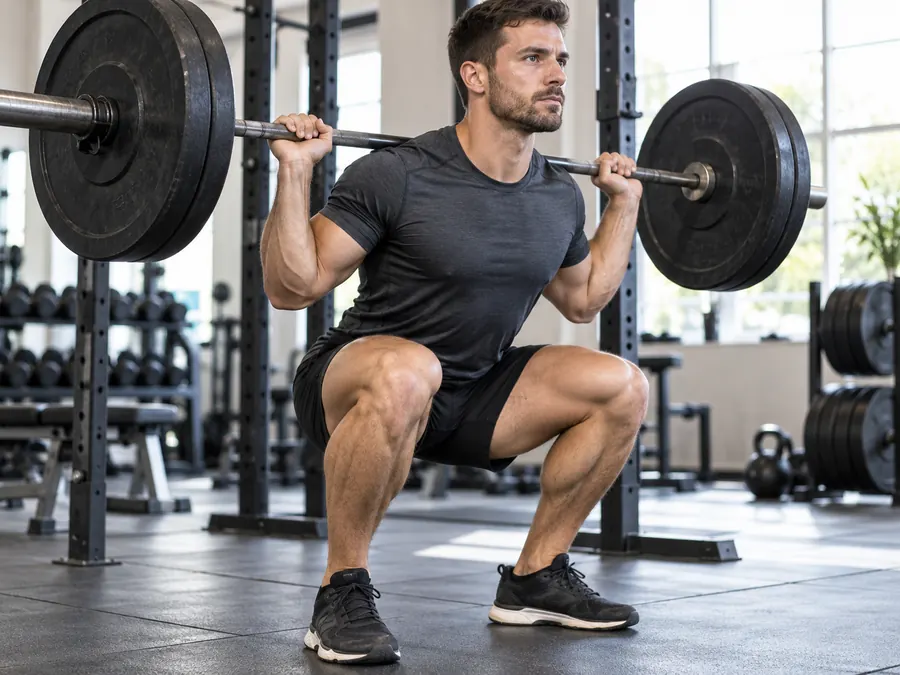
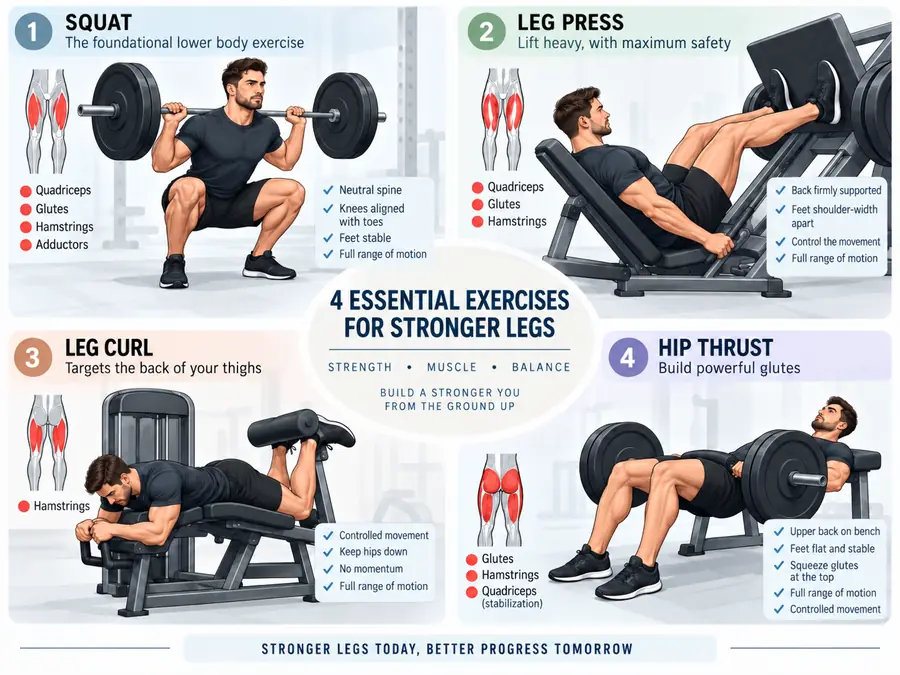
The squat is one of the best-known leg exercises, it mainly works the quadriceps and glutes, but it also requires stabilization of the core and the entire body. One of its benefits is that it allows several joints to work at the same time and lets you progressively increase the weight or repetitions. This does not mean that the squat is mandatory to build leg muscle. Depending on mobility, body proportions, technical level or simply how the movement feels, some people will be more comfortable with another variation or with a leg press.
The leg press provides more stability, because the back is supported and the movement is guided, which makes it possible to focus more of the effort on the legs without having to manage as much balance as with a free squat. However, this stability should not be used as a reason to load the machine without control, a heavy weight used through a very short range of motion is not necessarily more productive than a more reasonable weight used through an appropriate range of motion.
Lunges in strength training add another dimension, because each leg works more independently, they require more stability and can help limit strength differences between the two sides. Forward lunges, reverse lunges, walking lunges or split squats can all be useful, the choice mainly depends on comfort and the ability to keep the movement stable.
There is therefore no need to systematically pit squats, the leg press and lunges against one another, they can work perfectly well together in a leg training program.
Leg extension: isolate the quadriceps
The leg extension is a machine-based isolation exercise that, unlike the squat or leg press, mainly aims to work the quadriceps. It can be placed after more compound exercises to add volume for the front of the thighs without doing another exercise that requires a lot of stability and overall energy.
For example, after several sets of leg presses, two or three sets of leg extensions allow you to continue working the quadriceps with a lighter weight. The movement should remain controlled, with the goal of not throwing the weight up with the body and then letting it drop. Lifting cleanly, contracting the quadriceps and controlling the lowering phase is generally more useful. There is no need to systematically aim for the maximum weight, if a position or range of motion causes joint pain, it is better to adjust the setup or weight, or choose another exercise.
Leg curl: work the hamstrings
The quadriceps are often easier to feel and train than the back of the thighs, yet the hamstrings have an important place in a balanced leg workout. The leg curl allows you to train them directly through knee flexion, and can be performed seated, lying down or sometimes standing with one leg at a time. The feel can vary slightly from one weight training machine to another, but the principle remains the same. The important thing is not to turn each repetition into a swinging movement, the lifting phase should remain controlled and the lowering phase should also be controlled.
A common mistake is to devote many sets to the quadriceps while leaving only a few quick leg curl repetitions for the end of the workout. If the goal is to develop balanced thighs, the hamstrings need real work. The leg curl can notably be combined with a hip hinge movement to train the hamstrings more completely.
Stiff leg deadlift: back of the thighs and glutes
The stiff leg deadlift is often used to work the hamstrings and glutes. Despite its name, the knees do not necessarily have to be completely locked, a slight bend generally makes the movement easier to control. The main element is the hip hinge, you need to send the hips backward while the torso leans forward, rather than simply trying to lower the bar as far as possible. The back stays in a neutral position and the weight remains close to the body.
Depth depends on each person's mobility, going lower is not useful if it forces you to round the lower back, so a better reference point is to feel a clear stretch in the hamstrings while remaining stable. A manageable weight generally makes it easier to learn the movement than a very heavy weight used with approximate technique. This exercise complements the leg curl well: the leg curl mainly trains knee flexion, whereas the stiff leg deadlift uses more hip extension.
Hip thrust: target the glutes
The hip thrust is mainly used to develop the glutes and can therefore fit perfectly into a leg workout, especially if you want to strengthen hip extension or devote more volume to the glutes.
The upper back is generally placed against a bench while the weight rests over the pelvis. The movement then consists of pushing the pelvis upward with the push remaining controlled and the feet stable enough to transfer force into the floor.
At the top, the goal is to complete hip extension by contracting the glutes, without trying to rise ever higher by compensating with a pronounced arch in the lower back. The hip thrust is not essential if the program already contains enough work for the glutes, but it is an useful option when this area is a priority.
Building the calves: the often-forgotten work
The calves can easily take a back seat to the quadriceps, hamstrings and glutes in a leg workout, yet a few regular sets are often enough to include their training without considerably extending the workout.
The main calf exercises are standing calf raises, seated calf raises and calf raises performed on a leg press. The movement seems simple, but it is often performed too quickly, because for a calf exercise to be truly controlled, you need to lower the heel enough to get a comfortable stretch, then push through the front of the foot and complete the upward phase before starting again. Bouncing the weight through very short repetitions limits control of the movement.
Standing and seated calf raises do not feel exactly the same because of knee position, but it is possible to alternate between the two over the course of the program without having to use both in the same workout.
Adductors and abductors: useful but secondary
The adductors are already involved in several leg movements, including certain squats and unilateral exercises. Direct adductor training can nevertheless be added if you want to strengthen the inner thighs or complete lower-body development.
Adductor and abductor machines are easy to use and can be placed at the end of a workout. For a beginner, they are generally not the first priority. It is more important to build a foundation with a few compound movements, a hamstring exercise and steady progression. They can then become a useful addition depending on needs and goals.
Leg exercises at home
It is entirely possible to do leg exercises at home, even without machines. The bodyweight squat, for example, is a practical and very effective first option, while lunges and split squats can then increase the difficulty by making one leg work more at a time.
The floor hip thrust is practical for the glutes, while calf raises can be done standing, with or without weight. A step-up can also be used if you have a perfectly stable and suitable support.
The main problem with training the legs at home appears when the exercises become too easy. The legs can produce a lot of force and bodyweight alone often ends up no longer being enough.
Several options can help you continue progressing:
- slow down the lowering phase;
- pause in the difficult position;
- gradually increase the number of repetitions;
- use more single-leg exercises;
- add a resistance band;
- use a loaded bag or dumbbells if available.
Jump squats can also be used in some workouts, but they are not essential for building muscle and involve more impact.
A home leg workout can therefore be effective, especially at first, but over the longer term, having progressively heavier weights nevertheless makes progression easier.
Example of a complete leg workout
A leg workout does not need to contain ten exercises, with a few well-chosen movements and enough productive sets, it is possible to cover the essentials of the lower body.
Here is a simple example:
- Squat or leg press: 3 to 4 sets of 6 to 10 repetitions
- Lunges or split squat: 3 sets of 8 to 12 repetitions per leg
- Leg curl: 3 sets of 10 to 15 repetitions
- Leg extension: 2 to 3 sets of 12 to 20 repetitions
- Hip thrust or stiff leg deadlift: 3 sets of 8 to 12 repetitions
- Standing or seated calf raises: 3 to 4 sets of 10 to 20 repetitions
This is an example, not a mandatory template. You will need to add a warm-up before the workout to prepare the muscles for the exercises and avoid injuries.
The most demanding exercises are generally placed at the beginning of the workout, when fatigue is still low, while more targeted movements, such as the leg extension or calf raises, can come afterward. A beginner also does not necessarily need to do all six exercises from the first workouts, a shorter version could simply include a leg press, a split squat, a leg curl, a movement for the glutes or hamstrings and a few sets of calf raises.
What matters most is being able to progress over the weeks, which can mean a few more repetitions with the same weight, a slight increase in weight or better execution as the workouts go by.
Continually adding exercises is not a method of progression.
How many times per week should you train legs?
One leg workout per week can already work, especially in a program where each muscle group has its own day, it simply needs to contain enough work for the different muscles without becoming endless.
Two sessions per week can also be useful, this frequency can make it possible to spread out the exercises and sets rather than concentrating all the volume into one difficult workout. For example, a first workout can give more room to the quadriceps, with squats or the leg press, lunges and the leg extension, while a second can focus more on the hamstrings and glutes with the leg curl, stiff leg deadlift or hip thrust.
There is no need to do two enormous workouts to progress faster, because more volume is useful only if recovery keeps up, and this is true regardless of the muscle group. The number of workouts therefore depends on the complete program, level, recovery and priority given to the legs.
Common mistakes with leg exercises
The first mistake is thinking that a leg workout comes down to squats. The squat is a very good movement, but it does not necessarily replace specific work for the hamstrings or calves. Conversely, piling up a lot of machine exercises without trying to progress does not automatically produce better results.
On the leg press, a common mistake is prioritizing weight at the expense of range of motion and control. Adding several extra plates is not very useful if each repetition becomes shorter and shorter. Lunges are often performed too quickly, it is important to take the time to stabilize each repetition to generally allow better control of the working leg. The leg curl and leg extension are also easy to rush by using momentum, they are simple exercises, but they should still be performed cleanly.
The mistake also often happens with calves, which are sometimes completely forgotten because they come at the end of the workout, even though a few regular sets are more useful than training them only from time to time.
Finally, volume should remain consistent with the rest of the program. Doing a huge number of sets for the legs while already training several times during the week can make recovery more difficult.
A strong feeling of muscular effort during a set is normal, clear or unusual joint pain should not simply be ignored just to finish the set.
What to remember
To effectively build leg muscle, you need to combine several types of exercises rather than rely on a single movement. Squats, the leg press and lunges provide a good foundation for working the thighs, the leg curl and stiff leg deadlift give the hamstrings a real place, while the leg extension can complement quadriceps work.
The hip thrust is useful when the glutes are a priority, and a few specific sets help ensure the calves are not forgotten. The exact choice of exercises matters less than the consistency of the workout, quality of execution and ability to progress regularly. Of course, and this applies regardless of the workout, good strength training nutrition is essential for recovering properly and building muscle.
FAQ
What are the best leg exercises?
Squats, the leg press, lunges, the leg curl, leg extension, stiff leg deadlift, hip thrust and calf exercises are among the most useful movements. There is no need to do all of them in the same workout.
How do you build leg muscle with strength training?
You need to combine compound exercises such as squats or the leg press with movements that more specifically target the quadriceps, hamstrings, glutes and calves. Progressing the weights, repetitions or quality of execution over time remains essential.
Which leg exercise should you do first?
You generally start with the most demanding exercise or the one on which you most want to progress. This can be a squat, leg press or another compound movement.
Is the squat mandatory for building leg muscle?
No. The squat is very useful, but it is not essential. A combination of the leg press, lunges, hamstring exercises and other suitable movements can also help develop the legs.
Leg press or squat: which should you choose?
The squat requires more stability and technical control. The leg press provides a more guided movement and allows you to focus more of the effort on the legs. The best choice depends on your level, comfort and program. Both can also be used.
How do you train the hamstrings?
The leg curl works the hamstrings through knee flexion. The stiff leg deadlift works them more during a hip hinge. Combining these two types of movements can be useful.
Is the leg extension useful?
Yes, particularly for adding specific quadriceps work after movements such as squats or the leg press. However, it is not essential if quadriceps volume is already sufficient.
Is the leg curl important?
It is particularly useful for directly training the hamstrings. Because the back of the thighs can easily be neglected in a very quadriceps-focused workout, the leg curl is a simple exercise for balancing the work.
How do you build your legs at home?
Squats, lunges, split squats, floor hip thrusts and calf raises allow you to start without machines. To keep progressing, you will need to gradually increase the difficulty with more repetitions, a slower tempo, unilateral exercises or additional weight.
How many times per week should you train legs?
One leg workout per week can be enough in many programs. Two sessions can be useful for distributing volume more effectively or giving the lower body more priority, provided you recover properly.
Should you train calves with legs?
It is not mandatory, but it is often the most practical time. A few sets of standing or seated calf raises at the end of the workout allow you to train them regularly without creating a separate workout.
Related articles
Shoulder Exercises: How to Train Your Shoulders Properly?
Good shoulder exercises are not just about pressing as much weight as possible overhead. To develop complete shoulders, you need to combine several types of movements: presses for overall work, lateral raises to emphasize width, and specific exercises for the rear of the shoulder
Bulking in Strength Training: How to Gain Muscle Without Gaining Too Much Fat
Bulking is a phase where you aim to gain weight to support muscle building. In theory, the idea seems simple: eat more, train hard, and progress. But in practice, this is often where many lifters go wrong. Some eat far too much and mostly gain fat, while others are afraid to eat
Strength Training Machines: Which Ones Should Beginners Use at the Gym?
When you walk into a gym, strength training machines can quickly make it feel like you already need to know everything before getting started. There are machines for the legs, back, chest, shoulders, arms, and abs. Some are easy to understand, while others are much less obvious.