How to Train Your Back Properly?
Discover the best back exercises for strength training: lat pulldowns, rows, pull-ups, dumbbells, machines, lower back, and a complete workout.

Back Muscles You Should Know
When talking about the back in strength training, people often think of the lats, but this muscle group is not limited to that single muscle. The latissimus dorsi creates a large part of the width effect, especially when it is well developed along the sides of the torso, which explains why it is heavily involved in pull-ups, the lat pulldown, and certain cable pulling movements. There are also the trapezius muscles, which occupy a large part of the upper and middle back. The upper traps are visible near the neck, while the middle and lower traps are important for back thickness, shoulder-blade positioning, and stability during pulling exercises.
The rhomboids, rear delts, and muscles around the shoulder blades also contribute significantly to back training. They often create that impression of a denser, stronger, better-supported back, especially as you progress on rows, horizontal pulling movements, and exercises where you bring the shoulder blades together. Finally, the lower back and lumbar muscles should not be overlooked, because they help support the torso, stabilize the trunk, and maintain posture. However, they should be trained intelligently: the goal is not to load them heavily in any way possible, but to strengthen them progressively without confusing muscular work with lower-back pain.
The Essential Movements for Building a Complete Back
The best back exercises are those that let you pull along a good path, keep the weight under control, and feel your back working without your arms taking over. There is therefore no single mandatory exercise for everyone, but several families of movements to combine according to your level, equipment, and goal.
The Main Back Exercises
The lat pulldown is one of the simplest exercises for training the latissimus dorsi. It involves pulling a bar or handle down from above toward the chest while keeping the torso stable and focusing on driving the elbows down rather than simply bending the arms, making it a good movement for learning to feel the back working, especially when pull-ups are still too difficult.
The pull-ups are also a very effective exercise, but they already require a certain level of strength. They strongly recruit the latissimus dorsi, as well as the biceps, forearms, and core muscles. By primarily developing the latissimus dorsi, they contribute to the wider-back appearance sought in strength training. To get the full benefit, perform controlled repetitions through an appropriate range of motion without letting the arms do most of the work.
The seated cable row is particularly useful for developing what is commonly called back thickness, an expression that mainly refers to the volume provided by all the muscles of the middle back. The forward-and-backward movement and shoulder-blade retraction notably recruit the middle traps, rhomboids, and rear deltoids, in addition to the latissimus dorsi. It therefore does not work “thickness” exclusively, but it complements pull-ups and lat pulldowns well by placing more emphasis on the muscles around the shoulder blades.
The barbell row is a very complete back exercise , but it is also more technically demanding. It allows you to train with heavy loads and strengthen a large part of the back, but it requires keeping the torso solid, the lower back braced, and the movement path clean, because if the weight is thrown or the torso moves too much, the exercise loses much of its value.
The dumbbell row is often more accessible than the barbell row. It allows you to work one side at a time, focus more closely on the elbow path, and achieve a good range of motion, making it a very good exercise for the lats and middle back.
The machine row is useful because it provides more stability during the movement. It can be helpful for beginners, for people who want to feel their back working better, or for adding volume without fatiguing the lower back as much, provided the seat, chest support, and handles are adjusted correctly.
The cable pullover lets you train the lats with the arms nearly straight, without the biceps taking over as much. This can help you feel the latissimus dorsi better, especially at the end of a workout, but the movement must remain controlled so it does not turn into simple torso swinging.
Back extensions can strengthen the lower back, glutes, and hamstrings depending on how they are performed, but this is not an exercise to load too quickly. The first goal is to control the movement, maintain good positioning, and feel the muscles working without forcing the spine.
Back Width and Back Thickness
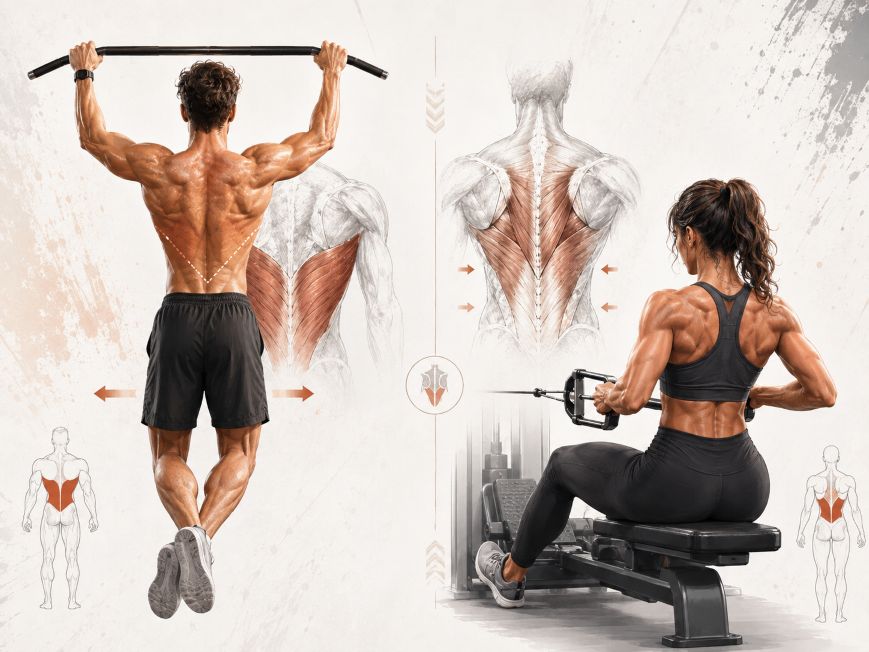
In strength training, people often talk about a wide back and a thick back. The expressions “back width” and “back thickness” mainly describe two visual effects, not two different directions in which the same muscle could develop. Some exercises place more emphasis on the lats, while others recruit the muscles that add density to the middle back more strongly.
For width, the focus is mainly on the lats and more specifically the latissimus dorsi. Pull-ups, lat pulldowns, and high cable pulldowns strongly recruit this muscle and therefore contribute to a wider appearance. Certain neutral or wide grips can be used depending on the exercise and individual comfort. Movements in which the elbows move down toward the hips also involve the latissimus dorsi effectively. However, it is not necessary to use the widest grip possible: a grip that is too wide can reduce the range of motion and make the movement less effective.
For thickness, rows play an important role. The barbell row, dumbbell row, seated cable row, machine row, and low cable row recruit the latissimus dorsi, but also the middle back, trapezius, rhomboids, and rear delts. Developing this group of muscles creates a denser, stronger back with more definition around the shoulder blades. These exercises therefore do not develop back thickness exclusively, but they place greater emphasis on the muscles that contribute to this visual effect.
In a well-designed workout, it therefore makes sense to combine a vertical pulling movement with a horizontal pulling movement. For example, you can perform a lat pulldown or pull-ups for width, followed by a row or seated cable row for thickness. This approach trains the back more completely than performing three almost identical variations of the same pulling movement.

https://www.bodytrainingguide.com/fr/articles/muscle-groups-understanding-the-main-muscles-of-the-body-to-train-better
Building Your Back with Dumbbells
Dumbbells are very useful for training the back, especially when you do not have access to all the strength-training machines for the back or when you want to correct an imbalance between the two sides. The dumbbell row is the main movement because it lets you pull heavy, work one side at a time, and control the elbow path well. To perform a dumbbell row properly, avoid thinking only about lifting the hand. A better cue is to pull the elbow backward or toward the hip, depending on the area you want to feel more, because if the hand rises but the shoulder moves in every direction, or if the biceps do all the work, the back will be recruited less effectively.
You can also perform the dumbbell row with one knee on a bench and one hand supported, or in a bent-over position with both feet on the floor. Each variation can work, but with the same goal: maintain control, avoid excessively rotating the torso, and do not throw the weight on each repetition. Dumbbells can also be used for pullovers, even though the cable version often maintains more consistent tension. This movement can help you feel the lats, provided you remain cautious with the range of motion and do not lower the weight too far if your shoulders are uncomfortable.
For a dumbbell back workout, you can already keep things simple with a one-arm dumbbell row, a bent-over row with two dumbbells, a dumbbell pullover, and then possibly an exercise for the lower back or some core work. It is not as complete as a well-equipped gym, but it is enough to build a solid foundation if execution and progression are taken seriously.

Training Your Back at Home: What Really Works
Training your back at home is more complicated than training your chest, because it is easier to push against the floor with push-ups than to pull without equipment. The back needs pulling movements, so without a bar, resistance bands, dumbbells, or a solid support, the possibilities are more limited.
That does not mean there is nothing you can do. Bodyweight exercises such as the superman, floor extensions, certain core movements, reverse snow angels, or floor rear-delt exercises can help strengthen the upper and lower back, but they will not completely replace pull-ups, rows, or loaded pulling movements.
If the goal is truly to build your back at home, the most worthwhile option is often to have a minimum amount of equipment. A pull-up bar, resistance bands, or a pair of dumbbells dramatically expands the possibilities, because with a bar you can do pull-ups or assisted pull-ups, with resistance bands you can do pulldowns, rows, face pulls, or pullovers, and with dumbbells you can do rows and pullovers.
For beginners, resistance bands are often a good option because they allow you to create a pulling movement without much equipment. You can attach the bands to a solid door or reliable support, then perform horizontal pulls, straight-arm pulldowns, or rear-delt movements, while simply paying attention to the safety of the anchor. A TRX is also very useful for training the back at home because it allows you to perform different bodyweight horizontal rows and easily adjust the difficulty by changing your body angle, provided you have a perfectly solid anchor point.
Training the Lower Back and Lumbar Muscles
The lower back deserves particular attention because it is involved in many movements but can also become sensitive if it is loaded poorly or too quickly. The lumbar muscles already work during several exercises such as bent-over rows, deadlifts, certain squats, back extensions, and all movements where the torso must remain solid. To strengthen the lumbar muscles, back extensions are a simple option, provided they are performed properly. Rather than trying to rise excessively by strongly arching the back, control the descent, come back up to an aligned position, and feel the posterior chain working.
Core work can also help, even though it does not replace actual pulling work, because stronger abdominal bracing helps support the pelvis and torso more effectively, which can be useful during heavy exercises. Many trainees can already make progress with solid core work, well-executed rows, and controlled back extensions. It is important to distinguish between muscle fatigue and pain. Feeling the lower back working is not necessarily a problem, but sharp, unusual pain that travels down the leg or persists should not be ignored. In that case, do not try to force more sets; adjust the training and seek professional advice if necessary.
Example of a Back Workout
A good back workout should cover several angles without becoming endless. For most trainees, four to five well-chosen exercises are more than enough, especially if the sets are performed with genuinely good execution.
At the gym, a complete workout can begin with pull-ups or lat pulldowns for 3 to 4 sets of 6 to 12 reps, continue with a barbell row or machine row for 3 to 4 sets of 8 to 12 reps, add a seated cable row for 2 to 3 sets of 10 to 15 reps, then finish with a cable pullover or a more targeted lat exercise for 2 to 3 sets of 12 to 20 reps.
If the lower back needs to be strengthened, controlled back extensions can be added at the end of the workout without trying to load them heavily from the start, with the goal of strengthening progressively rather than adding unnecessary fatigue.
For a beginner, the workout can be simpler: lat pulldown, seated cable row, machine row, and possibly light back extensions. The goal is not to do everything, but to learn how to pull with the back, control the shoulder blades, and progress without pain. For an intermediate trainee, you can vary things more, for example with a width-focused workout made up of pull-ups, lat pulldowns, and pullovers, then another workout later in the week focused more on thickness, with barbell rows, seated cable rows, and dumbbell rows.
The important point is to track progress, because if the loads increase but the movement becomes increasingly sloppy, that is not necessarily real progress. By contrast, keeping the same load with a better range of motion, more control, and a better feel for the back can already be useful progress.

Training Frequency and Volume for Progress
For most trainees, training the back once or twice per week is enough. One well-designed workout can already produce good results, while two workouts often make it easier to distribute volume and progress more consistently, especially if the back is a weak point.
Volume depends on level, program, and recovery. A beginner does not need to perform a huge number of sets to make progress, because the main priorities are learning the movements, feeling the back work, and building a foundation, while a more advanced trainee may need more volume, provided that volume remains recoverable.
In a push pull legs program, the back is generally trained during the pull workout, along with the biceps and sometimes the rear delts. In an upper-body / lower-body program, it may be trained twice per week along with the chest, shoulders, and arms, while in a more traditional split it may have its own dedicated workout. You should also consider balance with the chest, because many trainees do a lot of bench presses, incline presses, and pushing movements, but not enough high-quality pulling. A strong back helps balance the upper body, position the shoulders better, and build a more harmonious physique.
Common Mistakes on Back Exercises
The first mistake is pulling only with the arms. This is very common on pulldowns and rows, especially when the weight is too heavy or the trainee thinks only about bringing the handle toward the body. To feel the back better, it often helps to think about pulling with the elbows, controlling the shoulder blades, and maintaining a stable movement path.
The second mistake is going too heavy too quickly, because this becomes obvious very fast on a row: the torso moves, momentum replaces control, the range of motion decreases, and the back no longer works as intended. A slightly lighter load that is better controlled often provides better muscular work.
The third mistake is trying to train only back width or back thickness. These two terms mainly describe visual effects produced by the development of several muscles. Performing only lat pulldowns strongly recruits the lats, but does not always sufficiently develop the middle traps, rhomboids, and the entire middle back. Conversely, doing only rows limits the variety of movements given to the latissimus dorsi. It is therefore preferable to combine angles with at least one vertical pull and one horizontal pull.
The fourth mistake is neglecting range of motion. Many trainees shorten the movement on pulling exercises, either by not returning far enough or by not pulling far enough, even though enough movement is needed to stretch and contract the back properly without losing control.
The fifth mistake is positioning the torso and shoulders poorly. If the shoulders rise toward the ears on every repetition, the upper traps and arms may take over, while if the back rounds significantly during rows, the lower back may be overloaded.
Finally, many trainees change exercises too often. Variety can be useful, but if movements change every week, it becomes difficult to track real progress. It is therefore better to keep a few main exercises for several weeks, properly warm up the muscles, and improve execution, then adjust when progress slows.
Key Takeaways
To train the back properly in strength training, you need to combine vertical pulling exercises, horizontal pulling exercises, rows, and possibly more targeted work for the lower back. Pull-ups, lat pulldowns, seated cable rows, barbell rows, dumbbell rows, machine rows, cable pullovers, and back extensions can all have a place, but they do not serve exactly the same purpose.
The most important thing is to choose movements suited to your level, maintain clean execution, and progress with control. A wide, thick back is not built by pulling any way you can, but with well-chosen exercises, good technique, proper recovery, and genuine consistency over the weeks.
FAQ
What is the best exercise for the back?
There is no single best exercise for the back, but pull-ups, lat pulldowns, barbell rows, dumbbell rows, and seated cable rows are among the most effective movements. The right choice mainly depends on your level, the equipment available, and your goal.
What exercises should you do for a wider back?
To develop back width, pull-ups, lat pulldowns, and high cable pulldown variations are very useful, with the goal of recruiting the lats effectively without necessarily using a grip that is so wide that it reduces the range of motion. That said, all pulling exercises work back width.
What exercises should you do to build a thicker back?
To build a thicker back, rows are very important, especially barbell rows, dumbbell rows, machine rows, and seated cable rows, because these exercises work the middle back, middle traps, rhomboids, and rear delts more.
How do you train your back with dumbbells?
With dumbbells, the one-arm dumbbell row is the main back exercise. You can also do a bent-over row with two dumbbells or a dumbbell pullover, while always maintaining controlled execution and a stable movement path.
Can you build your back at home?
Yes, but it is easier with a minimum amount of equipment, such as a pull-up bar, resistance bands, or dumbbells, because without equipment you can strengthen the lower back and the rear of the upper body, but true pulling movements remain limited.
How do you train the lower back?
The lower back can be trained with back extensions, core work, certain well-controlled rows, and posterior-chain movements, while progressing gradually, avoiding adding load too quickly, and clearly distinguishing muscular work from actual pain.
Why do I feel my arms instead of my back?
If your arms take over too much, it is often because the load is too heavy, you are pulling with your hands instead of your elbows, or your shoulder blades are not well controlled. Reducing the load and slowing the movement can help you feel your back better.
How many times per week should you train your back?
Once or twice per week is enough for most trainees. Two workouts can help distribute the volume more effectively, especially if the back is a weak point, provided recovery remains good.
Related articles

How to train your chest properly?
The chest muscles are among the muscles that many lifters want to develop as a priority, whether to build size, improve the upper body, or make progress on exercises like the bench press, but training the chest properly is not just about doing the same movement over and over with

Bulking in Strength Training: How to Gain Muscle Without Gaining Too Much Fat
Bulking is a phase where you aim to gain weight to support muscle building. In theory, the idea seems simple: eat more, train hard, and progress. But in practice, this is often where many lifters go wrong. Some eat far too much and mostly gain fat, while others are afraid to eat

How to Cut: Lose Fat Without Losing Muscle
Cutting in strength training is a period where the goal is to lose fat while keeping as much muscle as possible. It often comes after a bulk, but it can also apply to someone who simply wants to improve their body composition, get leaner, or make their muscles more visible. The