Mobility exercises for strength training: improve joint mobility
Discover mobility exercises for the ankles, hips, shoulders, and back, with a simple routine to include before strength training.

Joint mobility, flexibility, and stretching: what are the differences?
The three terms are similar, but they do not mean exactly the same thing. The flexibility mainly refers to the ability of muscles and tissues to lengthen, while joint mobility refers to a joint's ability to move properly through a sufficient and controlled range of motion. A stretch is mainly used to work on flexibility, by gradually placing a muscle or tissue in a position where it lengthens. To work on mobility, mobility exercises are generally used instead, with active, controlled movements that move the joint through the desired range of motion.
For example, a calf stretch can help loosen the tissues at the back of the lower leg, while an exercise where the knee moves forward over the foot while the heel stays on the floor directly works on ankle mobility. For the hips, a stretch can help improve flexibility, while hip rotations or 90/90 movements are mainly used to work on the joint's ability to move and control that range of motion.
The two can therefore complement each other. If overly tight muscles limit a joint's movement, a few stretches can help, but to truly improve mobility, the joint itself also needs to move and learn to control this new range of motion.
Why work on mobility for strength training?
A limited range of motion can change the way a movement is performed. When doing a squat, for example, stiff ankles can make it harder to descend and cause the heels to lift, the range of motion to shorten, or the pelvis to compensate. During an overhead press, limited mobility in the shoulders or upper back can force you to arch more to get the arms overhead.
Working on mobility can therefore help restore a more stable position and a better-controlled range of motion. This can improve execution, allow the target muscle to work through a fuller range of motion, and limit certain compensations, for example when other muscles take over too much because the starting position is not good.
In strength training, this better range of motion can also be useful for hypertrophy, because many exercises become more effective when they are performed through a sufficiently large and well-controlled range of motion. This does not mean trying to achieve the maximum possible range at all costs, but rather using the range of motion that can actually be controlled without losing technique.
However, not everything should be attributed to mobility. If an exercise remains difficult, technique, strength, control, body structure, or simply the choice of variation may also be involved. The goal is therefore to improve mobility when it truly limits the movement, not to try to become more mobile for no reason.
Ankle mobility: exercises to increase range of motion
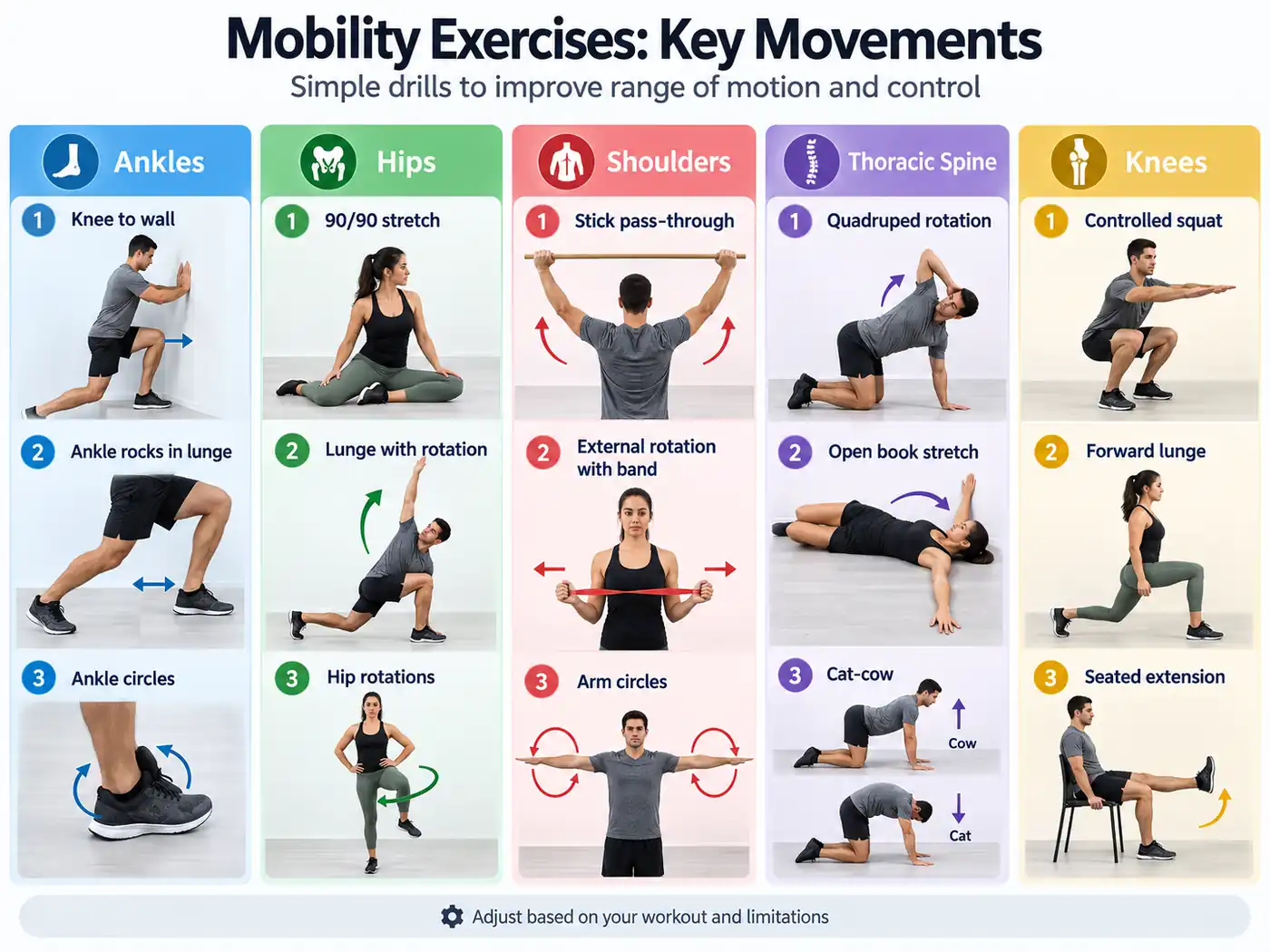
When the heels tend to lift during a squat or it becomes difficult to let the knees move forward without losing balance, the ankle may be one of the areas to look at. A very simple exercise is to place one foot in front of a wall, then gradually move the knee toward it while keeping the heel on the floor. The foot should remain stable and the movement should be slow. When the knee reaches the wall easily, the foot can be moved slightly farther back to gradually increase the range of motion.
The same principle can be used in a lunge position, with the front knee moving forward over the foot while the heel stays in contact with the floor. A few controlled repetitions on each side are generally enough to start.
This type of ankle mobility work can be particularly useful before squats, lunges, or certain leg press exercises, but it does not need to be done at every workout if there is no limitation.
Hip mobility exercises
The hips are involved in almost every lower-body movement. They need to be able to flex, open, and rotate, which is why a single movement is not necessarily enough to work on all of these possibilities. Seated hip rotations are a good place to start. For example, the 90/90 position can be used, with both legs bent, then moving slowly from one side to the other without trying to go fast. The movement should come from the hips and remain controlled.
A deep lunge can also be used as a hip mobility exercise. In this case, the goal is not simply to go as low as possible, but to keep the pelvis stable and gradually move into a comfortable range of motion.
Standing or quadruped hip openers can also be used before a leg workout.
Above all, avoid trying to find the same position for everyone. A comfortable stance width for a squat, the angle of the toes, or the accessible depth can vary from one person to another. Mobility work should help you move better, not force the body to reproduce a specific position.
Shoulder mobility: exercises to improve range of motion
You should be able to raise your arms overhead without having to arch your back significantly or push your head forward to complete the movement. When this movement is difficult, a few exercises can be used to gradually work on the range of motion.
With a stick or resistance band held between the hands, the arms can move from in front of the body to overhead, using a grip wide enough for the movement to remain smooth. There is no need to bring the hands closer together quickly; the goal is simply to control the available range of motion. Slow arm circles can be used as preparation, while external rotation movements with a light resistance band can complement the work around the joint.
The shoulder mobility becomes particularly useful for military presses, shoulder presses, or certain exercises performed overhead. If these movements are already comfortable and well controlled, there is no need to add many extra exercises, but they can provide a real benefit when there is a restriction during shoulder exercises.
Back and upper-body mobility
For the back, the work mainly concerns the thoracic area, meaning the upper back. This area is involved in torso rotation and supports many shoulder movements.
From an all-fours position, one hand can be placed behind the head, then the elbow can be gradually rotated toward the ceiling before returning. The pelvis remains relatively stable to prevent the whole body from rotating at the same time.
Another option is to lie on your side with the legs bent, then slowly open the top arm backward. This movement helps work on upper-body rotation without trying to force the range. These exercises can be useful before an upper-body workout when you feel stiff or as part of a mobility routine.
Mobility routine before strength training
Before a workout, three or four well-chosen movements are generally enough. A mobility routine should mainly prepare the joints that will be used, not work the entire body for no reason.
Before a leg workout, for example, you can do:
- 8 to 10 ankle movements on each side.
- 6 to 10 hip rotations.
- A few controlled lunges with hip opening.
- A few bodyweight squats, gradually increasing the range of motion.
Before an upper-body workout, the routine can be different:
- A few arm circles.
- Pass-throughs with a stick or resistance band.
- A few upper-back rotations.
- One or two light movements similar to the exercises planned afterward.
This does not replace warm-up sets. Once mobility has been prepared, the load on the main exercises should still be increased gradually before the difficult sets.
When should you do mobility exercises?
The timing mainly depends on the goal. Before training, the movements should remain relatively short and dynamic, with the aim of preparing a position or a joint, not fatiguing the muscles before the workout. When a limitation requires more work, a few minutes can be added at another time of day or in a short separate mobility session. This allows more time without making every warm-up longer. Consistency often matters more than duration. Five to ten minutes several times a week can be easier to maintain than one occasional long session. It is not necessary to work on mobility every day, and a joint that already has all the range of motion needed for the exercises being performed does not necessarily need additional work.
How should you adapt exercises to your own limitations?
The best starting point is to look at what actually happens during strength training exercises. If the heels lift quickly during a squat, ankle work can be tested. If raising the arms overhead requires a significant back arch, the shoulders or thoracic area may need more attention. If a lunge or squat position feels very limited at the pelvis, a few hip exercises may be useful.
But difficulty does not automatically mean that a joint lacks mobility. A lifter may have enough range of motion and simply lack strength or control in that position. Technique may also be involved, as can an exercise variation that is poorly suited to the person's body structure.
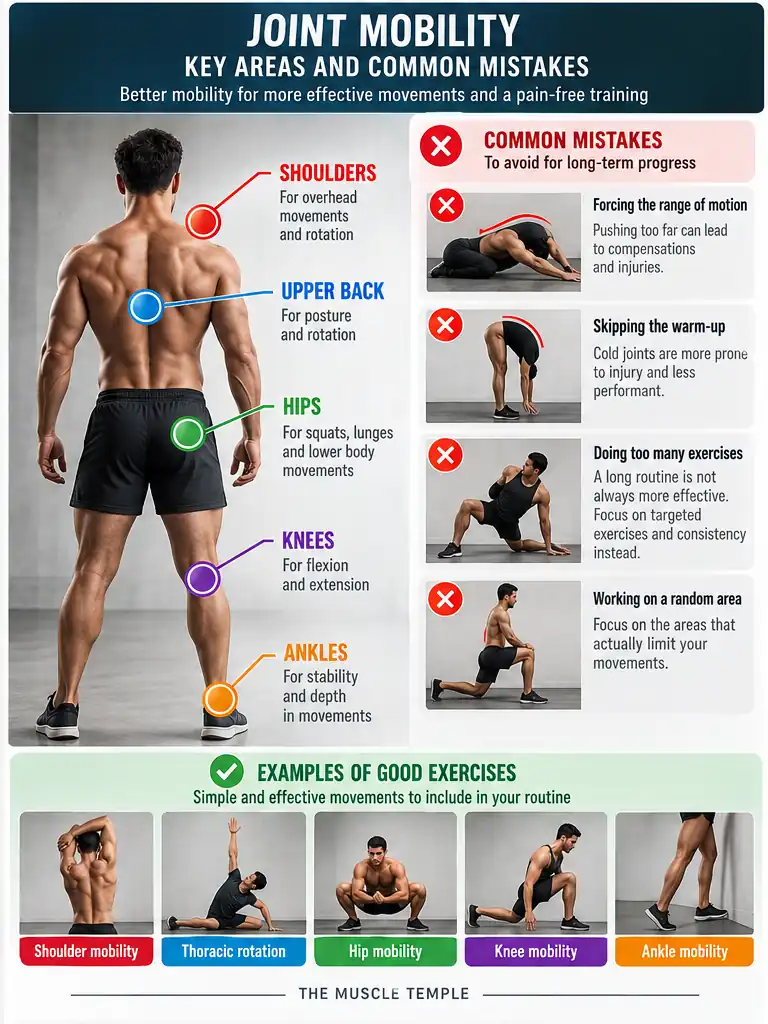
The knee is a good example, because when a squat seems limited, people sometimes immediately think about knee mobility, even though the ankles, hips, or foot position may play a more important role. The knee mainly needs to be able to flex and extend comfortably during the movement. Finally, sharp or persistent pain should not be treated simply by adding more and more mobility work. In that case, it is better to stop forcing the affected area and seek professional advice if the problem continues.
Common mistakes with mobility exercises
Forcing the range of motion is one of the most common mistakes. You may feel a stretch or tension, but it should not become painful or force you to completely lose control of the movement. Another mistake is accumulating exercises because they are popular on social media. A fifteen-movement routine is not necessarily better than a three-movement routine that is genuinely suited to the problem being addressed.
It is also important not to confuse mobility with warming up. A few hip or ankle rotations do not directly prepare you for a heavy squat; warm-up sets are still needed to gradually build up to the working weight.
Conversely, some people spend a great deal of time trying to improve a range of motion that causes them no problem. If an exercise is already comfortable and well controlled, there is not always a reason to try to go farther.
Mobility should support training, not become an additional obligation.
Key takeaways
The mobility exercises can help when a joint lacks the range of motion needed to correctly perform certain strength training movements. The ankles and hips are particularly important for the lower body, while the shoulders and upper back are more involved in upper-body movements.
There is no need to work on all of these areas at every workout. The most useful approach is to identify what is actually limiting an exercise, then choose a few simple movements and repeat them regularly.
Better mobility should mainly make it easier to move and better control the positions used during training.
FAQ
What is joint mobility?
Joint mobility is the ability to move a joint through a certain range of motion while maintaining control of the movement. It therefore does not depend on flexibility alone.
Which mobility exercises should you do before strength training?
The choice depends on the workout. Before training legs, you can work on the ankles and hips, while before an upper-body workout, a few movements for the shoulders and thoracic area may be more suitable.
How long should a mobility routine last?
A few minutes can be enough before a workout. A five- to ten-minute routine is already very useful if it includes movements suited to the exercises that will follow.
What is the difference between mobility and flexibility?
Flexibility mainly refers to the ability of muscles and tissues to lengthen, while mobility refers to the range of motion that can be used and controlled at a joint.
How can you improve shoulder mobility?
Pass-throughs with a stick or resistance band, certain rotation movements, and upper-back work can be used. It is better to progress gradually rather than immediately forcing a large range of motion.
How can you improve ankle mobility?
You can gradually move the knee forward over the foot while keeping the heel on the floor, either against a wall or in a lunge position. The range of motion can then be increased progressively as the movement becomes easier.
Does mobility help you squat better?
Yes, when a real limitation in the ankles or hips prevents you from getting into a good position. But technique, strength, control, and body structure can also affect the squat.
Do you need to work on mobility every day?
No. Regular practice can be useful when an area lacks range of motion, but there is no need to work every joint daily if the movements used in strength training are already comfortable.
Related articles
Strength Training Machines: Which Ones Should Beginners Use at the Gym?
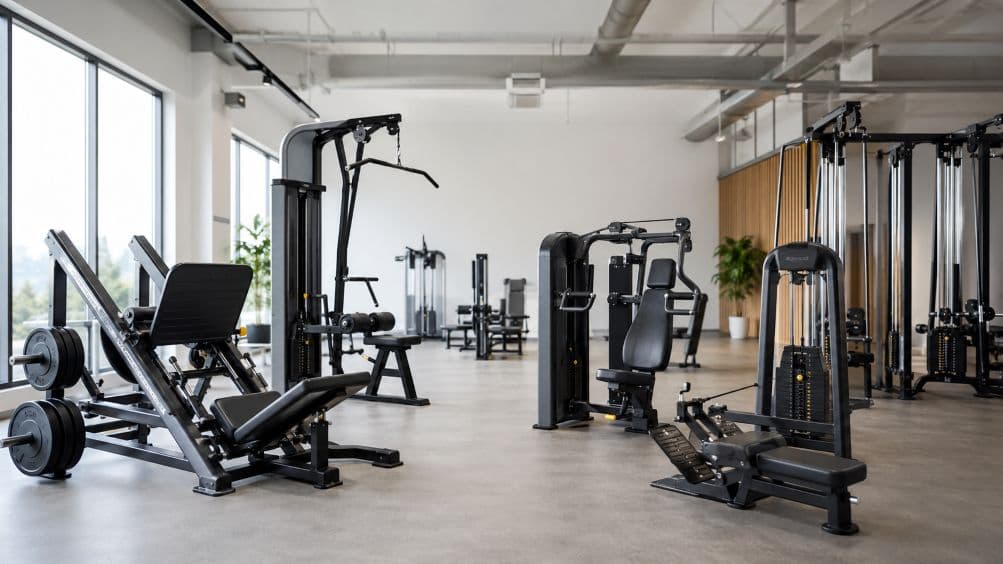
When you walk into a gym, strength training machines can quickly make it feel like you already need to know everything before getting started. There are machines for the legs, back, chest, shoulders, arms, and abs. Some are easy to understand, while others are much less obvious.

How to Build a Coherent Workout Based on Your Level and Goal
When you start strength training, you often think first about exercises, muscle groups, or dietary supplements. Yet what connects all of that is the program. Without a program, you go through workouts. With a program, you follow a logic, and it is this logic that allows you to kn
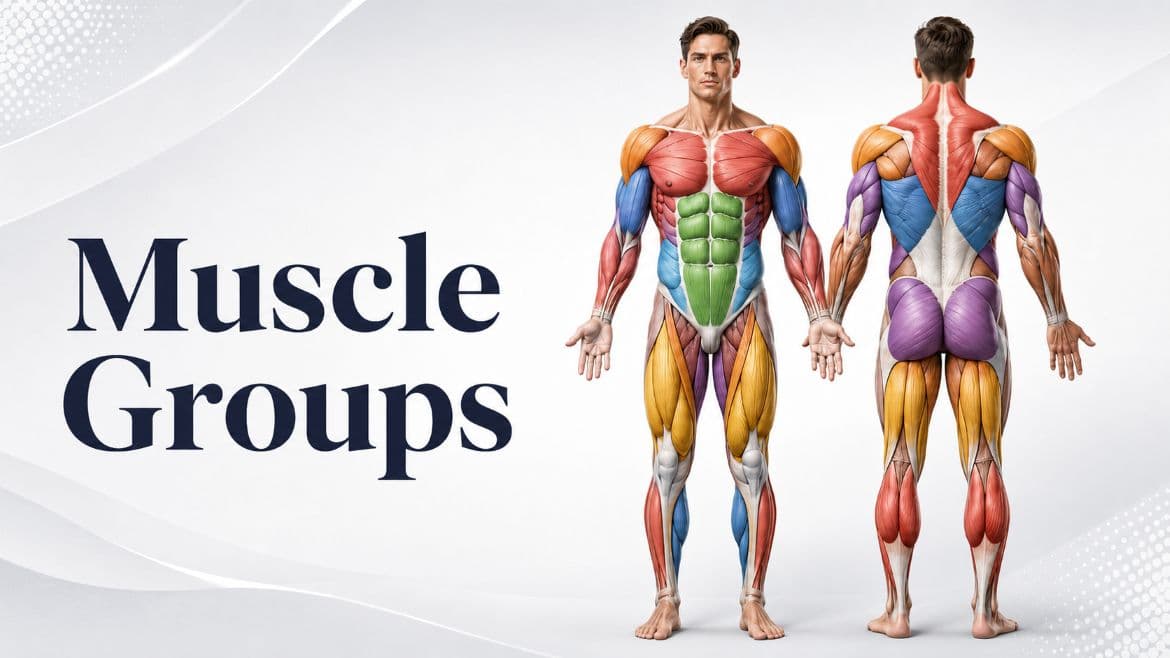
Muscle Groups: Understanding the Main Muscles of the Body to Train Better
A guide to understand the basics of the topic and organize your training more effectively.