Arm exercises: how to build your biceps, triceps, and forearms?
Discover which arm exercises to choose for the biceps, triceps, and forearms, with dumbbells, at home, and in a complete workout.
Arm muscles to know before choosing your exercises
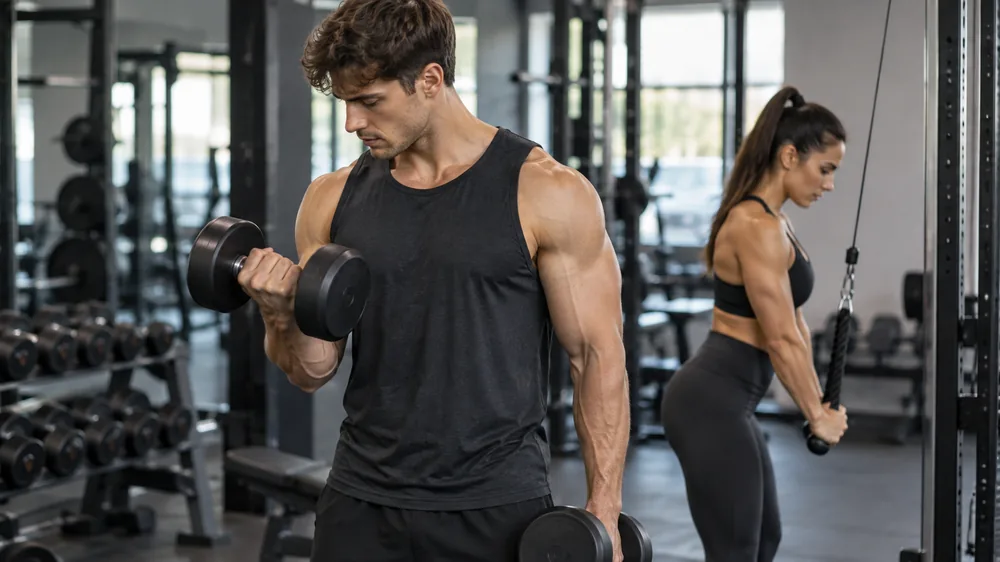
At the front of the upper arm, the biceps brachii contributes to elbow flexion, but also to forearm supination, meaning the movement that turns the palm upward. It is not the only muscle that flexes the elbow: the brachialis and brachioradialis also contribute to the movement.
At the back is the triceps, which contributes to elbow extension. It is therefore involved in cable extensions as well as the bench press, shoulder press, and dips. If the goal is to develop bigger arms, focusing only on the biceps leaves out an important part of the work.
The forearms include several muscles involved in movements of the wrist, fingers, and forearm, and they also work simply to hold a barbell or dumbbells. This is why someone who does a lot of pulling exercises, curls, deadlifts, or farmer carries may already train them heavily without any specific exercise.
Which arm exercises should you choose for strength training?
To train the arms completely, you mainly need to cover three types of movements: curls for the biceps and other elbow flexors, extensions or pressing movements for the triceps, and possibly specific forearm work. For the biceps, a barbell or dumbbell curl can serve as a base, an incline curl lets you work with the arm positioned farther behind the torso, while the hammer curl changes the grip and involves the elbow flexors more broadly. A cable can also replace or complement free weights.
For the triceps, the cable extension is easy to control and progress on, an overhead extension provides a different arm position, while dips or the close-grip bench press train the triceps in more compound movements where the chest and shoulders also contribute. The forearms do not necessarily need a long dedicated section. Reverse curls, wrist curls or extensions, and farmer carries can be added if this area is a priority or if you want to improve grip strength.
You then need to look at what you are already doing in the rest of your program. The biceps contribute to pull-ups, rows, and many back exercises. The triceps work during the bench press and other chest exercises, as well as during several shoulder exercises.
A back workout with a lot of pulling therefore does not have the same impact on the biceps as a workout where they are barely involved, and the same applies to the triceps after several pressing movements, so the right number of arm exercises depends partly on this indirect work. There is no single movement that is, by itself, the best exercise for the biceps or triceps. The most useful approach is to choose a few complementary exercises that you can perform correctly and progress on over the weeks.
Bicep exercises: which curls should you use?
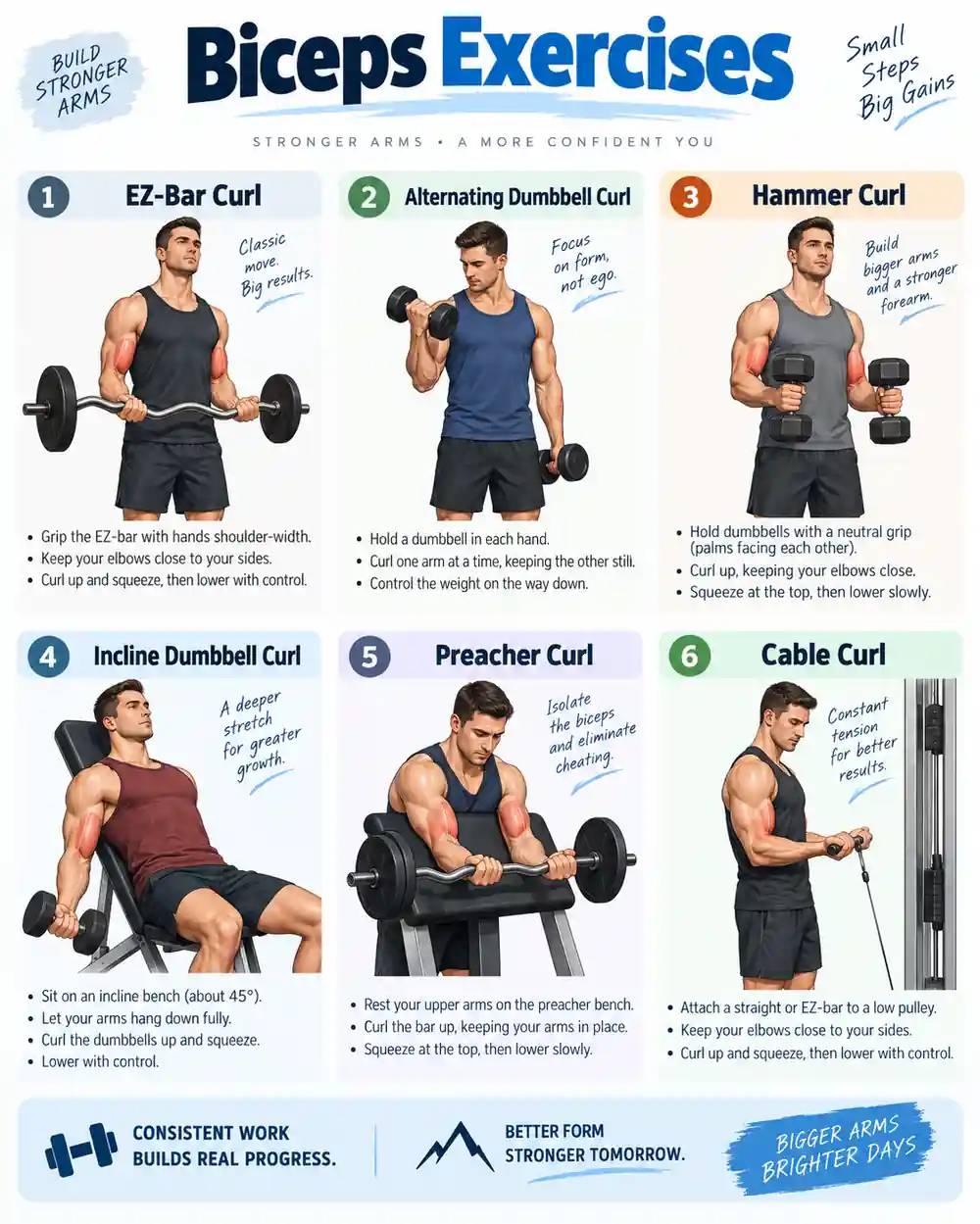
Curls are the main bicep exercises because they involve flexing the elbow against resistance. Depending on the variation, the position of the hand, arm, or resistance changes, but the basic movement remains the same.
There is therefore no need to do every type of curl in the same workout. Two or three well-chosen variations can already cover direct work for the biceps and other elbow flexors very well.
Barbell curl or EZ-bar curl
The barbell curl is easy to track: both arms work at the same time, and it is easy to gradually add weight or repetitions. With a straight bar, the hands remain supinated, while an EZ bar slightly changes this position through its angled grips and may be more comfortable for some people at the wrists.
In both cases, the weight should remain controlled enough that the movement does not systematically turn into swinging the torso. A little movement at the end of a set does not invalidate the exercise, but if the hips and back initiate every repetition, it becomes difficult to know whether the biceps are actually progressing.
Dumbbell curl
Dumbbell bicep curls allow each arm to work independently. This is useful for avoiding a barbell forcing exactly the same position on both sides and for making a strength difference easier to identify.
The hand position can also change naturally during the movement. You can start with a relatively neutral grip and then gradually turn the palm upward as you lift, but there is no need to force this rotation: it should remain comfortable.
The dumbbell curl can be performed with both arms simultaneously or alternated. The choice mainly depends on what you prefer and your ability to maintain clean execution.
Incline dumbbell curl
On an incline curl, the backrest positions the arms slightly behind the torso at the start, so the biceps begin the movement in a more lengthened position than in many standing curls.
The goal is not to lower the backrest as far as possible. You need to find an angle that lets the arms hang naturally, extend the elbow, and raise the dumbbells without strongly moving the shoulders forward. Because the position is more demanding, using less weight than on a standing curl is completely normal.
Hammer curl
The hammer curl is performed with a neutral grip, with the palms facing each other, while the biceps still contribute to the movement along with the brachialis and brachioradialis.
This different grip mainly explains the value of the hammer curl in a workout: it easily complements a curl performed with the palm facing upward, without needing to add much more.
Cable curl
The cable changes the direction from which resistance is applied. With a low cable positioned in front of you, the movement remains very similar to a conventional curl, but the cable maintains resistance along its line of pull throughout the movement.
It also offers many adjustment options, with body position, cable height, and the handle all able to be changed without needing to switch to a completely different exercise.
This does not automatically make the cable curl superior to dumbbells or a barbell. It is simply another way to perform an arm exercise, particularly useful when you want to fine-tune the load.
Tricep exercises: extensions, dips, and pressing movements
Tricep exercises are not limited to cable extensions. Whenever a movement requires extending the elbow against resistance, the triceps are involved. This is why they also work during presses and dips.
For triceps training, it can be useful to combine an extension exercise that is easy to control, a variation with the arm overhead, and possibly a compound movement.
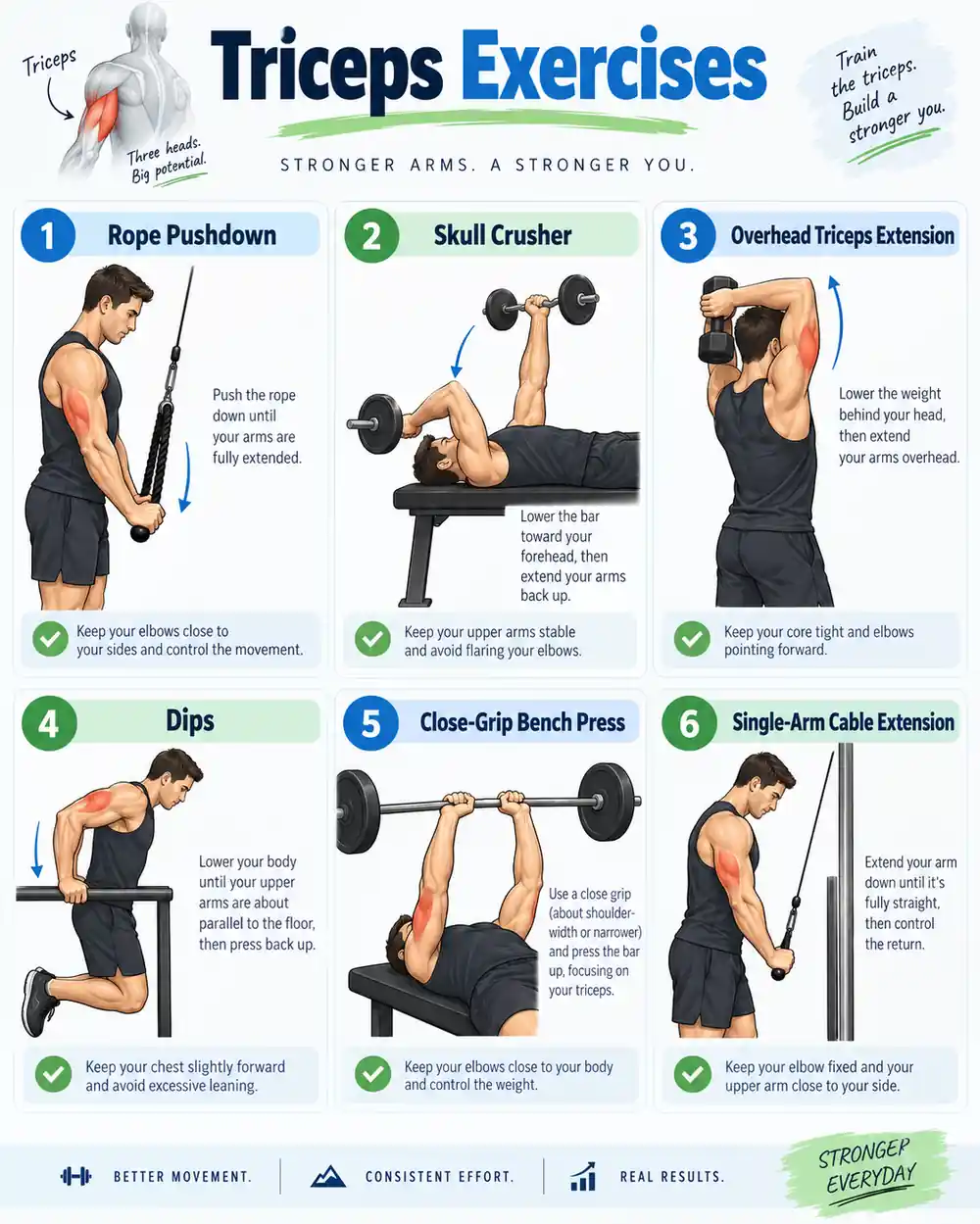
Cable triceps extension
The cable triceps extension is easy to incorporate into a workout because the weight can be adjusted quickly and the exercise can be performed with a rope, bar, or handle. The movement comes mainly from the elbow. The upper arms do not need to be locked as if they were fixed to the body, but they should remain stable enough to prevent the exercise from turning into a press using the shoulders and torso.
A rope allows the hands to move freely at the bottom of the movement. However, there is no need to try to spread it as far apart as possible: what matters most is completing elbow extension while keeping the movement under control.
Overhead triceps extension
When the arm is raised, the long head of the triceps is placed in a more lengthened position, which is precisely what truly distinguishes this variation from an extension where the arm remains alongside the body.
The exercise can be performed on a cable, with one dumbbell held in both hands, or with a dumbbell in each hand. The main goal is to find a position where the shoulders remain comfortable and the elbows can extend without the back arching strongly to assist each repetition.
This variation therefore complements a conventional extension well without requiring several other nearly identical movements.
Skull crushers
The skull crusher is an elbow extension generally performed lying on a bench, often using an EZ bar, although a straight bar or dumbbells can also work.
The name of the exercise does not mean that the bar must necessarily lower exactly to the forehead. Depending on your anatomy and chosen position, it can lower slightly higher or behind the head. The priority is to control the weight and find a path that is comfortable for the elbows.
Tricep dips
Dips heavily involve the triceps, but they are not isolation exercises. The chest and shoulders also contribute to the pressing movement.
They can already be difficult at bodyweight, so there is no reason to add weight as long as the exercise remains challenging enough without additional load.
Depth should also remain appropriate for your mobility and comfort. Going as low as possible is not a goal in itself. If dips cause shoulder discomfort, other exercises can train the triceps perfectly well.
Close-grip bench press
The bench press with a narrower grip places substantial emphasis on elbow extension while still involving the chest and front of the shoulder.
One benefit is the ability to work with a heavier load than on an isolation extension. It can therefore serve as a compound movement in a workout where the triceps are a priority.
However, “close grip” does not mean placing the hands right next to each other. A moderately narrower grip that allows you to press hard while keeping the wrists and shoulders comfortable is enough.
Arm exercises with dumbbells
A pair of dumbbells is enough to directly train the biceps and triceps. If you are looking for an arm exercise with dumbbells, the choice mainly depends on the equipment available: with dumbbells alone, you can already build a complete workout.
For the biceps, the standard curl lets you work in supination, while the hammer curl changes the grip, and if you have an adjustable bench, the incline curl adds a different arm position.
For the triceps, the overhead extension works very well with a dumbbell, while a lying extension can replace skull crushers, with the advantage of allowing each arm to position itself more freely.
The kickback is also an option because it can provide additional work, but its position generally limits the amount of weight that can be used and there is no reason to consider it essential.
A workout using only dumbbell arm exercises can therefore be built around four simple movements: a standard curl, a hammer or incline curl, an overhead extension, and a lying extension. You then simply need to progress the weight, repetitions, or quality of execution.
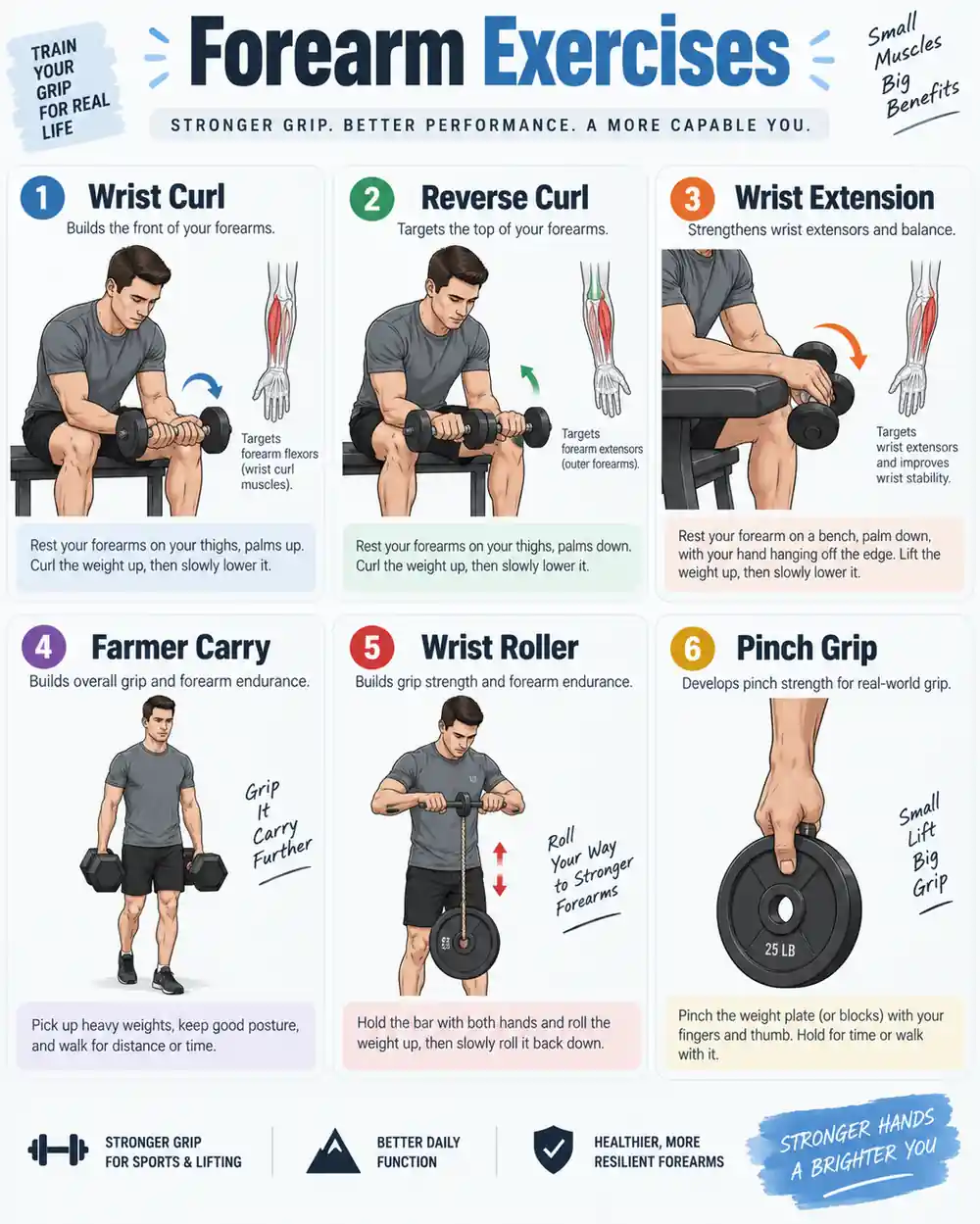
Forearm exercises: do you need to train them directly?
The forearms already receive a lot of work whenever you have to hold a load. Pull-ups, rows, curls, deadlifts, and farmer carries all challenge grip to varying degrees. For many people, this may be enough. It is therefore not mandatory to add a forearm exercise to every workout.
Direct work becomes more useful if this area is clearly lagging, if you want to strengthen your grip, or if the forearms are one of your physique priorities. Wrist curls work the flexors more, while wrist extensions involve the muscles on the other side of the forearm. The reverse curl adds another option: with the palms facing downward, the elbow flexors work in a different position than during a standard curl.
The farmer carry is different again because it does not require repeated wrist flexion: the work mainly consists of holding a heavy load while walking. It can therefore be used to strengthen grip without adding a long series of isolation exercises.
Arm workout: biceps and triceps example
An arm workout does not need to include ten exercises. The goal is to give the biceps and triceps enough work while still being able to progress on the movements you choose.
Here is an example arm workout:
- Barbell or EZ-bar curl: 3 sets of 6 to 10 repetitions
- Cable triceps extension: 3 sets of 8 to 12 repetitions
- Incline dumbbell curl: 3 sets of 8 to 12 repetitions
- Overhead triceps extension: 3 sets of 10 to 15 repetitions
- Hammer curl: 2 to 3 sets of 10 to 15 repetitions
- Forearms: 2 to 3 sets if needed
Rep ranges do not correspond to zones where the muscle suddenly functions differently; they mainly help organize the workout. A stable barbell curl is well suited to relatively heavy work, while an extension or curl performed in a more demanding position may be more comfortable with more repetitions and a lighter load.
This workout is not a template to copy into every program. If you train arms after a lot of pulling or pressing, the volume can be reduced. Conversely, someone who particularly wants to build their arms can devote more direct work to them.
How many exercises and sets do you need to build your arms?
There is no number of sets that works perfectly for everyone. The necessary volume varies according to your level, the number of workouts performed during the week, the intensity of the sets, and the indirect work already performed. Recent recommendations on hypertrophy show that a certain amount of weekly volume is useful and that more sets can, up to a point, promote more growth. This does not mean that you should add as much volume as possible.
For the arms, the question is even harder to reduce to a single number. A set of curls is clearly a direct set for the biceps and other elbow flexors, while a set of pull-ups is primarily a back exercise, but the biceps also work, and the same logic applies to the triceps with the bench press.
A beginner who already performs several compound exercises can therefore progress with relatively little direct work. A more advanced person who wants to make arms a priority can gradually increase the number of sets.
What matters is checking what this volume actually produces: progress in repetitions or loads, good recovery, and execution that remains correct. Doing twenty sets of curls simply because twenty is more than ten is not a progression strategy.
How many times per week should you train your arms?
Biceps and triceps work can be distributed across several workouts. Frequency mainly serves to organize volume in a way that keeps sets high quality. In a full-body program, a few arm sets can be spread across several workouts, while in a push pull legs program, the biceps are often trained directly with the pull workout and the triceps with the push workout.
A split can also include a dedicated arm workout. It is not mandatory: it becomes useful when this organization fits the program better or when the arms are a priority.
The available data mainly show that when weekly volume is comparable, simply increasing frequency does not guarantee more hypertrophy. You should therefore organize your strength training program according to total volume and recovery rather than searching for a perfect frequency.
Two direct training sessions during the week can, for example, be practical for someone who wants to emphasize arm training, but this is not a rule that applies to everyone.
Arm exercises at home: with or without equipment
To do arm exercises at home, a few dumbbells or resistance bands make things much easier because they let you easily reproduce the main movements used in the gym.
With dumbbells, standard curls, hammer curls, and triceps extensions are readily accessible. A resistance band also lets you perform curls, downward extensions if you can anchor it overhead, or overhead extensions.
With bodyweight, the triceps are easier to target directly. Push-ups with the hands relatively close together place more work on elbow extension while still involving the chest and shoulders.
The biceps are more difficult to train without equipment because you need to create a pulling or elbow-flexion movement against resistance. A pull-up bar, rings, or a resistance band then provides many more options.
It is better to acknowledge this limitation than to invent complicated exercises simply to be able to say that a complete workout requires absolutely no equipment.
How do you build your arms and keep progressing?
Choosing good exercises is only the first step. To actually build your arms, your training needs to evolve over time.
Progress does not only mean lifting more weight. You can start by performing more repetitions with the same load, and once you reach the top of the planned range with correct execution, slightly increasing the resistance becomes logical.
You can also progress by controlling the lowering phase better, reducing unwanted movement, or using a range of motion that you previously controlled less well. The goal is for the exercise to become progressively more demanding for the muscles you are trying to train.
Changing curls or extensions every week makes this progression harder to track. It is generally more useful to keep movements that suit you for several weeks before deciding whether they should be replaced. Sets should also be sufficiently challenging, but it is not necessary to systematically go to failure on every set. Training with high effort while sometimes keeping a few possible repetitions before muscular failure can already stimulate muscle growth while limiting some of the fatigue.
Finally, training does not work alone. Macronutrients such as protein, overall energy intake, and recovery contribute to muscle development. If the goal is a bulk, a calorie intake above expenditure can make gaining muscle easier, but eating much more than necessary does not proportionally accelerate arm growth.
Common mistakes during an arm workout
Using too much weight on curls is a common mistake. When the movement systematically starts with a push from the legs and a swing of the back, adding even more weight is not necessarily progress.
Conversely, there is no need to aim for artificially rigid execution. The main goal is to keep the movement stable enough for the target muscles to actually produce the effort and so you can compare performance from one workout to the next. Gradually reducing range of motion as the loads increase can also create the impression of progress when the exercise is simply becoming shorter. A consistent range of motion makes it easier to track progress.
Another mistake is multiplying nearly identical exercises. Four curls with nothing more than a different handle do not necessarily provide four genuinely useful stimuli. It is often more effective to keep a few movements that have a real difference in grip, position, or equipment. You should also avoid building all of your arm training around the biceps. The triceps deserve a comparable place in the program because they make up a large part of the upper arm and are involved in many pressing movements.
Finally, the burning sensation or pump alone cannot determine whether an exercise is better. A movement can burn a lot without being the one on which you progress best. Performance tracked over several weeks provides much more useful information.
What to remember for effective arm training
Arms are not just about the biceps. Complete training should account for the biceps and other elbow flexors, the triceps, and, if necessary, the forearms.
There is no need to accumulate exercises. A few well-chosen movements using a barbell, dumbbells, or a cable are already enough to build a good arm workout.
The exact choice then depends on the rest of your program. The more your biceps and triceps work during your back, chest, and shoulder workouts, the less necessary it is to add direct volume without a reason.
To progress, keep your main exercises long enough, gradually increase repetitions or loads, and adjust volume according to your recovery. This consistency matters more than constantly searching for a new variation.
FAQ
What are the best arm exercises?
There is no single best exercise. A complete workout can combine curls for the biceps and other elbow flexors, extensions or pressing movements for the triceps, and possibly a forearm exercise. The choice mainly depends on the equipment available and the rest of the program.
How do you build your arms?
To build your arms, you need to train both the biceps and triceps, use exercises on which you can progress, and perform a volume suited to the rest of the week. Sufficient energy and protein intake, along with good recovery, also contribute to muscle development.
Which exercises should you do for the biceps?
The barbell or EZ-bar curl, dumbbell curl, incline curl, hammer curl, and cable curl are the main options. There is no need to perform all of them in the same workout: two or three complementary variations may be enough.
Which exercises should you do for the triceps?
The cable triceps extension, overhead extension, and skull crushers directly train elbow extension. Dips and the close-grip bench press also heavily involve the triceps, but with the participation of other muscles.
How many exercises do you need for your arms?
There is no required number. Two or three exercises for the biceps and the same number for the triceps can already represent a lot of work in a dedicated workout. The number needed mainly depends on the volume performed elsewhere in the program and the number of weekly workouts.
How many times per week should you train your arms?
The arms can be trained once or several times during the week. When total volume is comparable, simply increasing frequency does not automatically ensure more muscle growth. The best frequency is mainly the one that lets you distribute the work and recover properly.
Can you train biceps and triceps on the same day?
Yes. Biceps and triceps can absolutely be trained during the same workout. They mainly perform opposing functions at the elbow, and an arm workout very often combines both.
How do you build your arms with dumbbells?
A pair of dumbbells already lets you perform standard, hammer, or incline curls for the biceps, as well as overhead or lying extensions for the triceps. A complete workout can therefore be built using only dumbbells.
How do you build your arms at home?
Dumbbells or resistance bands provide access to most of the necessary movements. Without equipment, close-hand push-ups mainly train the triceps, while the biceps are harder to train directly because they require a pulling or elbow-flexion movement against resistance.
Do you need to train your forearms separately?
Not necessarily. They already work during pull-ups, rows, curls, and all exercises where a load must be held. Direct work can be added when the forearms or grip strength are a priority.
Related articles
RPE, RIR, and muscle failure: how do you manage effort in strength training?
Learn how to use RPE and reps in reserve to adjust your sets, make progress, and manage muscle failure based on your goal.
Glute exercises: which movements should you choose to build them effectively?
Hip thrusts, squats, lunges, Romanian deadlifts, and hip abduction: learn how to choose your glute exercises, perform them, and progress.
Muscle Groups: Understanding the Main Muscles of the Body to Train Better
A guide to understand the basics of the topic and organize your training more effectively.