Bench Press: How to Perform It Properly?
Learn how to bench press properly: muscles worked, setup, grip, bar path, barbell or dumbbells, and mistakes to avoid.
Bench Press: Which Muscles Are Worked?
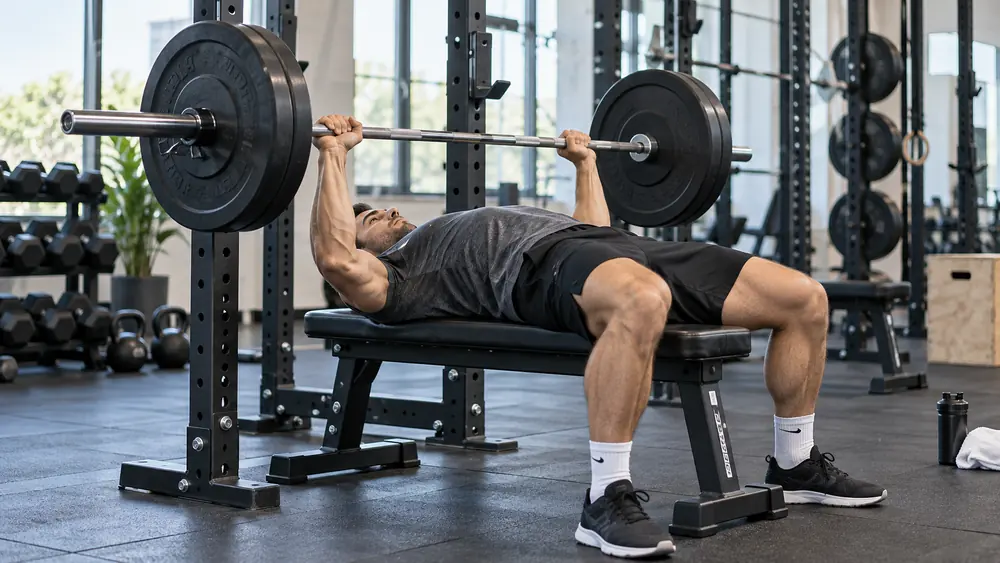
The bench press is a compound exercise: several joints and several muscle groups are involved in the movement.
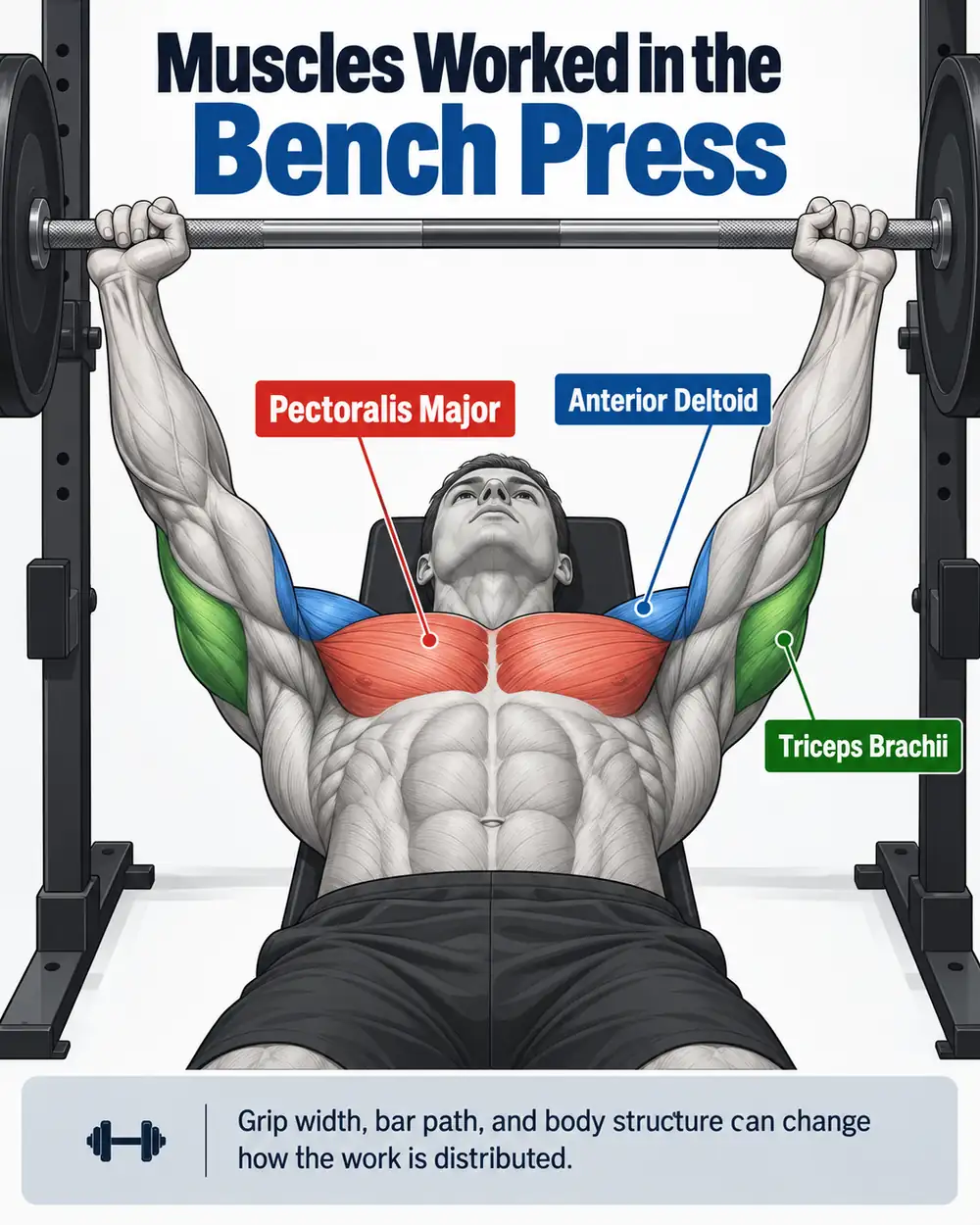
The main muscles worked are:
- the pectoralis major, which is the primary mover in the exercise;
- the triceps brachii, which contributes to elbow extension;
- the anterior deltoid, located at the front of the shoulder.
However, the distribution of work is not exactly the same for every lifter. Grip width, elbow position, range of motion, bar path, and body structure can change the relative contribution of the chest, triceps, and shoulders. A narrower grip notably increases the demands on elbow extension and tends to involve the triceps more. Conversely, widening the grip changes the demands placed on the shoulder without turning the movement into an exercise that exclusively targets the chest.
If your main goal is to develop this area, the bench press can therefore fit perfectly among your chest exercises, but the quality of your form remains more important than trying to find a position that is supposed to perfectly “isolate” a muscle.
Bench Press Position: How Should You Set Up?
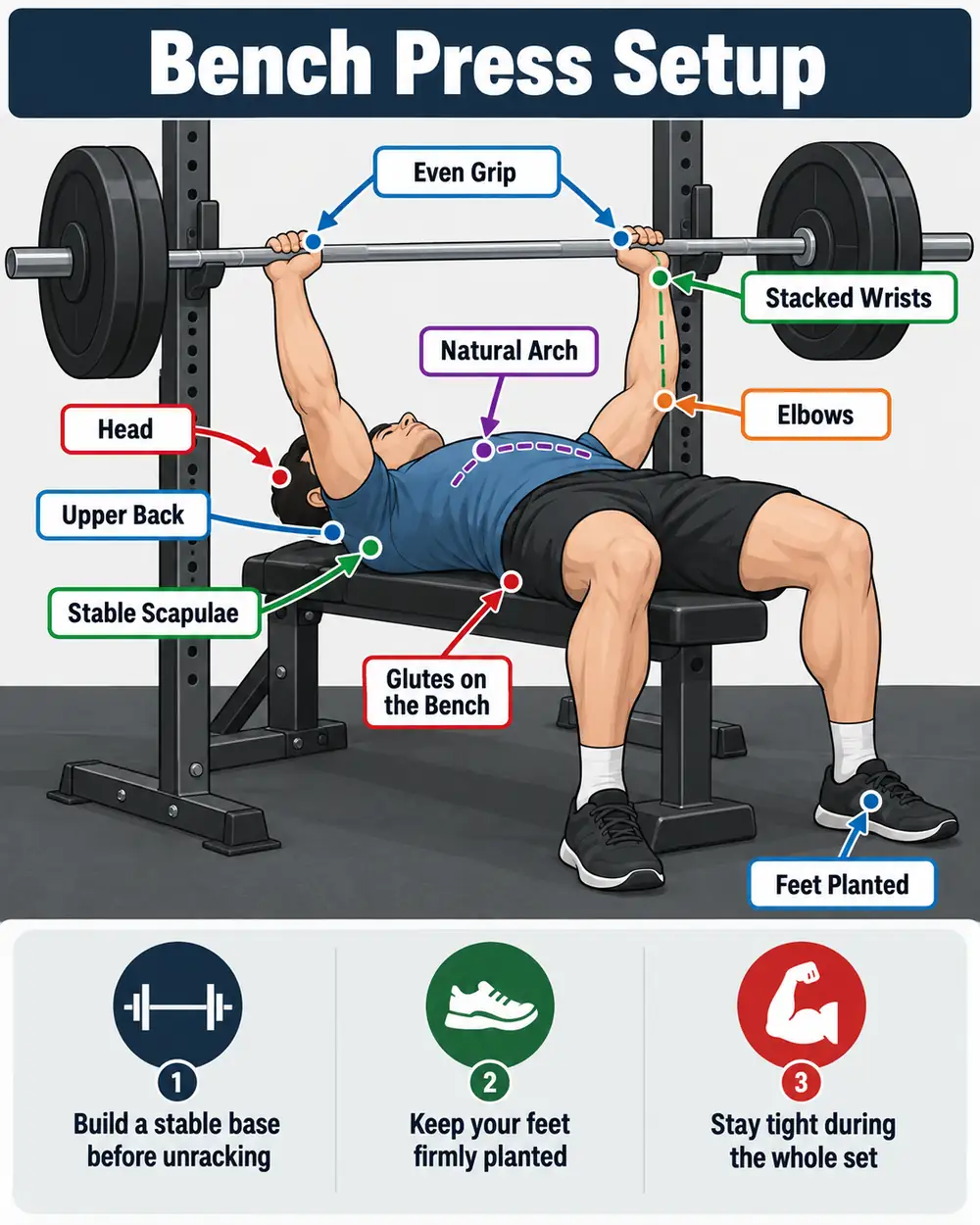
A repetition starts before you even unrack the bar. Taking a few seconds to set your body up properly makes it much easier to maintain a stable position throughout the set. Lie down so that you can unrack the bar without having to lift your shoulders completely off the bench. The exact position of your head relative to the bar depends on the rack being used, but the bar is often approximately above your eyes before you unrack it.
Your upper back should be firmly set on the bench, then place your feet on the floor so that you have a firm, comfortable base of support. Keep your hips in contact with the bench.
Before starting your set, also check that both hands are positioned symmetrically on the bar, using the markings on it to easily reproduce the same grip width from one workout to the next.
This preparation may seem secondary when you are starting out, yet it determines a large part of what happens during the rest of the movement. A good bench press setup mainly creates a base that is stable enough for your arms to produce force without your whole body moving with every repetition.
Shoulder Blade Position During the Bench Press
Your upper back is the main point of contact between your body and the bench, and to stabilize it, your shoulder blades can be pulled slightly back and kept against the bench throughout the movement. The goal is not to squeeze them together as hard as possible or create an artificial position. It is mainly to prevent your shoulders from rolling forward as the bar reaches the bottom.
This position provides a more stable base for pressing and makes it easier to reproduce a similar bar path from one repetition to the next. Once you have unracked the bar, try to keep your upper back in place rather than letting your shoulders move toward the ceiling at the end of every repetition.
What Grip Should You Use for the Bench Press?
There is no single perfect grip width that works for everyone. Someone with long arms and relatively broad shoulders will not necessarily find the same position comfortable as someone with shorter limb segments, and your mobility and training goal also matter.
A simple reference point is to look at your forearms when the bar reaches the bottom of the movement. Viewed from the front, they can generally remain relatively close to vertical. If your hands are positioned very far inside or outside your elbows, it may be worth trying a slightly different grip.
A wider grip generally shortens the range of motion required to bring the bar to your torso and changes the demands around the shoulder, while a narrower grip increases the range of motion and requires more work from the elbow extensors, particularly the triceps. Studies comparing several grip widths do find differences in muscle activity, but they do not establish one universally optimal grip width.
For the average lifter, it is therefore better to look for a comfortable, stable, and repeatable grip rather than trying to arbitrarily maintain a precise distance between the hands.
Foot Position and Bracing During the Bench Press
Your feet are not simply resting on the floor while you wait for the set to end; they contribute to the stability of your entire body.
Place them in a position that allows you to maintain firm contact without your hips leaving the bench. By pushing slightly into the floor, you create tension in the lower body and reduce unwanted movement during the repetition. This is the principle of leg drive, it does not mean pushing so hard that your glutes come off the bench, but rather using the floor as a point of support. Your torso should also remain sufficiently braced, and as the loads increase, poor stability at the hips or upper body can make each repetition different from the one before it.
Should You Arch Your Back During the Bench Press?
A slight curve in the lower back is normal for many lifters, so there is no need to deliberately try to press your entire spine flat against the bench. At the other extreme, the pronounced arch used by some powerlifters serves specific performance and competition goals. It is not necessary for someone who mainly uses the bench press to develop the chest.
For general training, focus mainly on finding a comfortable position: a stable upper back, hips in contact with the bench, and feet firmly planted. There is no benefit to deliberately creating an excessive arch solely to shorten the bar's travel as much as possible if your main goal is hypertrophy.
Bar Path: Where Should You Lower the Bar During the Bench Press?
During the descent, the bar generally does not travel in a perfectly vertical line. It most often moves toward the sternum or lower part of the chest. During the press, it can then move slightly back toward its starting position above the shoulders. The exact touch point varies with arm length, grip width, and the lifter's position on the bench. Giving one precise area that applies to everyone would therefore be misleading.
Good bench press form is more about finding a bar path that is consistent with your joints and that you can reproduce regularly, with t he descent remaining controlled all the way down. Touching your torso does not mean dropping the bar or using your rib cage to bounce it back up.
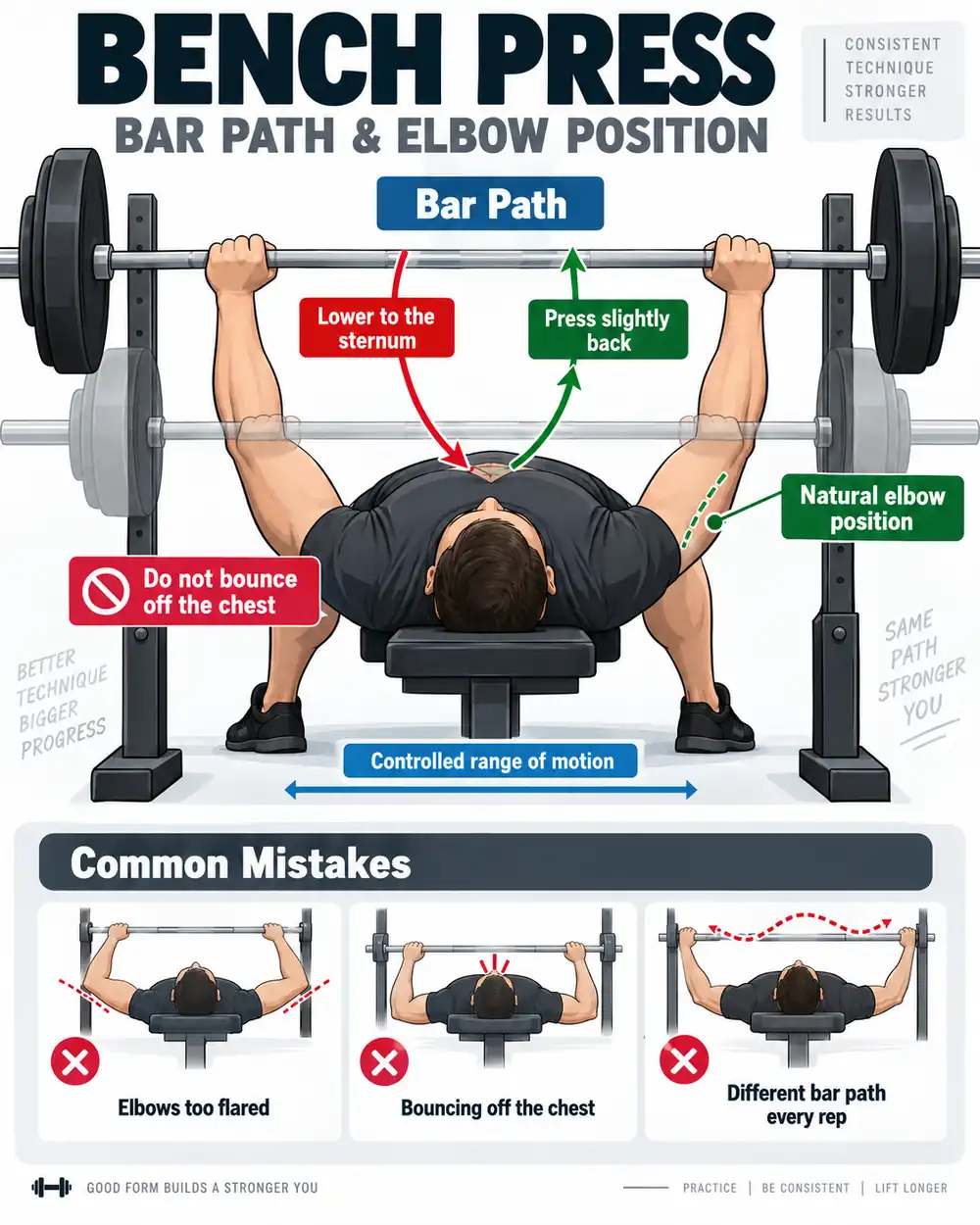
Elbow Position During the Bench Press
Two extreme positions are generally not very useful: flaring the elbows completely out to the sides or, conversely, trying to keep them pinned against the body throughout the entire repetition. In most cases, they naturally adopt an intermediate position. Their orientation also depends on your grip width, because changing hand position necessarily changes the geometry of the arm during the movement.
Rather than trying to maintain one exact angle, look at the movement as a whole: your wrists should remain properly positioned under the bar, your elbows should follow a consistent path, and your shoulders should not be forced into an uncomfortable position.
If you regularly train this area with other movements, the same logic also applies to many shoulder exercises and pressing movements: joint position should serve the movement rather than being imposed solely because a precise angle has been presented as mandatory.
How Far Should You Lower the Bar During the Bench Press?
For many lifters, the bar can lightly touch the torso while maintaining a comfortable position, but this is not an absolute requirement that applies to every body type and every situation.
Arm length, shoulder mobility, and individual structure can change the available range of motion. The goal is to maintain a sufficiently large range of motion without sacrificing your position just to lower the bar a few extra centimeters.
Conversely, deliberately shortening the movement solely to use much heavier weight is not necessarily relevant, especially if your goal is to develop your chest.
Research comparing different ranges of motion in the bench press shows an advantage for full-range training for certain strength adaptations. More broadly, the available strength-training evidence generally supports using large ranges of motion when they can be performed comfortably. Maximum range of motion and useful range of motion therefore do not mean exactly the same thing: use the range of motion you can control properly.
If a mobility limitation prevents you from comfortably reaching certain positions, appropriate mobility work may be more useful than forcing the joint directly under a heavy load.
Starting from “How should you press the bar correctly?”, I would simplify and merge several sections to avoid repetition while retaining the useful search queries.
Pressing and Breathing During the Bench Press
When the bar reaches the bottom of the movement, your upper back, hips, and feet should remain in the position established at the start so that force can be transferred without your entire body losing its setup. You can intentionally press the bar quickly, but the press should start from a controlled position, without bouncing the bar off your torso or allowing your shoulders to move forward as the load rises.
Your feet continue to push into the floor to maintain stability, while your torso remains sufficiently braced to prevent your hips or upper body from moving during the repetition. There is no need to deliberately slow the upward phase, because even when you intend to press quickly, a heavy load will naturally limit bar speed.
Breathing also contributes to this stability. You can take in air before the descent, maintain enough pressure through the hardest part, then exhale as the bar rises or when the repetition is complete. With lighter loads, breathing can remain fairly natural, while with heavier sets it generally becomes more structured, without an average lifter needing to try to hold their breath for an excessive amount of time.
Barbell or Dumbbell Bench Press: What Are the Differences?
The barbell bench press lets you work with both hands connected to the same load, which makes stability and tracking progress from one workout to the next easier. It is simple to add weight gradually and compare performance, which explains why this variation remains widely used for developing both strength and the chest.
With the dumbbell bench press, each arm works independently and can follow a slightly different path, providing more freedom to find a comfortable position for the shoulders and wrists. Dumbbells can also allow a slightly greater range of motion because nothing touches the torso, but this additional range of motion is only useful if it remains comfortable and controlled. The trade-off is that two independent loads require more stabilization, which can limit the amount of weight used compared with a barbell.
There is therefore no version that is systematically superior to the other: the barbell is particularly practical for tracking the load precisely and progressing, while dumbbells provide greater freedom of movement, and both can be used perfectly well within the same strength training program.
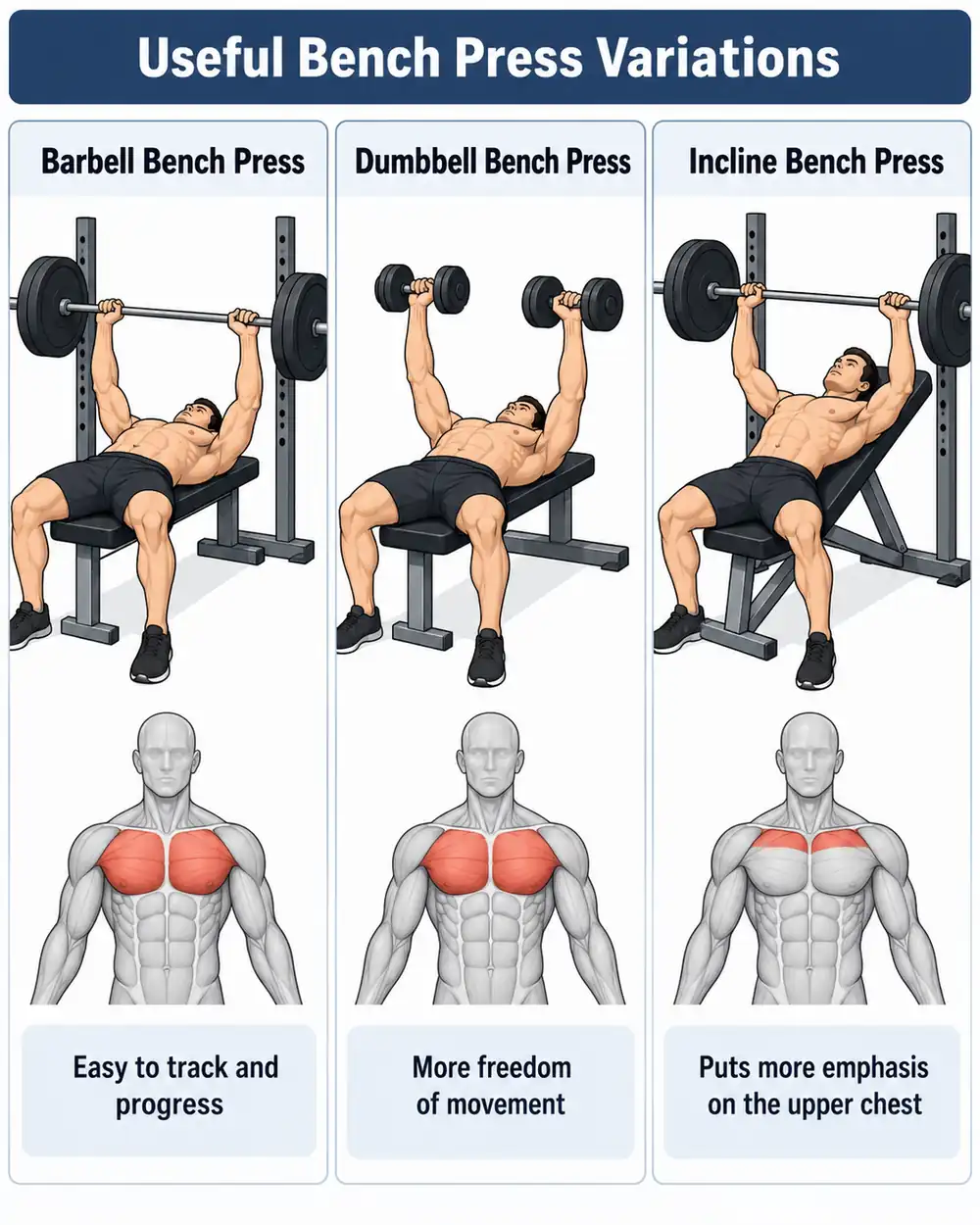
Incline Bench Press: When Should You Use It?
The incline bench press changes the direction of the press and generally increases the work performed by the upper chest, particularly the clavicular portion of the pectoralis major. The front of the shoulders also contributes more as the bench angle increases.
A moderate incline is generally sufficient if the goal is to complement the flat bench press with more upper-chest work, because as the backrest becomes nearly vertical, the movement gradually becomes more like a shoulder press.
There is therefore no need to choose between the flat and incline bench press as though one had to replace the other. The two can be complementary depending on how your chest workout is organized.
Common Bench Press Mistakes
A large proportion of mistakes come from using too much weight relative to the technique you are able to maintain. When the load increases too quickly, the range of motion shortens, the bar path becomes less consistent, the shoulders move forward, and the hips or feet may start to move in order to complete the repetitions.
The descent should also not become a free fall followed by a bounce off the torso, because this greatly reduces control of the movement. Conversely, there is no need to slow every repetition excessively: the main goal is to maintain a controlled descent and a repeatable bar path.
Wrist position also deserves attention, because if the bar sits too far behind the hand, it can force the wrist into substantial extension. Your grip, elbow position, and shoulder placement should work together rather than trying to impose a precise angle on each joint separately.
Finally, adding weight while gradually reducing the range of motion does not necessarily represent true progress. If a set at 80 kg uses a much shorter range of motion than a previous set at 70 kg, the two performances become difficult to compare.
How to Progress on the Bench Press
Progress becomes easier to measure when your bench press form remains relatively stable from one workout to the next. It is better to maintain a similar grip width, range of motion, and bar path, then gradually increase repetitions or load, rather than changing your execution every time the weight becomes difficult.
For example, if you perform 3 sets of 8 repetitions at 70 kg with clean form, you can gradually work toward 3 × 9 and then 3 × 10 before slightly increasing the load. This is only one example of a method, but it shows the value of comparing repetitions performed under similar conditions.
Your working sets also benefit from being preceded by a few warm-up sets with progressively heavier loads, especially when the bench press is the first heavy movement of the workout. The goal is to prepare for the movement and the load without accumulating enough fatigue to reduce performance during your important sets.
Progress also depends on the rest of your program, because the chest, triceps, and shoulders also work during other pressing movements. Simply adding more and more bench press sets is therefore not necessarily the best solution if recovery or performance starts to decline.
Bench Press for the Chest: Is It Essential?
The bench press is a very useful exercise, but it is not essential for building your chest. Dumbbell presses, a chest press, a converging machine, an incline press, or certain weighted push-up variations can also provide enough resistance to make progress.
For an hypertrophy goal, the most important thing is to have a movement that you can perform with an appropriate range of motion, progressively overload over time, and integrate into the rest of your training without pain. Some people will be very comfortable with a barbell, while others will get better results or sensations with dumbbells or a machine.
The bench press for the chest should therefore be viewed as one tool among others, not as a mandatory exercise. This also allows you to intelligently combine machines and free weights depending on the exercise rather than searching for one perfect variation.
Key Takeaways
Good bench press form is mainly based on a stable position, a grip suited to your body structure, a consistent bar path, and a range of motion that you can genuinely control. The load should progress without forcing you to completely change the movement.
The barbell, dumbbells, and incline bench press each have their own advantages, but none is systematically superior to the others. The best choice remains the one you can perform regularly, progress over time, and integrate properly into your chest training.
FAQ
How do you perform the bench press properly?
First set your upper back on the bench, plant your feet firmly on the floor, and choose a comfortable grip. Then lower the bar under control toward the sternum or lower chest before pressing it back up while keeping your hips and upper back stable. The exact bar path depends on your body structure and grip width.
What muscles does the bench press work?
The chest is the primary muscle group worked. The triceps and anterior deltoid also contribute significantly to the press. Their relative contribution varies notably with grip width and the technique used.
What grip width should you use for the bench press?
There is no ideal grip width for everyone. A good starting point is to choose a grip that allows your forearms to remain relatively close to vertical at the bottom of the movement, then adjust it based on your body structure and comfort.
Where should you lower the bar during the bench press?
The bar generally lowers toward the sternum or lower part of the chest. The exact point varies depending on your body structure, grip, and position on the bench.
Should you touch your chest during the bench press?
Many lifters can lightly touch their torso while maintaining good position, but this should not be considered mandatory in every situation. Your range of motion should remain compatible with your mobility and body structure, without pain or loss of control.
Should you arch your back during the bench press?
A slight natural curve in the lower back is normal. However, a very pronounced arch like those used in some powerlifting practices is not necessary for training the chest.
How should you position your shoulder blades during the bench press?
They can be pulled slightly back and kept stable against the bench. The main goal is to prevent the shoulders from rolling forward during the descent and to maintain a stable base for pressing.
Where should you position your elbows during the bench press?
Avoid systematically aiming for either extreme: fully flared out to the sides or completely tucked against the body. An intermediate position is generally more natural and should remain consistent with your grip width.
Barbell or dumbbell bench press: which should you choose?
The barbell makes loading and precise progress tracking easier. Dumbbells allow both arms to move more independently and provide more freedom in the movement path. Both can be effective for developing the chest and can be used in the same program.
Does the incline bench press work the upper chest more?
A moderate incline can increase activity in the clavicular portion of the pectoralis major. As the incline becomes steeper, the anterior deltoid contributes more, gradually making the movement more similar to a shoulder press.
Why do I feel my shoulders during the bench press?
The anterior deltoid naturally contributes to the bench press. Its involvement can increase depending on the bar path, elbow position, bench angle, or your body structure. Feeling the front of your shoulders working therefore does not automatically mean the movement is being performed incorrectly.
Is the bench press required to build your chest?
No. You can develop your chest with dumbbells, chest press or converging machines, incline presses, and other pressing movements. The most important thing is to have exercises that you can perform comfortably and progressively overload over time.
Related articles

RPE, RIR, and muscle failure: how do you manage effort in strength training?
Learn how to use RPE and reps in reserve to adjust your sets, make progress, and manage muscle failure based on your goal.
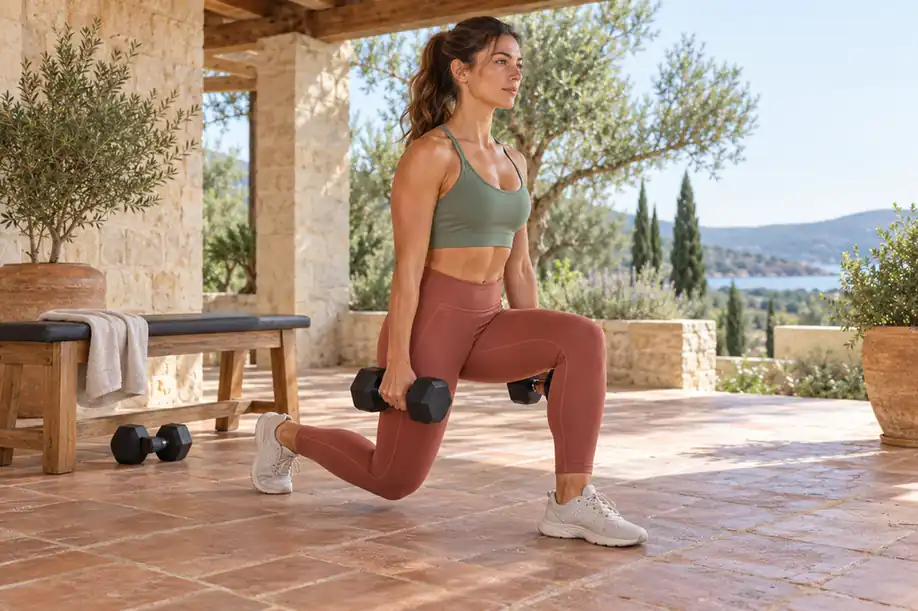
Glute exercises: which movements should you choose to build them effectively?
Hip thrusts, squats, lunges, Romanian deadlifts, and hip abduction: learn how to choose your glute exercises, perform them, and progress.
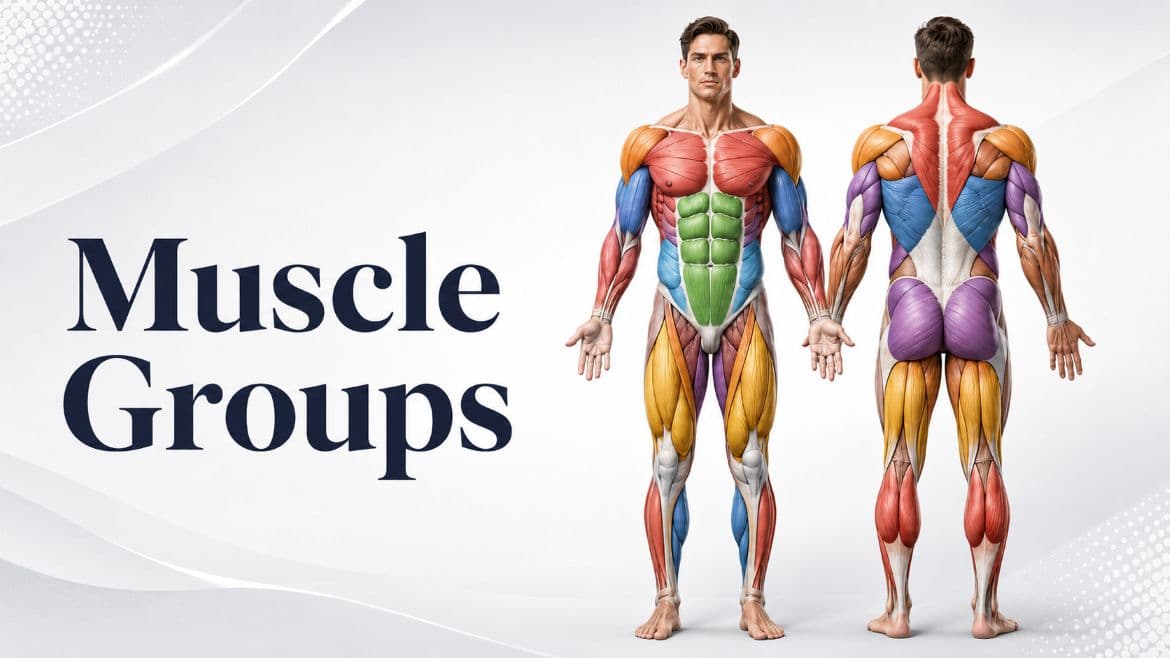
Muscle Groups: Understanding the Main Muscles of the Body to Train Better
A guide to understand the basics of the topic and organize your training more effectively.