Strength training stretches: when and how should you stretch?
Find out when to stretch for strength training, before or after exercise, how to stretch, and which movements to use for each muscle.
What are stretches for in strength training?
A stretch gradually places a muscle and the tissues around it in a position where they lengthen; when repeated regularly, this work can improve flexibility and increase the range of motion available around a joint.
For someone who does strength training, this can be useful when stiffness limits certain positions. Very tight hamstrings can, for example, make some hip hinge movements less comfortable, while limited flexibility in the chest muscles can create a feeling of tightness during certain upper-body movements.
However, flexibility and mobility should be distinguished. Strength training stretches primarily work on the ability of muscles and tissues to lengthen, whereas mobility work focuses more on the ability to use and control a range of motion at a joint. The two can therefore complement each other without addressing exactly the same need.
Stretching before or after exercise: when is the right time?
The best time depends on what you are trying to achieve. Before a workout, the main goal is to prepare the body for the movements and loads that will follow. Long static stretches are therefore generally not the priority immediately before a heavy set, especially when they are held for a long time on the muscles that will then need to produce a lot of force. Negative effects on strength are mainly observed with prolonged static stretching, particularly around one minute or more per muscle, while shorter durations have much less impact.
Stretches before a workout can nevertheless have a place when they are short, incorporated into a more complete warm-up, or used on a particularly tight area. They should then be followed by dynamic movements and warm-up sets that are similar to the exercises planned.
After training, the context is different: you can take more time to work on flexibility if that is a goal, without having to worry about immediately preserving your strength for a heavy set. Post-workout stretches can also feel good for easing a sensation of tightness, but they are not required for recovery.
Dynamic stretching: preparing movement before training
Dynamic stretching uses controlled movements rather than a position held for a long time. The muscle lengthens and then returns, with the range of motion gradually increasing over the repetitions.
Before a leg workout, this can take the form of dynamic lunges, hip openers, or controlled leg swings. For the upper body, shoulder rotations, pass-throughs with a stick, or arm movements can prepare the ranges of motion that will be used afterward.
Their main benefit is that they prepare the body to move without staying in a passive position for a long time, so they can fit naturally into a warm-up, especially before exercises that require a certain range of motion. There is no need to turn this phase into a workout of its own; a few well-chosen movements are generally enough before moving on to warm-up sets.
Static stretching: when should you use it?
A static stretch consists of getting into a position and then holding it for a few seconds; this is the type of work most commonly used when trying to improve flexibility. It can be done after training, during a separate session, or at another time of day, with the most important thing being to stay within a tolerable level of tension and not try to go as far as possible right away.
To start, holding a position for around 20 to 30 seconds is a simple starting point. The stretch can be repeated several times if necessary, but there is no benefit to forcing it to the point of pain in an attempt to progress faster.
Static stretching can increase joint range of motion, but the highest intensity is not necessarily required to produce a useful effect.
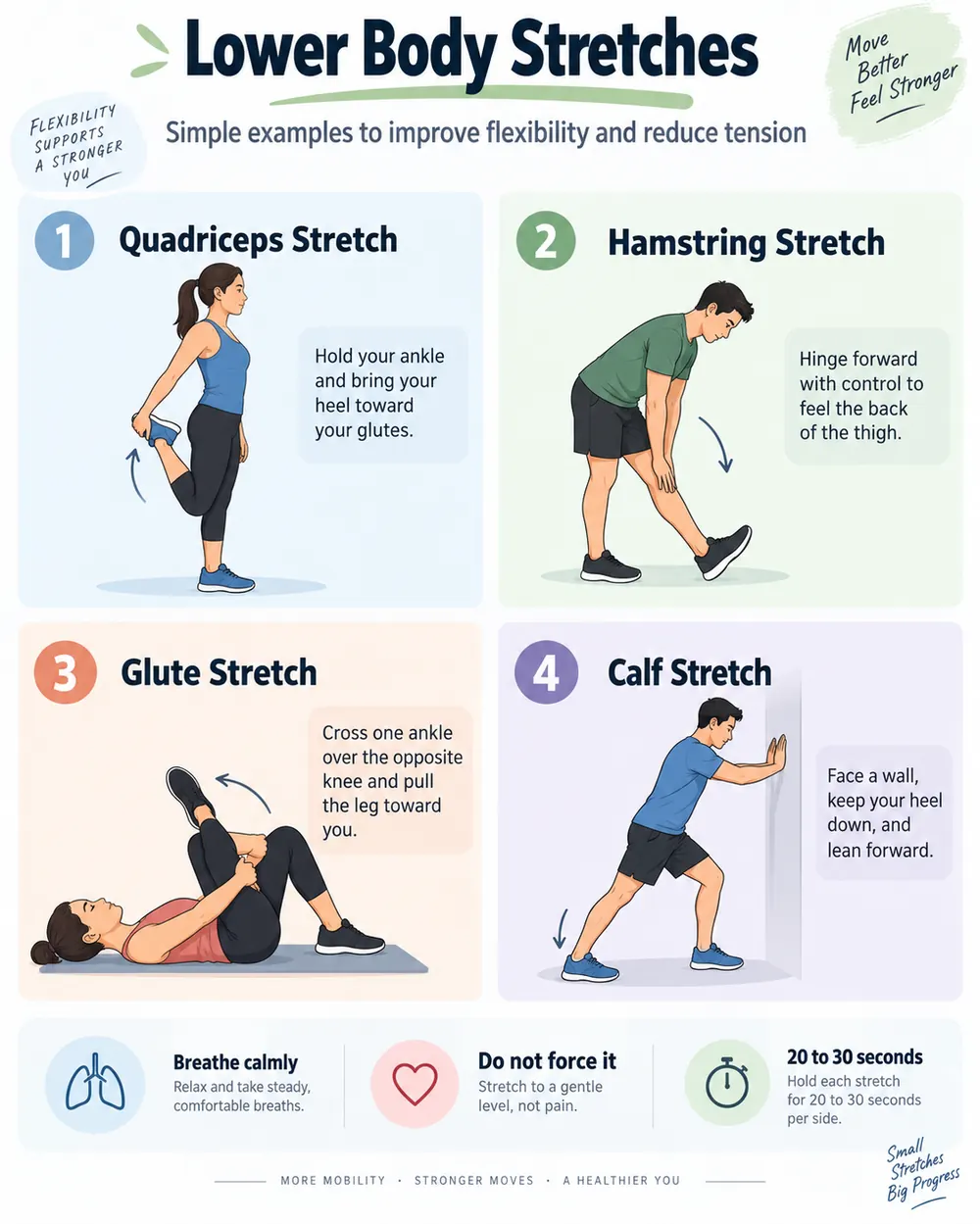
Leg stretches: quadriceps, hamstrings, glutes, and calves
Leg stretches cover several very different areas, so it makes more sense to choose the exercise based on the muscle you are actually trying to make more flexible.
Quadriceps stretch
The quadriceps are located at the front of the thigh, and one of the simplest movements consists of bringing the heel toward the glute while holding the ankle, keeping the knees relatively close together and the pelvis stable. The goal is not to pull hard on the foot or arch the back to gain a few inches; the tension should mainly be felt at the front of the thigh.
This position can be useful after a leg workout or when the quadriceps feel stiff, particularly after a lot of squats, leg presses, or leg extensions. It can also be done standing while holding onto a support if balance becomes an issue, or lying on your side if you prefer not to have to stay stable on one leg.
Hamstring stretches
The hamstrings are located at the back of the thigh. To stretch them, the main goal is to gradually move the pelvis away from the point of support while keeping the back reasonably neutral. A common mistake is simply rounding the back a lot to try to touch the feet. This can make it feel as though you are going farther, but the movement is not coming only from the back of the thigh. It is often more useful to think about tilting the pelvis slightly forward while keeping the torso controlled, even if that means going less far at first.
Hamstring stretches can be done standing, seated, or with one leg slightly elevated. It is better to choose a simple position in which you can control the pelvis and clearly feel the tension in the hamstrings. The leg does not need to be completely locked out if that makes the position uncomfortable; a slight bend in the knee can help keep the movement cleaner.
Glute stretch
A glute stretch can be useful when this area remains tight after a workout containing a lot of hip thrusts, lunges, or hip movements. One simple position is to lie on your back, place one ankle over the opposite knee, and then gently bring the thigh toward the torso. The tension should be felt mainly in the glute of the crossed leg. You can gradually increase this tension by bringing the thigh closer without forcing the knee or rotating the pelvis.
A seated variation can also be used, as long as the movement remains gradual and you do not try to force the knee down toward the floor. This version can be useful when you want to work the area quickly without lying down, but the position should remain stable and the sensation should stay localized in the glute rather than in the knee joint.
Calf stretch
For the calves, the wall exercise remains one of the simplest. One leg steps back, the heel stays on the floor, and the body moves slightly toward the wall. With the back leg fairly straight, the tension is felt more in the gastrocnemius. By slightly bending the knee while keeping the heel on the floor, the soleus is targeted more.
These two calf stretch variations are useful because the calf is not made up of a single muscle and the knee position slightly changes the area under tension. It can therefore be useful not to always use exactly the same position, especially for people who place a lot of demand on their calves through running, jumping, or standing exercises.
Upper body stretches
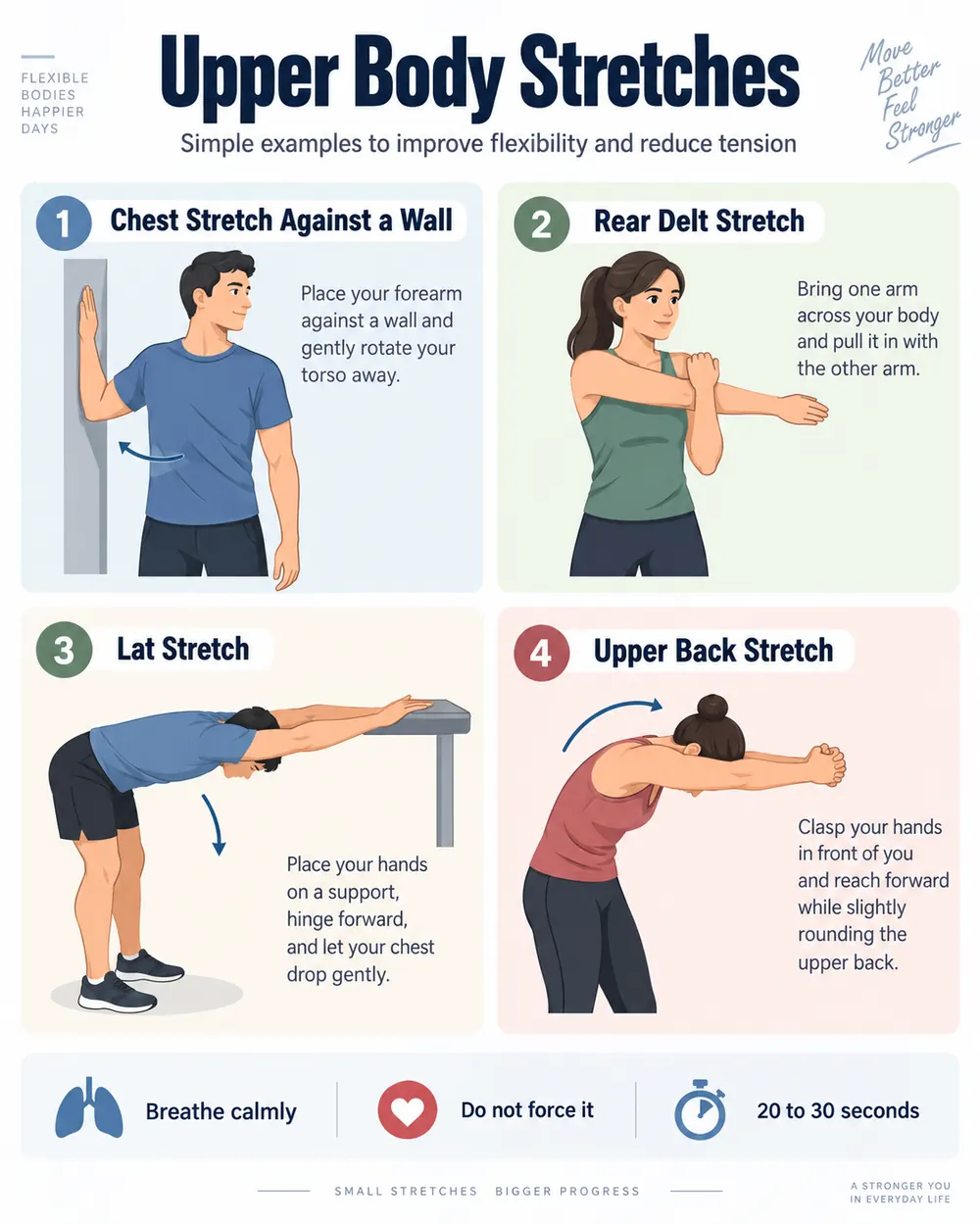
The upper body does not need to be stretched systematically after every workout, but certain areas can be worked if they are particularly tight or if the goal is simply to improve flexibility. The choice mainly depends on the movements performed during training and the areas where you actually feel a limitation or regular tightness.
Chest stretches
For the chest muscles, one simple variation is to place the forearm or hand against a wall and then gently turn the torso in the opposite direction. The angle of the arm can slightly change the sensation, but there is no need to seek an extreme position; moderate tension in the chest muscles is enough.
Chest stretches can be useful for people who spend a lot of time doing pushing movements or who feel a lot of tightness after a workout, without replacing mobility work for the shoulders or upper back. They can also be useful when doing a lot of bench press, incline bench press, dips, or other exercises that regularly place the chest muscles in a shortened position.
Shoulder stretches
The shoulders require a little more caution because the joint is very mobile. For the back of the shoulder, for example, you can bring one arm across the front of the body and gently pull it closer to the torso with the other arm.
For some overhead positions, it is often better to work on overall shoulder and upper-back mobility rather than only trying to pull hard on one muscle, especially if the issue appears during an overhead press or during a shoulder exercise in which the arm has to stay overhead for a large part of the movement.
Shoulder stretches are therefore mainly useful when a specific muscle seems tight, while limited range of motion during an overhead press or an overhead movement may require broader mobility work. You should also avoid trying to quickly gain range of motion at this joint simply by pulling harder, because comfort and control of the movement remain more important than the distance reached.
Back stretches
Back stretches can target several areas: the latissimus dorsi, upper back, muscles around the spine, or lower-back muscles, so there is no single stretch that is suitable for every situation. A position with the arms extended on a support can, for example, create a stretching sensation in the lats and upper body, while gentler flexion or rotation movements can create a different sensation. The choice of back exercise therefore depends mainly on the area you are trying to make more flexible rather than the general idea of “stretching the back.”
If pain is present, you should not try to make it disappear by forcing a stretch. Persistent or significant pain deserves a different approach than simple flexibility work, particularly because a feeling of stiffness does not necessarily mean the area actually lacks flexibility.
How long should you hold a stretch?
There is no need to time every second, but a duration of 20 to 30 seconds is a simple guideline for a standard static stretch. For actual flexibility work, several rounds can be performed on the same area. Someone who is particularly tight can start with a shorter duration and then gradually increase the time as the position becomes more comfortable. Movement quality matters more than holding the position for a very long time. If posture breaks down, if you start compensating, or if the tension becomes clearly painful, extending the stretch does not necessarily provide more benefit.
For dynamic movements, it makes more sense to think in terms of controlled repetitions rather than a fixed duration.
How often should you stretch?
A stretching routine does not need to be long to be useful; a few minutes repeated regularly are often easier to maintain than a very long session performed occasionally. If the goal is truly to improve flexibility in a specific area, several short sessions per week can be useful. If you simply want to maintain a comfortable range of motion, a lower frequency may be enough.
There is no need to stretch everything every time. Someone who mainly lacks hamstring flexibility will benefit more from working that area regularly than from doing ten different stretches without a specific goal.
Stretching and muscle growth: are they compatible?
Stretching does not prevent muscle growth; the issue has more to do with when it is performed and how long it lasts. Doing long static stretches immediately before a heavy set can temporarily reduce the ability to produce force, especially when the muscle is held in a stretched position for a long time. This does not mean that a short stretch before training will cancel out a workout, only that it is not the main tool to use before heavy work.
Conversely, regularly working on flexibility outside of sets does not prevent hypertrophy. Data on static stretching used on its own even show that muscular adaptations are possible under certain conditions, but the average effect remains small or uncertain and it does not replace resistance training.
You should also avoid confusing a passive stretch with working a muscle at a long length during an exercise. Performing an incline curl, seated leg curl, or certain movements through a deep range of motion places tension on the muscle in a lengthened position, but it is still a loaded strength-training exercise.
This distinction is important because resistance training at longer muscle lengths is currently the subject of specific research on hypertrophy.
Stretching and muscle soreness: does it really help?
Stretching after a workout can feel good, but that does not mean the muscles will recover faster. Available research does not show a major effect of post-workout stretching on muscle soreness in the following days or on recovery of strength compared with rest.
You can therefore stretch after training if it provides a feeling of relaxation or if you want to work on flexibility, but this practice should not be presented as a method capable of preventing muscle soreness.
Sleep, nutrition, and proper macronutrient distribution, management of training volume, and recovery time remain much more important for recovering from a difficult workout.
Common stretching mistakes
Forcing a stretch to the point of pain is probably the most obvious mistake. A stretch can create significant tension, but sharp pain is not a goal and does not mean the work will be more effective.
You should also avoid sudden movements or uncontrolled bouncing when you are simply trying to improve flexibility. The muscle should be able to adapt gradually to the position.
Another common mistake is doing long static stretches just before heavy exercises and then going straight under a bar without warm-up sets. If a stretch is necessary before the workout, it is better to keep it reasonable, then return to dynamic movements and gradually increase the load.
Finally, stretching an area simply because it hurts is not always a good idea. Pain can have many causes and does not automatically mean the muscle lacks flexibility.
What to remember
Strength training stretches are mainly useful for working on flexibility and maintaining a comfortable range of motion during a strength training exercise. Dynamic movements can be incorporated before training, while static stretches are more appropriate when you actually want to work on flexibility, after the workout or at another time.
There is no need to stretch everything or seek the greatest range of motion possible. The most useful approach is to target the areas that actually need it, progress without pain, and avoid confusing stretching, mobility, and warming up.
FAQ
Should you stretch before or after strength training?
Both are possible, but not for the same goal. Before the workout, dynamic movements or short stretches can be used if necessary, while longer static stretches are more appropriate after the workout or away from training when you want to work on flexibility.
Is it good to stretch after exercise?
Yes, if it feels good or if the goal is to work on flexibility, but stretching after exercise does not appear to greatly reduce muscle soreness or speed up muscle recovery.
How long should you hold a stretch?
About 20 to 30 seconds is a simple guideline for a static stretch, provided the position remains controlled and does not cause pain.
Can you stretch every day?
Yes, if the stretches remain reasonable and do not cause pain, but it is not required. Regular practice several times per week may already be enough to gradually improve flexibility.
Does stretching reduce muscle soreness?
Not to a significant extent. It can provide a feeling of relaxation, but available research does not show a notable reduction in muscle soreness compared with rest.
Does stretching prevent muscle growth?
No. It does not prevent hypertrophy, but long static stretches immediately before a heavy set can temporarily reduce force production.
What is the difference between dynamic and static stretching?
Dynamic stretching uses controlled movements through a progressively increasing range of motion, while static stretching consists of holding a position for several seconds.
What stretches should you do for your legs?
You can work the quadriceps, hamstrings, glutes, and calves separately. The choice mainly depends on the area that actually lacks flexibility and the exercises performed.
Related articles
RPE, RIR, and muscle failure: how do you manage effort in strength training?
Learn how to use RPE and reps in reserve to adjust your sets, make progress, and manage muscle failure based on your goal.
Glute exercises: which movements should you choose to build them effectively?
Hip thrusts, squats, lunges, Romanian deadlifts, and hip abduction: learn how to choose your glute exercises, perform them, and progress.
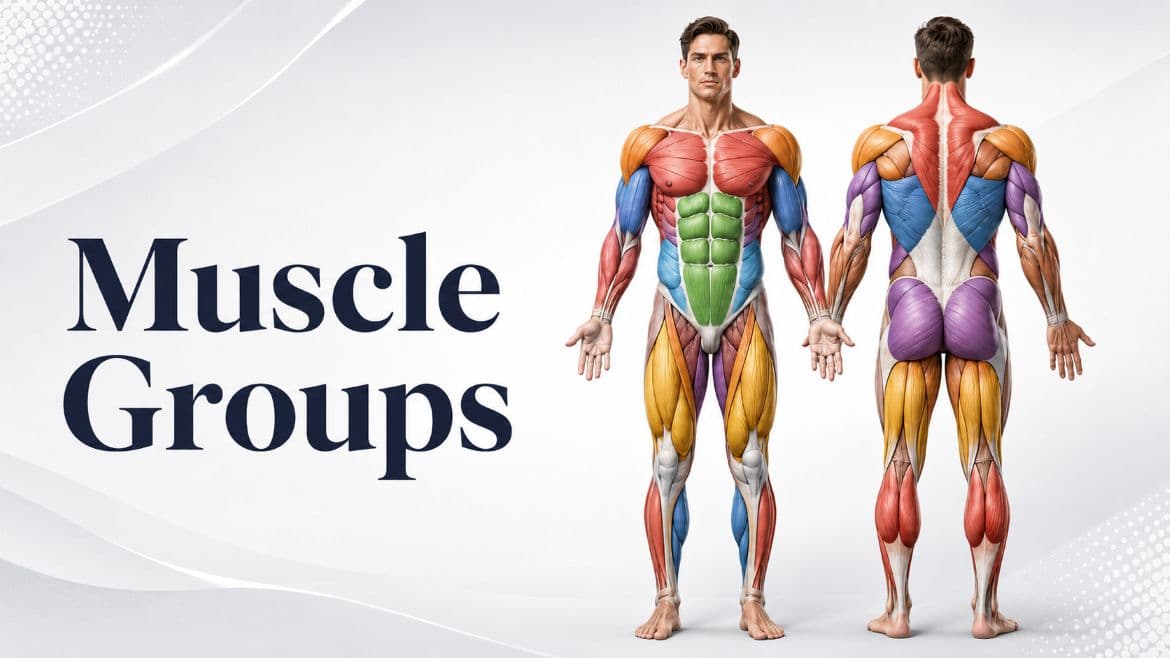
Muscle Groups: Understanding the Main Muscles of the Body to Train Better
A guide to understand the basics of the topic and organize your training more effectively.